
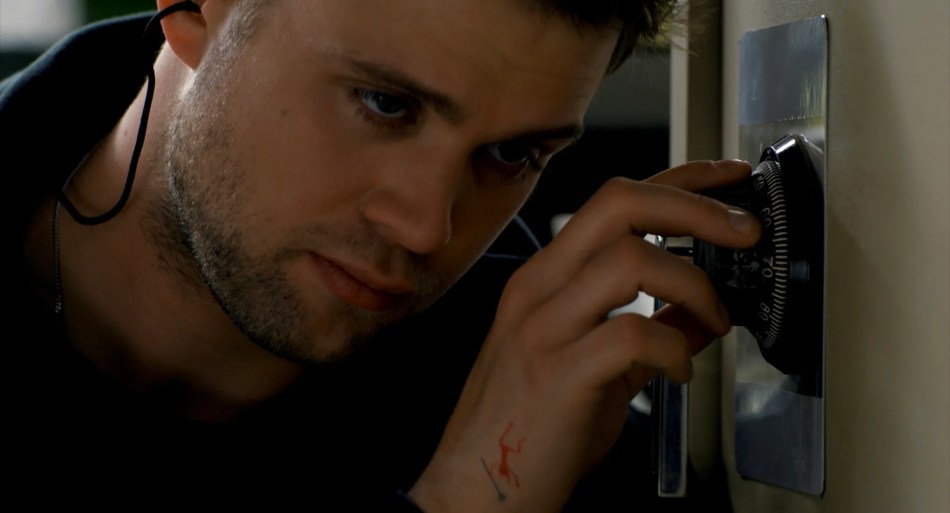
In director Daniel Roher’s Tuner, Niki White (Leo Woodall), who works as a piano tuner, explains to Ruthie (Havana Rose Liu) that tuners hate the “p-word” aka “perfect.” A piano is never going to be “perfect.” As Niki says, a few keys can be near perfect but something will always be off. Tuning a piano is about finding “harmony in chaos.” This comes to typify Tuner. Niki’s life is chaotic, partially through fate and partially of his own doing. He suffers from hyperacusis, an “allergy to loud noises.” He always wears earplugs and carries around noise-cancelling headphones for any “uncontrolled acoustic environments” he encounters. When his boss and mentor Harry Horowitz (Dustin Hoffman) falls ill, Niki is intent on helping Harry and his wife Marla (Tovah Feldshuh), who always treated him like a son, pay the mounting medical bills. Lacking the ability to get a loan and with piano tuning not lucrative enough of a business, Niki turns to crime. It pays, but comes with a cost all its own.

Tuner is about the struggle to find harmony. Every frame is filled with noise and chaos. The sound design turns the hum of the city into a cacophony, engulfing Niki and the viewer. When Niki’s hyperacusis is triggered, Roher and cinematographer Lowell A. Meyer dive into an extreme close-up while ringing in Niki’s ears and the expressed pain in Woodall’s face are claustrophobic and intense. Every sound makes up Niki’s world, just as the people he interacts with do and they prove just as discordant and chaotic. Some are just background, others are like beautiful music that make up his greatest passions in life, and others are a violent assault to the senses, upsetting the delicate balance of Niki’s life. The health problems for his mentor and father figure Harry. The financial problems faced by Marla. Niki’s romance with Ruthie has its own ups and downs. His connection to crime boss Uri (Lior Raz), who has Niki helping him break into safes at ritzy homes and risking everything he has worked for in his life. Niki is being pulled in every direction, his desires and obligations are at odds with one another. He is racing against time, desperate to find a way to have it all – to continue Harry’s piano tuning company, to pursue music again, to help Marla, to be with Ruthie, and to escape Uri’s grasp – and he is drowning, caught in a web of his ill-judgment.
As Tuner barrels towards its conclusion, it has the fast pacing and rush of anxiety one associates with the recent films from the Safdies, especially Uncut Gems and Marty Supreme. Niki, like the protagonists in those films, can be a bit petulant and impatient. He is supremely talented as a piano tuner and pianist, though he has not played since he was a child and diagnosed with hyperacusis, with his sensitive hearing and vast knowledge of music turning him into the very “virtuoso” that Harry hypes up. However, he is a poor decision maker. He is charming and mostly kind, but haunted by his own personal limitations, rendered insecure and desperate enough to be dangerous. The life of crime does not suit him, nor is it his first choice but his genuine generosity leads him to conclude it is the only option and his naivety only boxes him in further. Tuner, for the most part, is impressive in areas other than its crime elements. The caricature-like characterization of Uri and the way its crime portions spiral out of control begin to stretch thin any sense of credibility Tuner has. However, Tuner excels in making the heists slick and in making the audience feel the corner Niki boxes himself into, making for a tense and taut affair.
Tuner finds its heart and soul elsewhere. It is in the moments of Niki and Harry traveling around, shown in an early montage, tuning pianos. Their back-and-forth banter, Harry’s clear adoration for this man who is like a son to him, and Niki’s respect and love for this father figure and mentor pouring out of Hoffman and Woodall. They charm and work on their pianos, pouring their wealth of knowledge and attention into making these instruments sing for often underappreciative clientele. There is a tenderness and authenticity in the dynamic between Niki and Marla, as well, with the motherly Marla always on Niki to play things straight (early on, she makes sure he is not smoking then she is the only wise to him being up to something, albeit she has no idea it is robbing safes), to not worry about her and Harry’s finances, and to work on himself and his future. Feldshuh and Hoffman’s character types are not new either, but both actors imbue them with a human spirit that shines and provides color to their every scene.
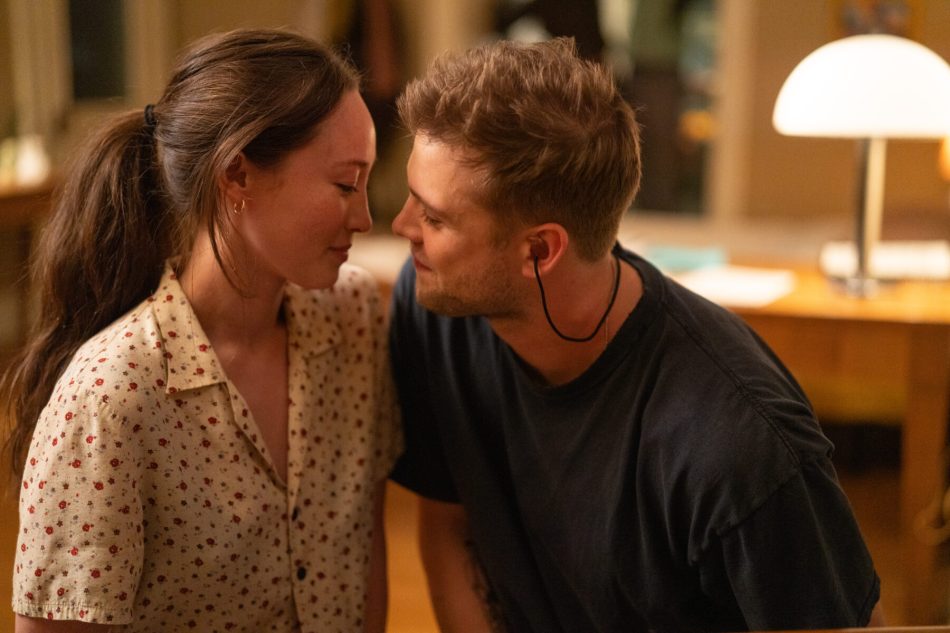
The same applies to the romance between Niki and Ruthie. What starts as a rapport between a tuner and a student using the freshly tuned piano turns into much more. Their dynamic as they sit on the floor of Ruthie’s apartment – Niki has come over to save her inherited and cherished piano, which has been damaged in a freak water leak accident – and talk about music, themselves, and their insecurities is filled with personality and chemistry. The insecurity of Niki is laid bare and his internal struggle over having this musical gift within him but lacking the physical ability to bring it to life in the way he wants, mixed with Ruthie’s own genius as a pianist and her growing nerves over her final school performance and future in the profession makes for a fascinating scene. Woodall and Liu breathe life into every line and expression. How Niki sits on the floor and how Ruthie curls up on the couch feels so authentic and lived-in. It is a wonderful moment of pure acting and direction that enables the scene to feel so alive. A scene at Ruthie’s school where Niki gives her a pearl watch to replace the one she had told him she lost is similarly brilliant. Niki’s vulnerability in expressing his feelings for Ruthie – the framing and blocking of this scene is terrific as well with gorgeous backlighting giving the moment a real glow – while Ruthie tries to come to terms with her own, Liu capturing the uncertainty and hesitation that such a sudden (they had been seeing one another for a month) gift arises within her. Her expressive face, precise tone, and grace in exploring this well of emotion in Ruthie is beautiful to watch. Liu and Woodall’s chemistry in these scenes and throughout grabs the viewer immediately, adding emotional tension that benefits the crime scenes as Niki imperils this relationship, suspense in a particularly striking cross-cut scene between a heist and Ruthie’s concert, and levity that transports and leaves the audience swooning watching two young lovers find something meaningful.
Like the jazz Harry loves and the orchestra arrangements that Ruthie composes, Tuner is about bringing many discordant elements into harmony. It is about finding that beauty and being moved. Tuner itself is emblematic of this, being far from “perfect” like any film. It has some elements that are off-key, namely its uninspired crime plot. It has notes completely in-tune with one another, particularly the exquisite cast led by the charming Leo Woodall, the lively Havana Rose Liu, and the still-got-it Dustin Hoffman with Tuner capable of going on incredible runs watching Woodall and Hoffman’s characters trade barbs and Woodall and Liu’s fall in love. It has plenty of style with great cinematography and wonderful sound design, coupled with strong direction from Daniel Roher that brings these many elements together into an impressive and tense package. Tuner is not perfect, but it does not need to be.
Discover more from Cineccentric
Subscribe to get the latest posts sent to your email.


0 comments on “Tuner ★★★”