
As someone who’s allergic to generalizations, I find it a little dicey trying to talk about cinema in broad, generational terms. Even the categories themselves, be it “Baby Boomers” or “Gen Z,” are pretty loosely defined, with a good amount of overlap on the edges and plenty of varieties within. But even though I think it’s too early to try and pin down Millennial Cinema or start calling out the defining movies of Gen Z, I believe enough time has passed that we can start solidifying the cinematic canon of Generation X.

I feel reasonably comfortable in this pursuit since I was born in 1976. A bicentennial baby. It puts me at the back end of the Gen X spectrum, but comfortably so. It’s a group that’s also been labeled as the MTV Generation, and the Latchkey Generation – two names that ring true since I indeed spent my formative years under the sway of MTV’s programming, and, starting at around age eight or so, I was often coming home from school to an empty home, happy to log in some precious TV time before the adults showed up.
I was also movie-mad from a young age. Like a lot of people born in the late 70s, I was raised on Star Wars and Spielberg. But my parents were pretty permissive, and before I even hit teenage status I was sitting with my dad watching gateway movies like Robocop, Evil Dead 2, and Raising Arizona (ah, good old 1987, perhaps my favorite movie year?). It was also the golden age of VHS and a healthy assortment of pay-cable stations with schedules I would eagerly scrutinize with each new copy of TV Guide. It wasn’t long before I was accumulating piles of Entertainment Weekly magazine, before moving on to the more generational signifying publications of Movieline, Film Threat, and Premier.
I know some folks my age who have wished they’d been born earlier, so that they could’ve been there to witness the New Hollywood movement firsthand; to have sat in the audience and seen the first run screenings of 2001: A Space Odyssey, Bonnie and Clyde, Taxi Driver and The Godfather. But it’s a pretty special thing to have been in your teens and twenties when the American indie movie boom was hitting its stride. Was this era as transformative, celebrated, and influential as the New Hollywood movement? Probably not. But that discrepancy may come down to the fact that only in the late 60s were Hollywood movies even allowed to deal with its themes so explicitly. The other question is, were the 90s and the indie boom just as generationally defining as the New Hollywood era was before it? I think so. Or at least, I think an argument can be made.
For this monthly series, I’m going to try and split the difference between the personal and the popular – to look at what spoke to me while at the same time keeping an eye on the zeitgeistiest fare to try and see what it says about my generation, our sensibilities, our hang-ups, and predilections. We’ll also look at what elements of the past these movies are holding onto, what the dialog was like between the movies and the music and literature of the time, and how, for better or worse, it all set the stage for the generations that followed. The aim will be to identify movies that not only serve as a time capsule for what was going on at the time, but that are still relevant in addressing ongoing concerns and perhaps showcasing a type of cinema that is in short supply these days. It should be a fun ride.
In the first proper entry in the series, I’ll take a step back and look at some movies from the 80s that speak to what it was like to be a kid at that time and how the family dynamics were shifting. From there, I hope to move more or less chronologically, from the late 80s on through the nineties, and wrap things up with a look at the brief, pre-9/11 2000s, when Gen X was growing up and things were already changing forever, but we just didn’t know how much.
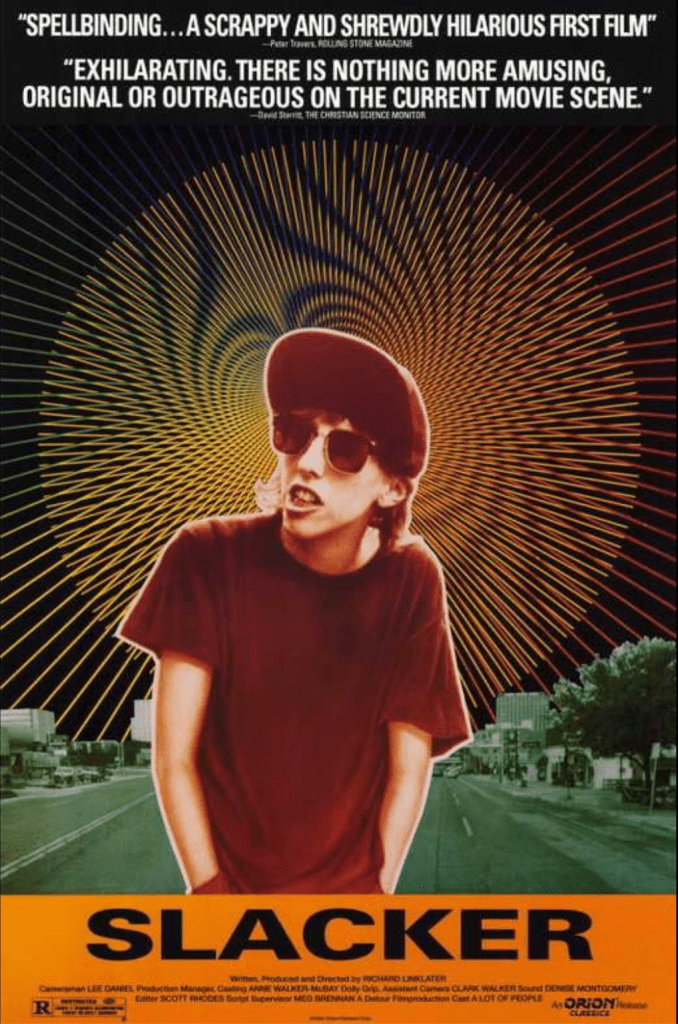
But for this introduction, I think we should mention a film that not only has the distinction of being a quintessential Gen X movie, but also touches on a lot of what we’ll be getting into: Richard Linklater’s Slacker.
In case you’re unfamiliar, Slacker is essentially a movie made up of conversations – some of them very one-sided. As Linklater described it in 2004, one of the driving conceits was, what if people spoke their internal monologues aloud? But the novel aspect is the film’s daisy chain momentum. For the most part, we follow one person as they meet another person and talk. Then, when they go their separate ways, we follow that second person as they walk off and meet someone else, rinse and repeat. Aside from being simple yet effective, it has this subtly profound effect of bringing the six-degrees of separation theory to life. It shows that you’re never that far removed from a guy who lives in a room surrounded by VHS decks and flickering monitors, with a television strapped to his back.
Slacker was shot for $23,000 in 1989 (approx. $60,000 today) and premiered in 1990 (again, even the timing of its release adds to its pedigree as a perfect introductory Gen X case study). I first saw this odd little film when it was first available as a VHS rental in 1992, and it activated me in a way that was different from just about anything else I’d seen before. Part of the appeal was that it demystified movies in a way. It felt like some kind of code had been cracked. It somehow made the idea of throwing away money I didn’t have to a crappy film school sound suddenly… reasonable? It was no coincidence that when I did get to that film school a couple of years later, the first movie I saw screened outside of class, from a video projector aimed at a bed sheet tacked to a wall of some guy’s apartment, was Slacker.
It’s worth noting that by the time of Slacker’s release, the American indie movement was already producing some landmark low-budget movies. Linklater himself talks about being inspired after seeing movies like 1980’s Return of the Secaucus Seven by John Sayles; 1982’s Chan is Missing, made by Wayne Wang for around $22,000; Eagle Pennell’s 1983 film, Last Night at the Alamo, which cost around $25,000; and Jim Jarmusch’s Stranger Than Paradise, from 1984. Linklater calls them “backyard movies.” As he puts it in the very soothing commentary track for his pre-Slacker film, It’s Impossible to Learn to Plow by Reading Books, watching something like Jean Renoir’s Grand Illusion is more humbling than motivating. Watching Chan is Missing, on the other hand, makes you want to pick up a camera and get some friends together and see what happens.
But all of those movies, along with Slacker’s brethren, the other low-budget Gen X movies that we’ll get into later, like Reservoir Dogs, El Mariachi, and Sex, Lies and Videotape, appealed to a broader set than just geeky wannabe filmmakers. Crucially, the late 80s/early 90s indie films had the benefit of a growing home video market, allowing them to reach a bigger audience and speak to them in a way that mainstream movies often failed to do. Yet, as far as generational statements go, Slacker is perhaps the most telling. It delivers the classic desultory Gen X vibes in a real chef’s kiss kind of way. From start to finish, it captures the lives of shiftless people eager to opt out of the capitalist machinery, happy to spend days reading, listening to music, watching too much TV, philosophizing, and conspiracy theorizing. They’re in bands, they take classes, but they’re also the kind of people who muse on the immense effort required not to create, wondering why no one talks about the exhausting obsessiveness of passivity. These are the self-proclaimed ultimate losers who just need to find a way to kill five hours before band practice starts. Or, as one of the more indelible characters says, “I may live badly, but at least I don’t have to work to do it.” The only thing work does is fill the bellies of the beast who exploit us! Of course, that’s the same guy who thinks voting is a waste of time.
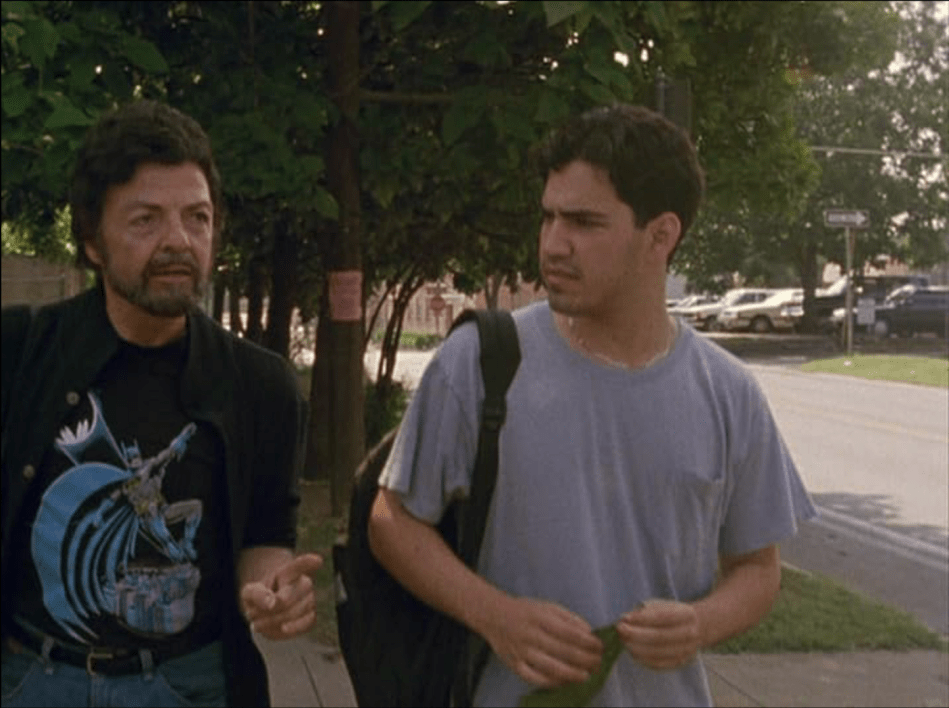
One of the most interesting, time-capsule qualities of Slacker is that it takes place in Austin, Texas, which perhaps more than any other American city has highlighted the weird shifts the country has taken over the past 50 years. Is it implausible or inevitable that the world on display in Slacker would eventually become home to Alex Jones’s Infowars, Elon Musk’s breeding compound, and ground zero for the manosphere? Jones himself would later pop up to deliver a sweaty screed in Linklater’s Waking Life, but versions of him are already there in Slacker: in the JFK assassination obsessive and the guy in the Batman t-shirt quoting articles from U.S. News and World Report and going on about covert CIA operations that neatly addresses both missing people and global warming.
Likewise, the scene where a guy in a polo shirt helps another guy get over his breakup by destroying things that remind him of, as he puts it, “the bitch who fucked him over,” reminds me of prototypical red-pilled MRA speak. As does the following scene where one of the guys walks off to meet up with the girlfriend in question and proceeds to patronize her with libertarian talking points. Then there’s the old anarchist, who walks past a “Ron Paul for President” billboard before denouncing libertarians as self-centered and celebrating violence and mass shootings as a means for true social change. It’s head-spinning seeing all of these guys parade in front of us, one after another. They’re still around today, only now the messages are more curdled, more desperate, and a whole lot louder and unavoidable.
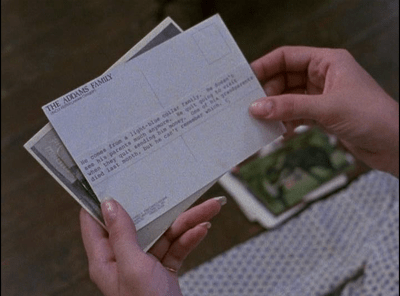
One of the scenes that has always stuck with me the most is the “Paul’s moved out” section, which happens early on. Paul’s roommates go to his room to find it completely empty save for a stack of postcards with printed labels stuck to the back that describe his story. He hardly knew any of the four or five other people living in the house. Every day he woke up late, ate a bowl of cereal, walked around, went to a movie, went back to his room, and watched reruns on TV until he fell asleep. The last card eerily (jokingly?) projects his future: he’ll get recruited by a terrorist organization that will give him access to guns and bombs. Hearing his story this time around, it made me wonder, is Paul an incel? A pre-internet Elliot Rodger? It’s hardly a stretch to imagine. (A gruesome note: the year after Slacker’s release, 35-year-old George Hennard killed 23 people and wounded 27 more after opening fire at a restaurant in Killeen, Texas, just an hour north of Austin. Hennard’s primary motivation was his anger towards women.)
Oddly enough, for a movie that is often quite funny, violence is never that far off-screen. While the most memorable scene in the movie – the one that graces all the posters – is about a girl trying to sell a bootleg Madonna pap smear, let’s not forget that the scene starts with a story about an angry driver on the highway, waving a gun out his window, firing off shots, before turning the gun on himself (which is supposedly a true story that the actress/musician, Teresa Taylor, had heard about). And the aforementioned scene with the guy surrounded by televisions? That one starts with the tube-obsessed man lamenting the fact that he witnessed someone getting stabbed and couldn’t adjust the hue to make the pooling blood look better. It then ends with an early version of a viral video, of a grad student (“hey, he looks like John Hinckley”) ranting about how men are made to feel inferior, and then brings out his gun collection, points one right at us and pulls the trigger. It’s another micro-manifesto that sounds all too familiar. Some of this vibe can be chalked up to the lingering aura of Charles Whitman, the man who killed 17 people and wounded 31 more from the clock tower at Austin’s University of Texas campus – an event described by the old anarchist in this movie as “this town’s finest hour.”

Whitman’s legacy brings up another issue that feels quite relevant to today. Give a horrible tragedy enough time, and the perpetrator of that tragedy will find his way to becoming a hero to the fringes of our society. Time has a way of muddying the waters, due to a combination of our collective short attention spans and the amount of misinformation that can be disseminated. Sometimes it’s crackpots like the old anarchists doing the dissemination, sometimes it’s governments trying to put false stories in our school’s history books. But as Slacker points out, even one of the worst events in a city’s history can be pitched as a triumph, given enough distance. And one of Linklater’s most astute bits of direction in Slacker is that none of the people on the receiving end of these rants or wild theories even so much as raises a skeptical eyebrow.
There’s something alchemic, and often more than a little dark, going on in Slacker. While it wasn’t exactly unheard of for a movie to simply be made up of conversations, it nonetheless feels like Linklater has cracked the lid on something entirely new – something that has been brewing and festering for a while, but is seeing air for the first time. The people walking and talking in Slacker aren’t the same people that have walked and talked in movies like Scarecrow, Faces, or Five Easy Pieces. The people in Slacker are messed up in a different way – in a way that builds off of the angst in those movies and finds its characters grappling with modernity just before modernity got completely out of hand. It’s a form of disaffection that isn’t far off from today’s vibes, but it’s missing the constant nerve-jangling anxiety of being online.
Because of that pre-internet time – and despite all the unsettling notes – it’s tempting to look at Slacker with a glint of nostalgia in one’s eye. Maybe it makes sense that people born in the 1970s can now look at Slacker the way people who were born in the 1960s can look at Linklater’s Dazed and Confused. One of Linklater’s gifts, apparent from early on, was how he could portray the sense of time and space that his characters existed in. Truly, as we see it in Slacker, it was a space filled with time, void of the pressing insistence and distraction that has marked the age of the smartphone. The conspiracy theorizing, manifestos and threats of violence all seemed less threatening when it didn’t have the powers of amplification and instant dissemination that came with the internet and smartphones. And just as warmly nostalgic as it can be to see the kids of the mid-70s cruising around town listening to Aerosmith, we can now look at the kids of 1989 Austin and also see a time lost to history, when there was more time in a day and things seemed to be a lot less complicated. It makes someone like me think, remember when conspiracy theorists and anarchists wrote books and magazines, and the dissemination of their ideas was reliant upon mailing lists? Those were the days…
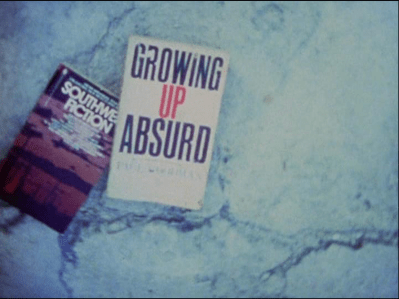
Linklater was already 30 years old when Slacker came out – an age that might position him as a perfect conduit for a few generational interests. As if to signify his own concerns about youth cultures in general, at the very end of Slacker, right before the camera is thrown off the cliff, we see a brief image of two books. One is Growing Up Absurd by Paul Goodman, published in 1960, the year Linklater was born. The book made headlines at the time for being the first to look at disaffected, nonconformist, potentially violent youth, with a more empathetic eye. It may have been inspired by the kind of kids we saw in Rebel Without a Cause, but here the book is, on a hill in Texas, speaking to the next generation.
But really, in Slacker, there’s very little of the warmth or sentimentality that would later appear in Linklater’s work. Like all of the great films that manage to perfectly capture a contemporary setting, it’s not a movie that tries to sand the rough edges or worry about alienating certain viewers. What prevents it from being alienating is that other Linklater quality – his ability to sympathize or at least empathize with even the most dubious characters in his films. Often his movies don’t have bad guys. He tends to avoid that kind of binary good-versus-evil approach to storytelling. We’re all flawed, but some people strive to be more virtuous than others. There is a comfort in that humanistic worldview and it lends his films a level of useful realism that we could use more of today.
Despite all the continued relevance within Slacker, it’s hard to say how much its influence can continue to be felt. Slacker’s effect on American cinema was certainly apparent in the 90s and aughts. For better or worse, it had the same effect on Kevin Smith that Chan is Missing had on Linklater, serving as a key inspiration for making Clerks. The filmmaker and actor Jay Duplass also cited the film as a major influence, which is a sentiment that I’m sure the other purveyors of the early 2000s mumblecore movement would abide by.
The low-budget, DIY, professional-actors-optional approach had its adherents for, at the very least, the next two decades. The South By Southwest film festival always felt indebted to the early spirit of Linklater and fellow Austinite Robert Rodriguez. Did the advent of digital filmmaking tools help the subsequent generations? For a while, it did. But the cinematic landscape was changing fast. A big reason Slacker ever saw the light of day was thanks to an investment from Westdeutsche Rundfunk Köln (WDR), a German television station, and pre-sale interest drummed up at international showcases like the European Film Market (EFM) event that coincides with the Berlinale Film Festival. So, while the tools to make something like Slacker have become more accessible, that also means the market has become more flooded, making it more difficult than ever to get your project seen by the right people.
The EFM event at the 2026 Berlinale saw over 600 movies from all over the world in need of funding get screened, with some of those projects arriving with names like Nicolas Cage and John Woo already attached (and that’s not including the number of TV series projects also looking for cash). Around Slacker’s time in 1989, the total number of projects at the EFM was at best a third of what it is now. European TV channels were happy to spend a little money on an American movie for broadcast rights. This was the funding path that Jim Jarmusch had relied on and Linklater certainly benefitted from the in-roads he’d made, and the fact that Slacker shared some of Jarmusch’s deadpan sensibility.
But now? Your best bet is probably crowdfunding, which is how Tyler Taormina got his 2019 debut film, Ham on Rye, over the final production cost hurdles. I mention Taormina because he might be the best example of someone who’s keeping the flames of that certain Gen X-ish strain of American indie moviemaking alive. Like Linklater’s first two movies, Taormina’s first two: Ham on Rye and Happer’s Comet, are not the kind of crowd-pleasing movies made by someone who’s simply angling for a studio gig. They’re the kind of uniquely personal movies that have earned him spots in top-tier international film festivals despite being micro-budget productions.
So while this decade may be missing the kind of easily categorized indie movement we’ve seen in past generations, there are of course still Americans auteurs out there doing the hard work. Taylor Taorimina is not alone, and we’ll get to more of them in future installments. But in the next one we’ll take a small step back to look at the cinema of the 80s that spoke to growing up in that time, with the nuclear family melting down, and generational values shifting. I can promise at least one thing: we will be going to the River’s Edge.
Discover more from Cineccentric
Subscribe to get the latest posts sent to your email.


0 comments on “Latchkey Cinema – An Introduction (ft. Slacker)”