
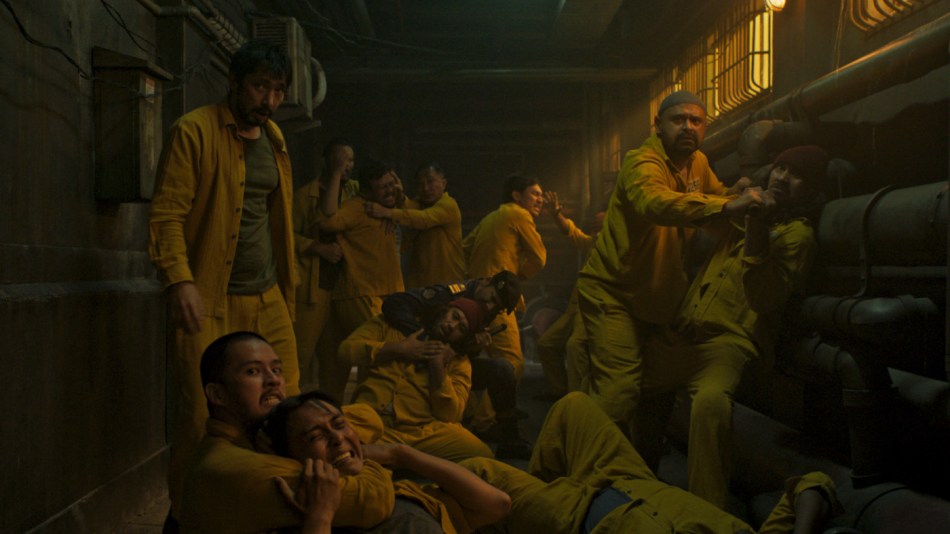
While it is easy to poke holes in Joko Anwar‘s latest feature (yet, it should be added, as the incessantly prolific Indonesian director has already two new ones lined up), from its uneven tone to the multiple inconsistencies in the hilarious plot, there is also some undeniable fun in watching this wild mix of a host of genres, most prominently horror comedy, prison thriller, supernatural parable, and social satire. The systemic critique is as garish as the splatter scenes, but it’s nevertheless amusingly accurate in its depiction of the financially facilitated hierarchies within the titular prison setting. The latter becomes the claustrophobic stage for a series of grisly murders.
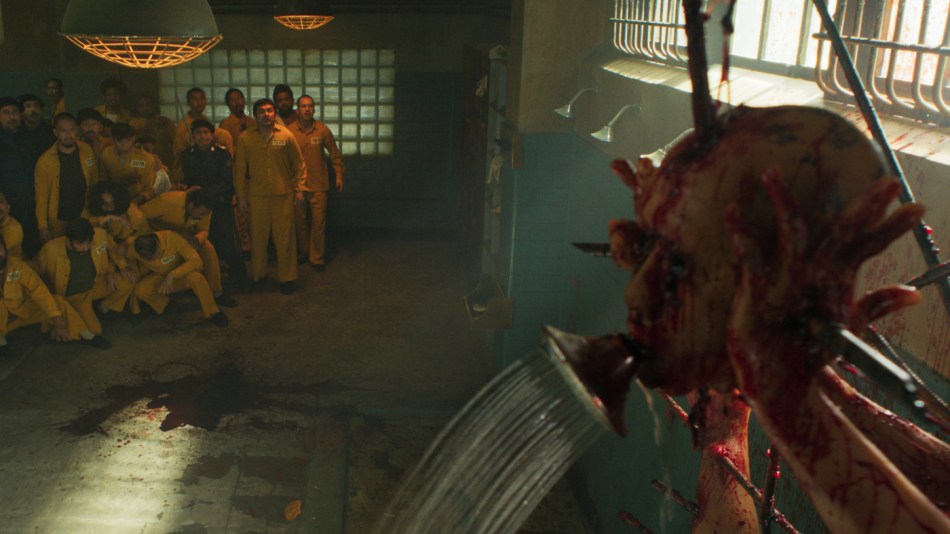
The first of these mysterious killings, culminating in sanguinary set pieces somewhere between Gunther von Hagens’s plastinates and Hannibal Lecter, happens on the outside. It’s one of many deaths about to happen in close proximity to hapless Jakarta reporter Dimas (Endy Arfian). In the first scene, he’s just finished a late-night exposé on a string of mysterious murders connected to an illegal mining operation in Borneo and feels certain that this investigative piece will boost his career. Instead, his editor reacts furiously—there is a nice touch of self-irony in this prologue, alluding to Anwar’s own professional experience as a journalist—and orders him to rewrite the whole thing. But the evening still gets worse.
Dimas’s boss is hung by his intestines from a ceiling fan, Dimas gets the blame for it, and is sent to one of the worst prisons in the area. Everything happening after the ceiling fan, however, is only filled in through dialogue later inside the prison where the rest of the story plays out. The narrative jumps right into the penitentiary’s block D, introducing the inmates who will subsequently become Dimas’s buddies or enemies in the fight against sadistic wardens and a ghostly evil. However, the sinister spiritual force that Dimas unwittingly carries into the confined setting is apparently taking a half-hour break. This spare time is passed with clunky character introductions, bad jokes, and fighting.
None of it adds much to the plot, be it momentum, atmosphere, or depth. When the ghost isn’t killing inmates, it kills the suspense by letting the plot move in circles. Narrative U-turns and pointless storylines leading nowhere stretch the promising premise to the breaking point. Occasional quips about the government, corrupt politicians continuing their lavish lifestyle behind bars, and a disingenuous society driving people to violence can’t bridge the dramatic gaps. Plot progression is unnervingly sluggish between the killings and the few dynamic scenes in which the remaining inmates, among them the eccentric Tokek (Aming Sugandhi) and disillusioned family father Anggoro (Abimana Aryasatya), bond together to exorcise the angry spirit.
The haunting feeds on decades of systemic abuse and moral rot, and exposes the hypocrisy of an institution that is merely a facade of justice. But this social-critical subtext is too crude and sketchy to really sting. Cinematographer Ical Tanjung makes little of the sleazy setting but captures some pleasantly creepy shots of the practical effects and prosthetic makeup. Through escalating supernatural mystery and increasingly desperate alliances, the climax attempts to resolve multiple thematic threads simultaneously, but after all the slacking, the conclusion remains incomplete and rushed. This chaotic conglomerate of genres and dramatic styles, haunted by the ghost of a better movie that Anwar can’t quite bring to life.
Discover more from Cineccentric
Subscribe to get the latest posts sent to your email.


0 comments on “Ghost in the Cell ★★”