
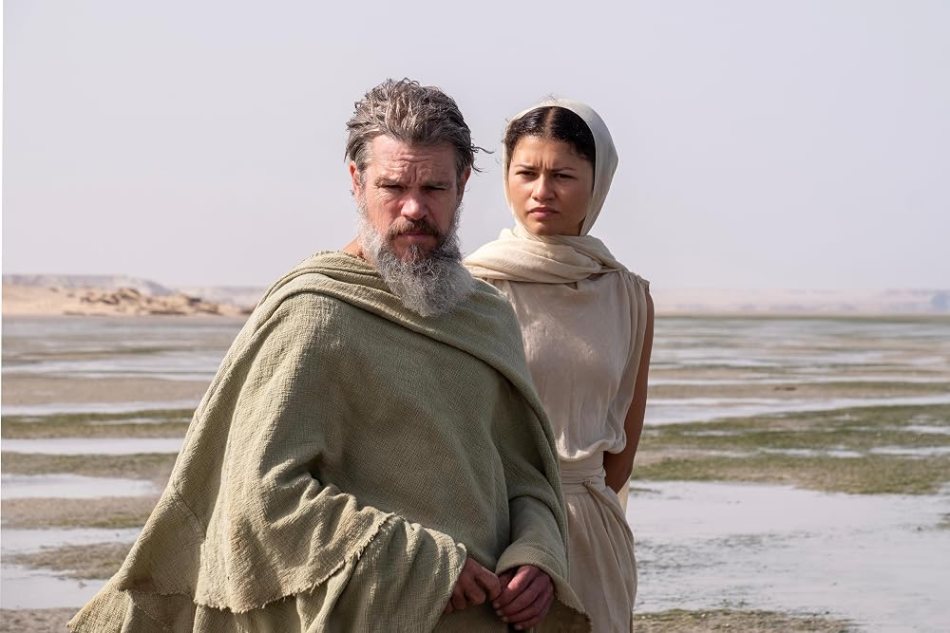
Christopher Nolan‘s The Odyssey is an achievement in grandeur. There have been countless stories inspired by Homer’s epic poem, The Odyssey, ranging from films like O Brother, Where Art Thou? to The SpongeBob SquarePants Movie. Nolan himself, in a 2025 interview with Empire, said, “When you start to break down the text and adapt it, you find that all of these other films – and all the films I’ve worked on – you know, they’re all from the Odyssey.” Nolan’s been making films about men struggling to return home for his whole career, with the most direct example being Interstellar. In adapting the foundational Greek poem, Nolan attempts to tell his biggest story yet. The Odyssey is an epic and loud adventure, but it is also an intimate and profound commentary on humanity’s struggles with agency, fate, and duty.
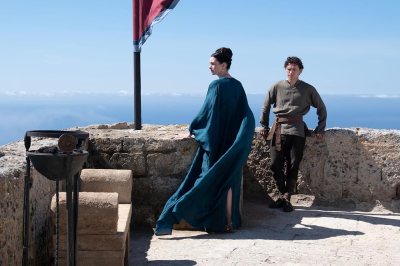
The Odyssey opens in a crowded palace, amid a feast of unwanted hedonism, greed, and predation. A bard (Travis Scott) tells the story of the missing warrior-king who devised the Trojan Horse. The Trojan War has been over for years now and Ithaca grows weary of awaiting the return of its king, Odysseus (Matt Damon). Penelope (Anne Hathaway), Odysseus’s wife, has stayed loyal to her husband for the entirety of his 20-year absence, but the dozens of suitors are restless for her to choose a new king. With the rumors of a dangerous sea-people attacking along the coast, Penelope is wracked by the tension between her loyalty to her husband and her duty to her people. Ithaca needs a king to defend it, but Penelope needs Odysseus. Odysseus left for the Trojan War shortly after his son Telemachus (Tom Holland) was born, and the young prince yearns to know the man behind countless tales of legendary heroics. Mostly, Telemachus is grieved by his inability to defend himself and his mother against the suitors who dine in Odysseus’s home every night. Meanwhile, Odysseus is stranded on an island with Calypso (Charlize Theron), his memories fragmented into abstract yearnings and his identity lost to a comforting fog. Odysseus knows there is some great duty that calls him, some love that draws him, but he can’t place the urges to a memory.
Telemachus travels to Sparta in a desperate attempt to find any information on his father’s whereabouts. It is there that he meets Menelaus (Jon Bernthal), the king of Sparta, who fought alongside Odysseus in the Trojan War. Menelaus tells of the ingenuity of Odysseus in conceiving the trickery of the gifted wooden horse, his bravery in war, and his honorable duty to his men. On Calypso’s island, Odysseus begins to regain his memories. He remembers the ruthless Agamemnon (Benny Safdie) summoning him to war, the excruciating struggles of awaiting the right moment in the Trojan Horse, and the brutality of the fall of Troy. But the war ends with success and the Ithacans are ready to return home, not suspecting the peril that lies before them. On one island they follow a herd of sheep into a cave and become trapped by a massive cyclops, a son of Poseidon. The cyclops is terrifying, with paper-thin, wrinkled skin and an unbothered demeanor, eating men with ease as if they were dropped crumbs. The scenes with the cyclops are uncomfortably claustrophobic, confined to a cave in which the monster’s hunched posture obscures its true size. While they are able to escape, losing several men along the way, they inadvertently bring the wrath of Poseidon onto themselves by injuring his son.
The crew continues to suffer casualties as they encounter greater and stranger forces fighting against them. On another island while Odysseus hunts, his crew finds a lone woman and begs her for food. After feeding them, the witch Circe (Samantha Morton) turns the men into pigs in a stomach-churning and visceral sequence involving the deforming and stretching of faces into porcine forms. It’s only after Odysseus finds Circe that he learns of the transformation and is able to persuade her to change them back. Circe tells Odysseus that the pigs reveal the men’s true nature: warfare considers their savagery discipline, disregarding the brutality that it cultivates in their hearts. As Odysseus continues his journey home, he loses more and more men along the way. It becomes clear to Odysseus that the gods’ providence will not permit the safe passage of his crew. Odysseus is determined to defy the gods in an attempt to protect his men and get home in time to protect his family.
The Odyssey focuses on the tension between loyalty and obligation through both Penelope and Odysseus. Penelope is tormented by the need to remain loyal to her husband and the obligation to protect Ithaca. Odysseus is drawn home by his love for Penelope, but has a duty to his men to find safe passage. The most prominent theme in The Odyssey is the tension between agency and determinism. Odysseus’s fate is determined by the gods, but he struggles against the divine will and defies the gods. Through countless hardships, his duty to his men and his love for his family make him contend for sovereignty over the outcome of his actions. However, the world of The Odyssey is not a world in which any human can achieve this. At the same time, Odysseus is wracked with guilt over the consequences of his decisions in war and in his flight home. The film features many scenes with poignant dialogue between Odysseus and Athena (Zendaya). In one scene, Athena persuades Odysseus that certain things are willed by the gods and he cannot feel guilt over that which he cannot control. The film walks a tightrope of combatibilism in which Odysseus is responsible for the mistakes he makes while the gods’ divine will determines the outcome of his journey. Through Odysseus’s journey, the consequences of his actions become clearer to him. Odysseus’s trickery of the wooden horse in the Trojan War becomes emblematic of a rejection of Zeus’s Law, in which people should treat strangers as they would wish to be treated. The film presents Greece as having built a society of palaces and culture, yet argues that Odysseus’s wartime ingenuity helps bring about Greece’s destruction through a rejection of benevolence and acceptance of insatiable rapacity.
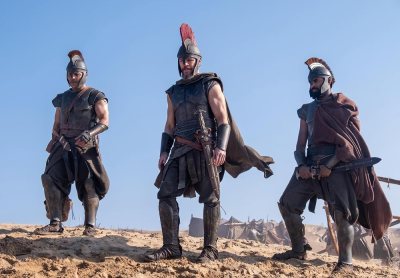
While The Odyssey is an adaptation of an ancient Greek poem, Nolan’s style permeates every shot. Nolan famously plays with time in his films, and this film uses non-linear editing to jump between present and past to capture a race against time as Odysseus finds his way home. Vivid practical effects is also a recurring stylistic choice in Nolan’s films, such as The Dark Knight and Interstellar. In adapting a Greek myth, another filmmaker may have been tempted to lean into a more fantastical or surreal approach. However, Nolan stayed true to his commitment to physicality in The Odyssey. That commitment produces breathtaking sequences through a variety of means. The cyclops and Circe’s witchcraft both have a practical, tactile quality that creates visceral discomfort, bordering on horror. The sequences showing the fall of Troy give the violence a grief-stricken weight, with the realism subverting the glorification of atrocity.
There are countless moving parts to make a scene work, but the performances, character design, and score work together to elevate The Odyssey beyond an action movie into a film with heavy emotional weight. Matt Damon gives a laudable lead performance, bringing Odysseus to life at times as a legendary warrior and at times as a heavy-laden and lost man. Anne Hathaway brings so much emotion to the character of Penelope. She has some of the best monologues in the film, confessing the pain and suffering caused by her husband’s absence and the suitors’ presence. Robert Pattinson‘s performance as the Machiavellian coward, Antinous, is quite impressive. Both Pattinson’s mannerisms and Antinous’s cowardly scheming make the character a great villain. Regarding the character design, Agamemnon stands out as remarkably epic. It is incredible to see a legendary figure from The Iliad in a menacingly massive suit of armor at the gates of Troy. The score from Ludwig Göransson emphasizes the dual nature of Odysseus. At times it is violently roaring; at others, it is intimate and contemplative.
It’s worth asking: what makes Homer’s epic poem such a foundational story? At its core, the narrative asks if a man will make it home in time to save his wife and son. But that simple homecoming narrative contains a greater struggle over identity and obligation. It’s about a man struggling against a world that he cannot control. It’s about a man fighting to be a soldier and a husband and a father and a king and a friend all at once. The Odyssey tells a tale in which the hard part should be over. A man seizes victory in war but sees the horrors of the triumph. The war is won: all that is left is to go home, but the gods have other plans in mind. It is also the story of a wife and a mother and a queen being held captive by the greed of men who feel entitled to her hand in marriage. It’s also about a son who both wants to know his father and become his own man. The Odyssey is certainly made epic by the sheer scale of the journey and the oddities throughout. However, the breadth and the intimacy of the personal human struggles are what make The Odyssey an epic. The human tensions are what make it universally adaptable in countless shapes and forms. Envisioning the coming dark age, Odysseus says, “The songs are all we have to remember.” In a nod to Homer and to all chroniclers, The Odyssey fully realizes the human struggle made immortal by stories.
Christopher Nolan took on a Herculean task in adapting Homer’s Odyssey: how could you possibly do the foundational epic story justice? Well, Nolan has had a lot of practice. The Odyssey feels like the ultimate fulfillment of the story that Nolan has been trying to tell for his entire career. It explores several pressing themes to the director while remaining grounded in a circuitous plot with a simple dramatic aim. The film captures an ancient expression of the hero’s journey, with an epic theatrical conclusion. The Odyssey is an accomplishment: it integrates Nolan’s career-long preoccupations with Homer’s enduring human conflicts.
Discover more from Cineccentric
Subscribe to get the latest posts sent to your email.


0 comments on “The Odyssey ★★★★”