
Middle-class boys who haven’t learned yet that their needs always come first are never too young for their very own manic pixie dream girl, Rebekah Fortune suggests in her whimsical sophomore feature. Even though its female character, ready to pour all her exuberant energy into giving not one, but two guys drowning in privilege and self-pity back their lust for life, is more of a manic pixie dream woman. It’s a depressingly dull and dusty premise for any film, but especially for one inspired by the Headington Shark. Said creature is a piece of protest art in the shape of a gigantic shark, positioned to look like it was crashing into the roof of New High Street in Headington, Oxford.
Imagined as a statement against nuclear warfare, the shark put Headington on the map in 1986, and it’s still there 40 years later (both the shark and Headington on UK maps). But Fortune imagines it in one of those nameless picturesque towns that only exist in films and children’s books – thankfully. In this fictional world, the shark sculpture is no longer the work of artist John Buckley, but Rory Kinnear‘s single father and artist Peter, who lost all his inspiration and drive after his wife died. His little son Leo (Ezra Carlisle) observes his father’s ever-growing apathy with the matter-of-fact pragmatism that is apparently funny to all disconnected from the reality of kids caring for mentally unstable parents.
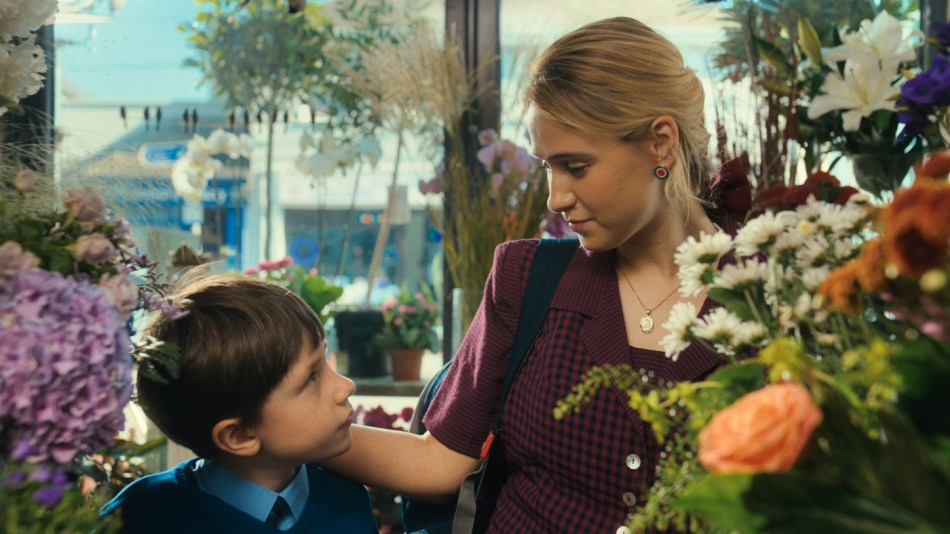
Five years after the death of his mother, Leo has accepted his extended responsibilities and deprivation from normal childhood activities like meeting friends, playing, and occasionally even school, to take care of Peter. He wavers between flattering attempts at art and apathy, until warmhearted au pair Anya (Maria Bakalova) disrupts their compulsive routine. With her lively spirit and 24/7 all-around cheerful service, she pushes father and son to finally get out there again and enjoy life. Until now, Leo could tell his worries only to the shark connected to his room, but Anya is obviously ready to fill that gap as well as the vacant spot at his father’s side.
As an easy and humorous way to avoid dealing with the complicated perspective of a child living with a depressed parent, Fortune depicts Leo’s simplified thoughts as whimsical animations. An overdose of sentimental fantasy undercuts any sense of dramatic urgency and psychological complexity. This sugarcoated view of depression, which without its more severe symptoms is more like “depression light” on screen, becomes all the more frustrating as it further stalls the already predictable plot. A reliable performance by Kinnear and a solid one from Bakalova can’t quite overcome the limitations of their one-dimensional characters. This is even more true for Ezra Carlisle, who seems often lost and as bland as the generic set design.
For a work heavily indebted to magical realism, Learning to Breathe Underwater remains visually trite and stylistically unadventurous. Even the animated bits stick to the overall dogma to keep it all nice and pleasant. Richard Kendrick’s cinematography uses shades of blue as an obvious association with sadness and the sea, brightening the scenery with warm colors as Peter’s mood improves. No surprises await as the narrative runs its predictable course towards an overly tidy ending and a healing that comes way too easily. Commercial trivialization is the last thing a kids’ movie about psychological struggles needs.
Discover more from Cineccentric
Subscribe to get the latest posts sent to your email.


0 comments on “Learning to Breathe Under Water ★★”