
I’m going to bestow Kramer vs. Kramer with an honorary mention in the Gen X movie pantheon. It’s very much a Boomer relationship drama. But man, did this movie loom large over the 1980s. It was released in December 1979, an Oscar contender that overdelivered with five major wins, including Best Picture. But it could have been released at any time of the year since it was destined to become a cultural force from day one, a box office behemoth that would go on to be a hot button talking point for years to come. In its own way, it kicked off the 1980s with a skeptical tone, asking “We’re all a bit messed up, aren’t we?”
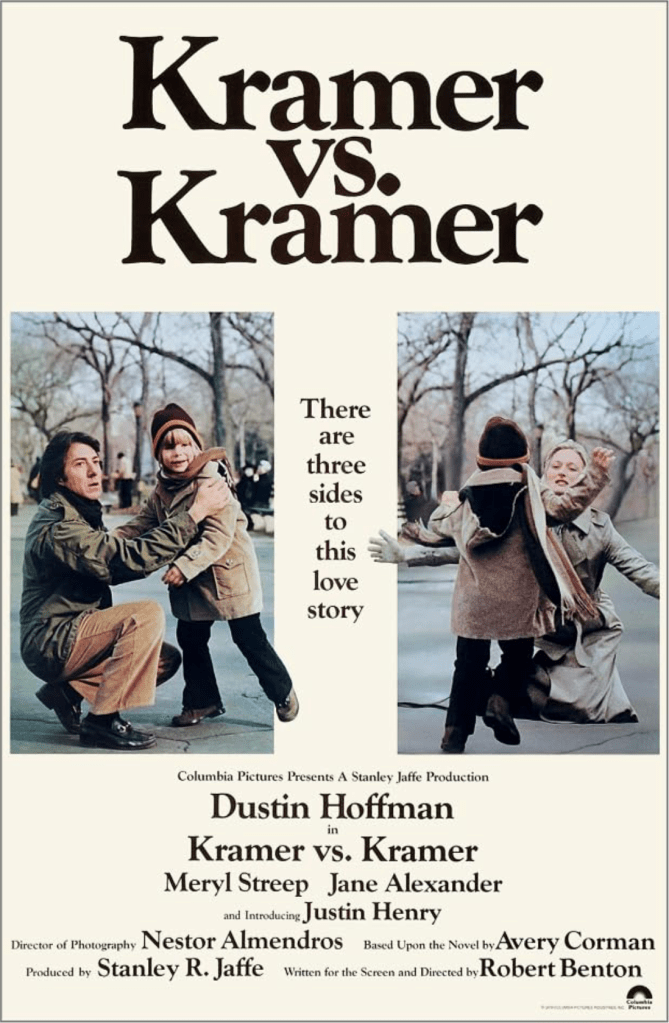
More than just a movie about divorce, Kramer vs. Kramer is about the dissatisfaction of being a stay-at-home mom. But as quaint as it might sound today, neither of those issues had received much mainstream, public discourse prior to the film’s release. And that’s why it was such a hit: everyone wanted to see and talk about the elephant in the room – that the 1970s had seen a shift, or a disintegration, of traditional relationships and the patriarchal family dynamic. It’s something that continues to be a subject of panicked talking points in the twenty-first century. Part of the MAGA ethos is reinstating those traditional roles and getting moms to stay-at-home again so that insecure men don’t feel so existentially threatened.
But change was afoot in the 80s and sensible people knew (and still know) there was no going back. Still, this change, of more moms pursuing careers outside the home, was a development so unheard of that a new generation of children needed a designation that befit their unusual upbringing. They became known as “latchkey kids.” I find this terminology of the Latchkey Generation rather interesting because, unlike the MTV Generation or Generation X, the description is really touching on two generations at once and even suggests how the changing values in the older generation has an impact on the younger one. So for this column, which is kicking off the generational timeline proper, I thought it fitting to bring up a few movies that reflect on this generational passing of the torch that occurred in the 1980s, while taking the temperature of what it was like growing up at the time.
My own memories of that decade are dramatically bifurcated. The first eight years of my life, prior to 1983 or ‘84, were spent bouncing around the North Shore of Massachusetts, until we ended up spending an idyllic couple of years in the tiny, woodsy, Mayberry-esque town of Merrimac. These were the start of my latchkey years, with both my parents working, and my elementary school just a five minute walk down the street. I remember running home after school, trying to make it back before the Scooby-Doo rerun started. A friend and I even tried starting our own mystery-solving detective agency, taping up advertisements on telephone poles. It may shock you to learn that we never got any clients.
Merrimac was about as sleepy as a town gets, but there were darker stories getting passed around between the town’s free-roaming, unsupervised kids. Within the woods next to the school was a place called Cat’s Hell, a clearing where a decrepit part of some old structure stood – just a few crumbling, graffitied concrete walls. The story was that teenagers went there to kill neighborhood cats. Like some sort of animal sacrifice. At that point, around 1984, we were too young to have read Stephen King stories about the creepy goings-on in Castle Rock, Maine, but it was all in the air. Lest we forget, this was the era of the Satanic Panic.
By 1986, my mom’s burgeoning career as a teacher led us to relocate to San Bernardino, a large, sprawling district of Southern California that couldn’t be more different than Merrimac. California was in desperate need of teachers at the time, and the incentives on offer were enough to drag us across the country. But once we got there the family unit started to disintegrate, with my dad unable to find or hold down a decent job and his drinking, and his untreated PTSD from his tours in Vietnam, getting worse by the year. Things got a lot darker in sunny So. Cal, but – not to diminish my own experiences – it wasn’t exactly a unique experience. There were a lot of struggling families out there and San Bernardino was full of them.

For my money, nothing captures that specific flavor of growing up in the 80s – the reality of the latchkey experience, the broken homes and single parents, the darkness in the woods, the uncertain futures, the awkward and uneasy teenage friendships – quite like the 1986 film River’s Edge.
Appropriately enough, about fifteen minutes into director Tim Hunter’s movie, a high school teacher, Mr. Burkewaite (Jim Metzler) struts around his classroom, bringing his students up to speed: Sure, all the hippies are executives now and everybody has sold out, but fundamental changes were made. The civil rights movement happened, women are now expected to have careers, and the counterculture fought against the police in the streets and succeeded in turning public opinion against the Vietnam War. This Boomer teacher wants his Gen X students to understand what happened to the country just a short time ago. But the only response he gets from his checked-out class is one kid who agrees that busting the heads of cops is pretty cool.
Mr. Burkewaite’s brief lecture comes right after the plot of the movie has established itself. There’s a small group of friends – seven teenagers – who like to drink, smoke pot, skip class, listen to Slayer and Iron Maiden, and dream of leaving their dreary Northern California town. But their friendships are tested and their lives of idle delinquency are thrown into turmoil when they discover that one of the girls in their circle has been killed by one of the guys.
River’s Edge gains a degree of relevancy for being inspired by the true story of 14-year-old Marcy Renee Conrad, who was raped and killed by 16-year-old Anthony Jacques Broussard, in Milpitas, California, in 1981. Broussard showed no remorse, and even took his friends to see her dead body. Notably, it took a couple days before anyone reported this to the police. I wouldn’t say that writer Neal Jimenez and director Tim Hunter set out to explain how this could happen, exactly, but they do address a lot of the factors, and raise a lot of interesting points – particularly around the question of why it took so long for one of the friends to call the police. In a 1992 interview in Bomb Magazine, Jimenez said that River’s Edge isn’t about the murder, it’s about how these disaffected kids react to the murder.
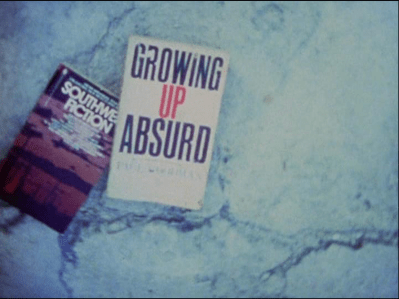
In the introduction to this series, I briefly mentioned a book that makes an appearance in Richard Linklater’s Slacker: Paul Goodman’s 1960 treatise on juvenile delinquency, Growing Up Absurd. Goodman asserts that the uptick in delinquents is directly related to the fact that American life offers very little to look forward to. Peering out towards adulthood, all a teenager can see is conformity, a meaningless rat race built around an increasingly narrow class structure – a future where you’re being asked to take part in a pointless competition that requires role-playing, putting on a mask, and embracing a phony culture. As Goodman puts it, so many of the jobs teenagers are being prepared for are by and large absurd, as they are just part of a senseless consumerist landscape, helpful only in that the tasks being performed make executives wealthier by facilitating more sales of products that people don’t need.
Goodman goes on to break down American youths into categories. There are the “bright young ones” who will enter the rat race, but whose intelligent, independent thinking will be thwarted and crushed by the conformist system. And then there are the “problem children”: they will either decide to opt out of the system (which is a sensible enough reaction in Goodman’s estimation), or they will come from the underprivileged class and they will recognize that the system is rigged against them. So, maybe these kids aren’t necessarily rebels without a cause. Maybe the cause is a looming existential void that they can see coming but can’t really put into words.
That was in 1960. In the 25 years since, there weren’t a whole lot of improvements. Whatever hope there might’ve been for a resurgence in Social Democracy with Jimmy Carter’s presidency was thoroughly demolished with the onset of the “greed is good” Reagan era, which saw a dramatic widening of the disparity between the classes along with a dismantling of the nation’s social safety nets. These are the factors that added pressure to families around the country, helping the underprivileged and the adolescents feel more adrift than ever before.
All of this feeds into where we find the disaffected youth of River’s Edge, and many other similar movies from the era, including the rebellious teens in 1979’s Over the Edge (a Kurt Cobain favorite) to the explorations of gang violence in movies like 1988’s Colors and 1991’s Boyz n the Hood. Goodman highlights how, in the 1950s, American culture was already failing to reward the human impulse to be of service – to help other people. So our instincts for fraternity, camaraderie, and belonging found a home in delinquent behavior, which gave voice and action to our frustrations. This only intensified as the Reagan era amplified the nation’s focus on wealth generation and individualism above all else.
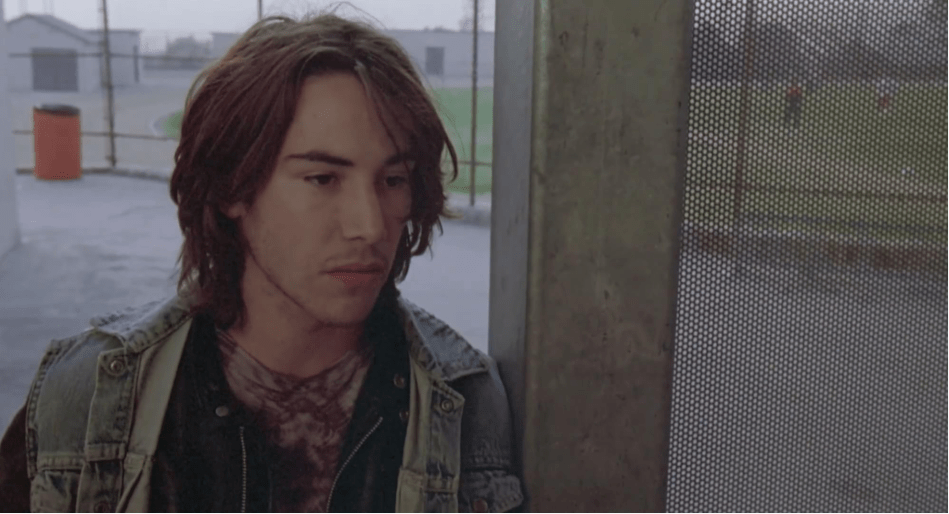
In the main characters of River’s Edge, we see these conflicted teenage impulses play out – the desire to rebel against adults and authority and, at the same time, the desire to be an accepted part of something. Only one of the kids, Layne (Crispin Glover), has a car, which makes him sort of the de facto leader of the group, a role he’s happy to embrace in a not so benevolent manner. But overall we spend more time with Matt (Keanu Reeves), the sensitive and charismatic member of the group, who lives with his younger brother and sister, his mom, and his mom’s live-in, deadbeat boyfriend.
Matt’s pint-sized brother Tim (played by 11-year-old Joshua John Miller, who gave another memorable performance a year later in Kathryn Bigelow’s Near Dark), is the true nightmare version of the latchkey kid – as he rides around on his bike looking to score weed, shoplifting beer, and trying to impress the older kids. Tim is a frustrated little troublemaker, and he’s the first character we meet, as he drops his younger sister’s favorite doll off a bridge, into the river. But in doing so, he also spots John (the formidable Daniel Roebuck), one of his brother’s friends, sitting by the edge of the river, next to the dead, naked body of Jamie, another member of this brother’s high school clique.
From here, we follow the same chain of events as the Milpitas case, John shows up at school telling his friends that he’s killed Jamie. Some of them, including the other two girls in the group Clarissa (Ione Skye) and Maggie (Roxana Zal) think John is just being weird, telling a bad joke. The likelier story is that Jamie is skipping class again. But eventually Matt and Layne follow John to the river to see for themselves. Layne responds with an immediate desire to close ranks around John, a friend who’s gotten himself in trouble and now needs help. Matt – well, Matt’s not so sure. To him, and to the viewer, it kind of seems like John is practically asking to be held accountable for what he’s done.
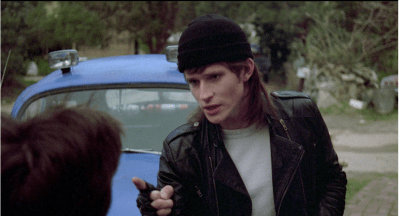
As Layne says as they’re driving away from the crime scene, “It’s like some fucking movie, man.” That line pretty much sums up his reaction. He’s kind of thrilled to be part of something so extreme. It makes him feel like Charles Bronson. The fact that most Gen Xers were raised as much by TV and movies as by parents isn’t lost on the movie. The opening title sequence even starts with a distorted image of the river, like a television station with a poor signal, and the sound of the flowing water is indistinguishable from airwaves static. At the time, movies and music were very much the targets of conservative ire, the scapegoats for the so-called moral erosion of the nation’s adolescents. This argument is woven into the fabric of River’s Edge – after all, these kids look exactly like the nightmare that every white, god-fearing suburban mom was having in the 1980s. But the movie uses them, along with the dope-smoking and the beer-drinking, as the obvious parts of the argument to push aside.
Layne tells us that his burning desire to help John stems from the fact that they’ve all been friends since the second grade. This means something to Layne, but it’s unclear which is more important: his feelings of protectiveness and a sense of duty in rescuing a troubled friend or his getting a chance to act out some macho fantasy. Of all the things a viewer can feel conflicted about in watching River’s Edge, Crispin Glover’s performance is surely somewhere near the top of the list. I understand that Glover showing up in any movie is like cilantro: some people love it, and for others it’s like eating soap. I find his characterization of Layne fascinating to the point of being transcendent. He’s always been a theatrical performer, and putting him in a movie where nearly everyone else is aiming for naturalism is a risky maneuver. But Glover’s choices aren’t completely wild. He’s nailing a very specific California accent, and he really runs with the idea that Layne is an inveterate speed freak. In one of the funnier moments in the film, as Layne’s efforts to control things are falling apart in every which way, we see his character talking to himself in the car, munching on one yellow pill after another, trying to keep himself alert.
Glover’s performance is really just one element to the layers of dark humor and weirdness that make up the unsettling vibe of River’s Edge. In most filmmakers’ hands, this kind of ripped-from-the-headlines look at troubled youth would receive the somber, afterschool-special treatment. But there’s a reason that David Lynch chose Tim Hunter as one of the directors for the initial run of Twin Peaks. River’s Edge is, in many ways, Twin Peaks before Twin Peaks – opening with the eerie blue body of a dead high schooler, and proceeding to ask questions about what this death means to her friends and what it says about the sleepy Pacific Northwest town. Is this horrific death pointing at a larger problem lurking deep within the fabric of American society?
As in Lynch’s disorienting take on the soap opera, River’s Edge bounces between tones, mixing humor and despair, darkness and light. Glover’s presence alone is usually enough to give your movie some Lynchian undertones, but those vibes are compounded by the presence of Dennis Hopper (appearing in this the same year he did Blue Velvet) who plays Feck, a disturbed shut-in and local weed dealer whose only trusted friend is a blow-up sex doll named Ellie. Then there’s the score, by Jürgen Knieper, the German composer who is probably best known for his work with Wim Wenders during the 70s and 80s. There are moments in River’s Edge where Knieper’s mournful melodies sound strikingly familiar to the ones that Angelo Badalamenti made eternal in Twin Peaks.
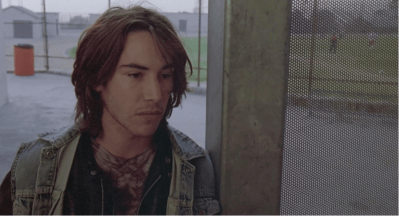
Parents don’t factor into the story very much, but that’s kind of the point. Hopper’s half-gone Feck is essentially the de facto father figure for these kids, the film’s generational bridge. But we do get a few looks into the home life of Matt, in scenes where the inherent sweetness of Keanu Reeves shines, as does the memorable performance of Constance Forslund as Matt’s single mom, who’s barely keeping it together with three kids and a deadbeat boyfriend. Throughout the movie, Matt tries to comfort his little sister and his mom – mostly due to the trouble being caused by the miscreant middle child, Tim. Matt pleads with his brother, why do you have to be such a jerk? In the film’s most touching scene, he helps his sister build a little grave site for her lost doll; and in a chaotically funny moment, he tries to reassure his mom – after taking one of her joints, and after she’s had a full-on meltdown where she threatened to leave the kids – that things will be alright. Despite Matt’s association with guys like John and Layne, and despite his broken home, it’s clear that his moral compass remains built upon a solid foundation. It’s a testament to the odd power Reeves has that, despite the darkness that surrounds him, you kind of believe him.
But that doesn’t mean Matt isn’t a little messed up, like so many kids of his generation. He clearly fits the mold of the disillusioned delinquent, but he’s also out of place in his own circle of friends. In its own way, River’s Edge is a strange meditation on what it means to be a friend at that age – or rather, what it should mean to be a friend. Maybe friendship among adolescents and young men has always been a fraught thing, no matter the generation and despite the natural yearning for fraternity and camaraderie, but there’s a specificity to the lonely, desperate kind of peer pressure and craving acceptance that’s at the heart of the film. The whole scenario can make you think we’ve hit some kind of rock bottom. So when Matt sees Jamie’s dead body, he just turns away in disgust. He doesn’t want to help John, but he doesn’t know what else to do, either, because ratting out a “friend” to the police is its own sort of crime – a taboo, a line he would have to cross where nothing would ever be the same again.
Matt’s arc in the film is essentially a coming of age story. He’s our little beacon of hope as he works up the nerve to finally call the police. With the help of his young sister and Ione Skye’s Clarissa, he’s able to grow up a little bit, achieve a modicum of enlightenment, and see the world – especially women – in a different way than Layne and John. Layne’s entire reasoning for helping John can be boiled down to the old “bros before hoes” mentality. Why did John kill Jamie? Layne believes it’s a reasonable excuse to think that Jamie might have said something about John’s dead mom. But then we hear John explain the whole thing to Feck and it sounds like he choked the life out of Jamie due to a pathological desire to feel powerful and in control. It’s a disturbing confession, and one that sends a chill down Feck’s spine.
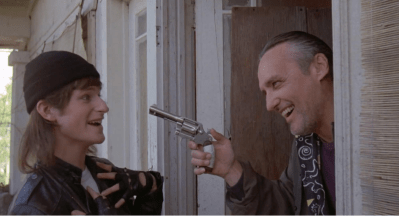
Dennis Hopper’s performance as this wounded, pathetic, but ultimately sympathetic shut-in is something to behold. His character is both the past and the future – the bridge. He’s the paranoid countercultural relic of the previous generation. A former biker whose gang left him bleeding in the street after an accident claimed one of his legs. A sign, perhaps, of how the 60s counterculture got left behind, literally ditched in this case. But Feck is also a cautionary tale, a look at what’s in store for these kids if they don’t find a way past all the drinking and drugging. Whenever someone meets Feck, he tells them he’s killed a woman before, and that people are looking for him. So, when Layne decides to hide John at Feck’s place, it’s a real two-spoiled-peas-in-a-pod situation. But even this old burnout doesn’t like what he sees in John. The big difference, at least as Feck sees it, is that he loved the woman he killed. Committing the murder essentially killed a part of him as well. It left him a shut-in, burdened with regret and paranoia. Whereas John confesses that murdering Jamie made him feel alive for the first time in his life. In an act that can seem like reparations for his past misdeed, or due to an unbearable shame in what he hath wrought, Feck decides John must die. The boomer delinquent – played by the star of Easy Rider, no less – peers into the soul of this new breed and has to shut it down.
There are certainly other films that speak to growing up at this point in history, but River’s Edge ticks a lot of boxes for me. It captures the ideological disconnect between the kids of the 60s and the kids of the 80s. While the hippies that were turning on, tuning in, and dropping out were tapping into some larger countercultural value system, one that included a utopian and perhaps naive hope for a better future, Gen X kids like Matt were missing that ingredient. They were turning on and dropping out because they didn’t see the point in showing up for class or preparing for a future that offered nothing of interest. Mr. Burkewaite tries to get his class politically engaged but from their vantage point it’s hard to see what good it would do if the protests of the 60s and 70s were what got us to the Reagan 80s.
Individualism, as opposed to collectivism, was on the rise. The writer Tom Wolf labeled the 1970s as the “Me decade,” the era when the Boomers turned away from trying to enact collective change and toward narcissistic self-help pursuits. And you can see the effects of it in the ways these Gen X kids respond to the death of their friend. Empathy has been drained from them. It’s almost like a confusing foreign concept. The social bonds they have with one another are more or less entirely pop culture related. They’re friends because they like the same music and think the same things are “cool.” So when a crisis within the group occurs, it’s an open question as to whether it’s appropriate to respond by doing nothing that might threaten their own situation. It’s chilling because of how sadly accurate it all is.
But there’s also the aesthetics of the movie. I don’t remember how old I was exactly when I first saw River’s Edge. At this point, it feels like it’s always been with me, not unlike the movies of David Lynch and the dark, moody music of the Pacific Northwest that soundtracked most of my high school years. Not for nothing, River’s Edge fully captures the grunge aesthetic a good five years before it hit the mainstream. In its own unsettling way, it felt exactly right at the time and continues to hold up as a perfect time capsule.
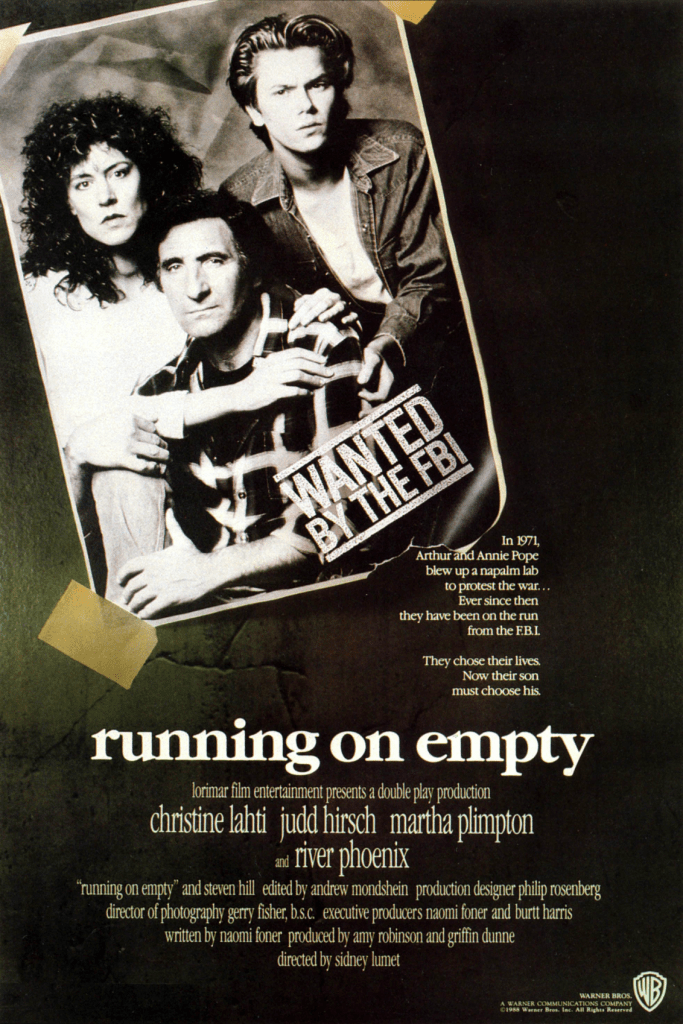
Still, I know River’s Edge isn’t for everyone, and I know that many Gen Xers may not relate to growing up under such somber circumstances. So let me point you toward the other side of the coin, where the parents have a strong bond and try their best to raise a bright, morally grounded child amidst the bankrupt ideals of the 1980s. That film is Sidney Lumet’s underrated 1988 family drama Running on Empty. It also fits the bill for this column by being one of the most impeccable generational handshake movies I know of as it presents three branches of a family tree who are all trying to cope with the broken promises of the late 60s countercultural movement. In doing so, it gets at an important aspect of Gen X apathy, even as it shows one of the icons of the generation — River Phoenix — breaking free from the baggage of the past and largely avoiding that trap.
(Not to derail this segue, but I feel compelled to acknowledge that a couple of years prior to Running on Empty, Phoenix starred in Stand By Me, a tale that shares many similarities to River’s Edge in that it takes a group of boys, all of whom come from dysfunctional families, and ties a transformative moment in their life, their loss of innocence, to seeing the dead body of another kid their age – a moment that challenges their ideas around friendship and broader societal responsibilities.)
In Running on Empty, Phoenix plays Danny, the oldest son of Arthur and Annie Pope (Judd Hirsch and Christine Lahti), two revolutionary, anti-war activists (think The Weather Underground) who’ve been on the run from the FBI since blowing up a napalm factory 15 years ago. Danny is our entry point into the story. Coming home after striking out during a baseball game, he spots the FBI stakeout near his home, collects his younger brother and their dog, and heads off to warn his parents. He may not be good at baseball, but he’s a bright kid who knows how to spot trouble and make a clean getaway.
At a motel, they dye their hair and Arthur shaves his beard. They get some new wheels and move on to the next town where they get jobs and enroll Danny in school. But Danny is basically a ticking clock for this family. He’s seventeen, about to become an adult. Will he be expected to stay a part of this family — which means continuing to run alongside them whenever trouble rears its head — or will they let go of him, and run the risk of spending years never being able to see him again? This decision is further forced upon the family when Danny falls in love with his music teacher’s daughter (played with absolute perfection by Martha Plimpton, Phoenix’s girlfriend at the time) and secretly nails an audition for the Julliard School. It’s becoming more and more apparent that he’s a gifted pianist and even a fledgling composer.
Lumet and screenwriter Naomi Foner (mother of Maggie and Jake Gyllenhaal) do a magnificent job in drawing generational parallels between Danny’s situation and that of his parents and his grandparents, all without beating you over the head about it. Foner was rightfully rewarded with an Oscar nomination for this script and the way it brings all the members of the Pope family – their personalities and concerns – to life in such an unforced and graceful way, with Lumet and the actors making it all feel lived-in and genuine. It’s remarkable how much backstory and little personal and relationship details that the cast and filmmakers are able to pack into the margins of the film.
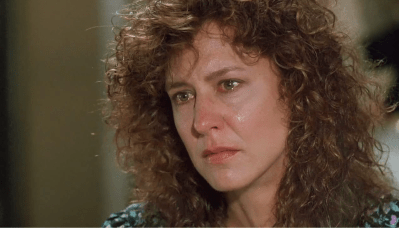
A lot of what makes the movie so special can be found in what is arguably the most powerful moment in the film: a clandestine meeting at a fancy restaurant where Danny’s mom, Annie, comes face-to-face with her own father (Steven Hill of Law and Order fame) for the first time in fifteen years. All the conflicting impulses and emotions are present and accounted for in this scene. Even if they don’t directly address all of them, they’re in the performances. Annie is there to ask her father for help, to take Danny so that he can go to college and have a normal life. But the price Annie has to pay is to sit there in this fancy restaurant and answer a few questions. Does she regret the pain she’s caused her parents? Did she think about them at all when she decided to set off that bomb?
Christine Lahti and Steven Hill deliver a masterclass in acting in this one scene. Annie can hold her head up high because, despite the circumstances, we’ve seen that she’s raised Danny to be a bright, respectful, morally grounded kid. We also learn that she’s the one who taught him to play piano, and that she must have decided at some point, probably around Danny’s age, to sacrifice her potential music career for something that meant more to her at the time. Her decision likely had to do with wanting to rebel against her privileged, upper class parents. So, yes, she may regret having to ask for favors now, and she may feel terrible about recreating this situation where Danny will be cut off from his parents, but she won’t apologize for standing up for what she believed in and taking action against an unjust war that was killing, wounding and poisoning millions of people. She’s proud of Danny, and she’s willing to pay another price for her choices if it means he can have a better life.
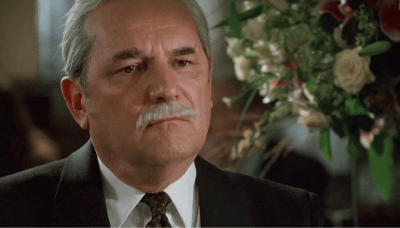
Throughout this scene, Annie’s father wants to be upset. He too was making decisions that he believed would lead to a better life for his children. But we get the sense that, for him, it was all about making money and providing financial security. By most metrics, he did a good job. So it’s a wonder to him just how it ended up like this. It really underlines the frustrations that have been compounded through the years. As Mr. Burkewaite in River’s Edge explained, a lot of the hippies and activists from the 60s ended up selling out, getting corporate jobs, becoming part of the machinery. The ones who didn’t, like the Popes, have been successfully pushed to the margins, taking on community-based jobs that are underpaid and undervalued. It makes the apathetic Gen X kids wonder, what, if anything, really changed in the 60s and 70s – further underlining the question of what options have we really got?
The answer that the film provides is one of the more rational options that Growing Up Absurd recognizes and one that always seemed the most logical to me, even from a young age: art. A brilliant little detail in Running on Empty is the tradition the Popes have when it comes to giving birthday presents. The gift has to be either something you found or something you made. Money may be a necessity, but creativity has more value. Ultimately, it’s Danny’s chance at being an artist that makes his parents essentially push him out of the nest. His dad may prefer that he was more James Taylor than George Gershwin – he’s no fan of the high society elites that attend piano recitals – but even Arthur can’t deny this kind of future for his son.
Running on Empty may not be the most well-remembered of 80s films, but its examinations of the pivot in generational values continues to resonate. In May 2026, the memoir Dangerous, Dirty, Violent, and Young was published, written by Zayd Ayers Dohrn, who was raised by parents who were in the Weathermen and on the run from the FBI after that militant group set off a series of bombs in the early 1970s. Dohrn mentions that by the time he was three years old he’d learned how to spot undercover cops in a crowd. But, perhaps more to the point, he was also raised to be a smart, grounded person, with his own upstanding sense of morality.
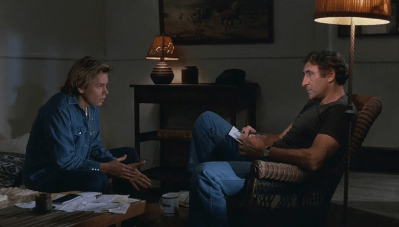
It’s fascinating how close Dohrn’s story sounds to Running on Empty and it’s pretty enlightening to watch the movie in the wake of Paul Thomas Anderson’s One Battle After Another. Both films show a world where an older generation of activists are in hiding, relying on an underground network of old connections while trying to protect their kids. They’re very different movies, of course, but it’s like watching the generational torch continuing to be passed, while at the same time seeing how few problems have been solved. The funny thing is though, both movies show how these radical parents end up raising wonderful kids.
A reasonable person wouldn’t necessarily agree that blowing up federal buildings (even when no one is in them) is the right way to protest America’s endemic inequality and injustice – which is how the parents behaved in Running on Empty, One Battle After Another, and in the real world of the Weathermen – and yet that’s not to say one can’t understand the anger and frustrations that led to these actions. Likewise, a reasonable person might think it’s irresponsible to raise children under such unstable circumstances, where their parents could be taken away at any time, where they may have to uproot themselves at a moment’s notice, but it’s also understandable – perhaps even more so for parents – to want to do whatever they can to create a better world for the next generation. Maybe holding firm to your values, taking action, and standing up for what you believe in is the best lesson you can teach your progeny.
But in the end, the lessons that the Gen X kids learned from their parents weren’t so clear cut. From the vantage point of the 1980s, it looked like it was all for naught. “Apathetic” and “cynical” were words frequently used to describe teens at the time. What did the future hold? Nuclear weapons and credit card debt? Maybe the kids who were numbing themselves with drink and drug in Less Than Zero were just feeling the “end of history” vibes that were in the air as the 90s got underway. Maybe that’s what’s informing the let’s-blow-it-all-up sentiment at the darkened teenaged heart of Heathers.
In the next column we’ll take a closer look at that classic brand of apathetic, Gen X adolescence that was coalescing as the 1980s met the 1990s, just as some of the new cinematic sensibilities that were emerging to meet the moment. We’ll talk some more about what, exactly, the “end of history” meant at the time, and how it informed the stories and a generation of people staring down the barrel of adulthood.
Discover more from Cineccentric
Subscribe to get the latest posts sent to your email.


0 comments on “Latchkey Cinema – Bridging the 80s (ft. River’s Edge & Running on Empty)”