
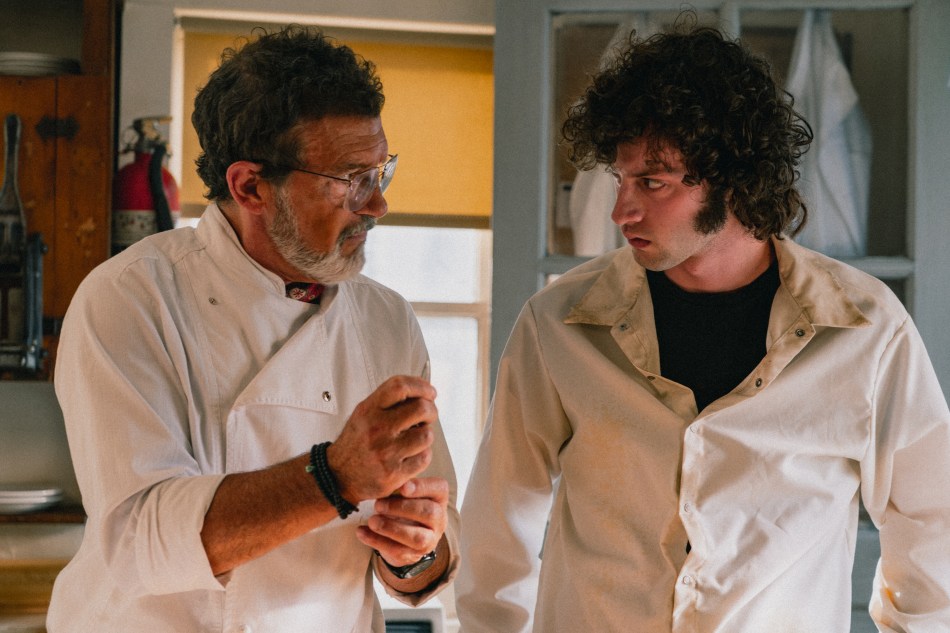
Matt Johnson’s Tony is both coming-of-age and origin story, depicting the transformative summer where Tony (Dominic Sessa), as he had liked to be called, became Anthony Bourdain. In 1975, Tony had no aspirations of becoming a professional chef. He was a writer and had hoped to spend the summer writing his first novel through a fellowship. He is so confident, in fact, of receiving the fellowship that he told the interviewers that his novel would be written on a single page and be inspired by the writing of George Orwell and Jack Kerouac. Tony took the blank, silent response from the interviewers as an affirmative signal he would receive the fellowship. Tony’s arrogance and dishonesty is shown as he tells his father, mother, and love interest Nancy (Emilia Jones) that he had received the fellowship which quickly becomes a problem when he is notified shortly thereafter that he was not accepted. Rather than risk disappointing his parents and tell them the truth, he decides to chase after Nancy to Cape Cod where she is spending the summer.
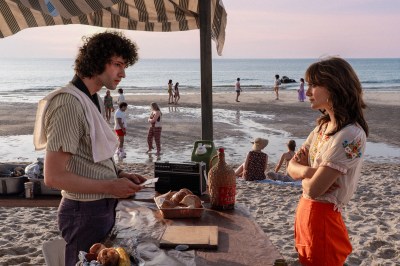
This decision sets into motion the events that led Tony to his first job in a kitchen. After binge drinking and getting robbed, Tony is left moneyless with no direction. The Chef (Antonio Banderas) of the restaurant that Tony is thrown out of takes pity on Tony, and Tony wakes up after his long night in a hammock at the Chef’s beachside home. Tony convinces him to let him continue sleeping in the hammock the following nights in exchange for working at the restaurant. Washing dishes for his coworkers Sal (Leo Woodall), Stavros (Stavros Halkias), and Tyrone (Michael Jibrin), Tony is in the thick of it, observing the hecticness, disorder, and even grossness that occurs within a restaurant kitchen.
Despite the chaos, Chef has one clear rule for his kitchen: never be late. Sleeping on Chef’s hammock, Tony is awakened each morning with a bucket of sea water to the face. It’s effective: Tony is never late. This recurring gag never fails to prompt laughter. Otherwise, Chef displays an extraordinary level of tolerance, even willing to turn a blind eye to Sal and Stavros’ use of cocaine in the kitchen. Tony is clearly curious about this drug use while Sal takes Tony under his wing in helping Tony acclimate to his new job and not knowing anyone in the city. Sal is brotherly yet is clearly a negative influence to Tony, and as a character represents a view at what Tony’s life would become if he leans into his egoist tendencies. Sal is also a womanizer which to some extent Tony looks up to, yet Tony is nowhere near as suave and recognizes that Sal’s playbook is not an appropriate means to earn the affection of Nancy.
At work, Tony is influenced by Chef. Tony recognizes that Chef believes in his capabilities and instills his passion for cooking in Tony. Living on Chef’s back porch, Tony spends much of his summer with Chef and recognizes there is more than meets the eye to the enigmatic restauranteur. Despite not knowing Chef’s name or nationality, Chef shares with Tony where his interest in cooking originated and why he owns a dingy seafood restaurant even though he had previously been a Michelin star chef. Under Chef’s guidance, Tony becomes more talented in the kitchen and his aspirations for his novel become a foregone memory.
Tony is pulled between his two influences – Sal and Chef – for much of Tony’s runtime along with having to weave a less-and-less believable web of lies for Nancy under the guise he is still writing a novel through his fellowship (which just so happens to be in the same city she is in). First and foremost, Tony is young and impressionable, and Dominic Sessa conveys this superbly through nonverbal acting in Tony’s silent observation of Sal and Chef’s actions. Sessa makes clear that Tony is clearly in search of a path forward, both in his pursuit of Nancy and in deciding for himself what kind of person he would become. Tony is provided with grace by Chef even if not wholly deserved, and Antonio Banderas makes clear how Chef’s simple, humble passion in cooking and in cooking for others could win Tony over.
Solely focused on one summer early in Anthony Bourdain’s life, Tony avoids most pitfalls of biopics. Bourdain is certainly not placed on a pedestal within Tony, and director Matt Johnson chooses to illustrate a number of Bourdain’s character flaws in his youth to grant the film realism. At its core, Tony shows that formative experiences can come out of something seemingly unremarkable and recognizes the impact that having someone to look up to can have on a person. For Tony – rather, for Anthony Bourdain – this impact cannot be understated and would ultimately lead him to becoming the globally-renowned travel chef.
Discover more from Cineccentric
Subscribe to get the latest posts sent to your email.


Tribute to Tony B!
LikeLike