
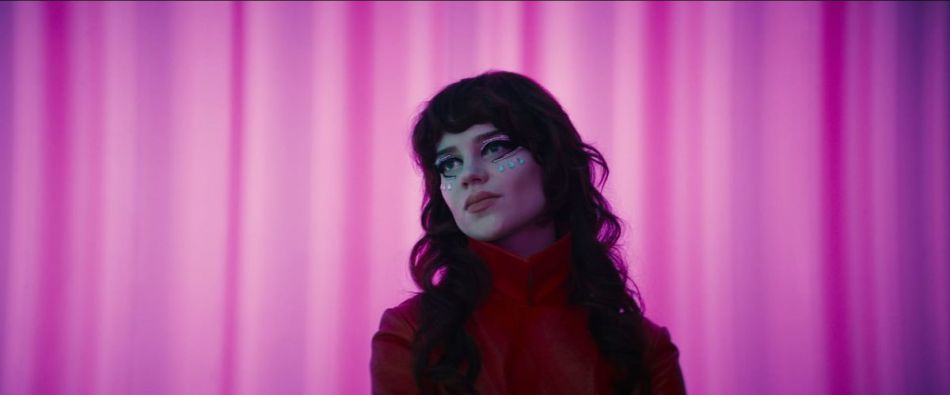
Director Nicolas Winding Refn’s Her Private Hell plays like a half-remembered dream with details slipping away as the dreamer tries to recollect their experience. Since breaking into the mainstream with Drive, Refn has leaned hard into the neon-soaked aesthetic that film notably showcased, as well as the emotionally distant, slow-paced, violent, and hyper-stylistic approach he has established as his personal brand. Her Private Hell is perhaps his most formalistic film yet, an exercise in style with little-to-no regard for conventional narrative structure. Her Private Hell is all about mood. Its style is its substance, making this a near impossible film to sell to those agnostic to Refn’s filmmaking approach. For those who count themselves as fans, Her Private Hell will undoubtedly appeal. Personally, I found myself somewhere in the middle with Her Private Hell standing as an often confounding and challenging experience that defies any chance to shape it into something coherent.
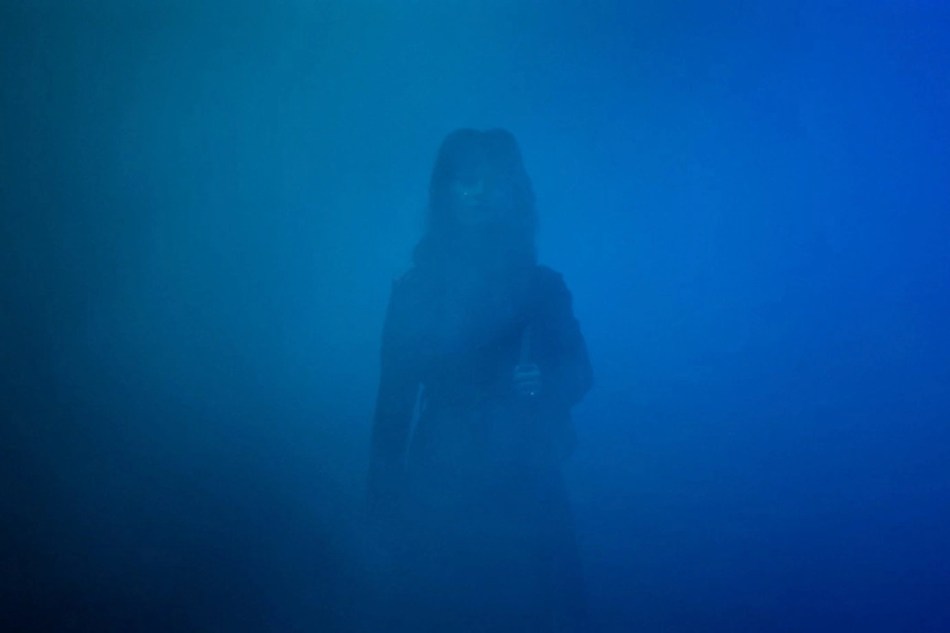
Her Private Hell is centered on the threat posed by a killer known as “The Leather Man”, a leather-clad assassin with diamond-studded black gloves who kills women. The only way to stop him is to cut off his hands, or else he will claim his latest victim. The establishment of the world of Her Private Hell is befuddling in every facet. On one hand, there is Elle (Sophie Thatcher). She lives in a futuristic city engulfed by mist, a mist that is said to usher in “The Leather Man.” Working as an actress, she lives with her father Johnny Thunders (Dougray Scott) and stepmother Dominique (Havana Rose Liu), while fellow actress Hunter (Kristine Froseth) comes to live with them as they work on a new film. As Johnny fills their heads with tales of The Leather Man, the women soon find themselves in the crosshairs of the killer. Meanwhile, in what appears to be post-war Japan, US Army Private K (Charles Melton) wades through the mist trying to find his daughter, who has been taken by The Leather Man, and to get revenge.
These stories make up the foundation of Her Private Hell’s plot threads with the pair barreling towards an intersection in the climax. It is hard to grasp onto anything to do with these characters and these stories. They are all so ill-defined and underwritten. Her Private Hell’s pseudo-futuristic setting is evidently occurring in the same universe or time with what seems to be post-war Japan and, eventually, some apparently in-between world. One thinks of Refn’s Only God Forgives often in relation to Her Private Hell. At the time of its release, Refn touted the “heightened reality” that made it into a sort of “fairy tale,” while Only God Forgives also touches on themes relating to sexual perversion and a father’s duty to protect his daughters that define Her Private Hell. With both films, it is probably best to not try to make sense of what Refn creates, because as is the case with Her Private Hell, there is more-or-less little care or consideration paid to how it develops. Every scene simply exists. One could watch any clip from Her Private Hell and have as much context for its occurrence as is given in the film itself. It all proceeds like a music video, and given Refn’s reliance on pulsating and ear-catching scores like that of composer Pino Donaggio’s here, this may be the goal. Her Private Hell is ultimately vapid, dramatically inert, and shapeless, simply drifting along as a loose set of ideas that never come together.
Yet, Her Private Hell is far from an abject failure. Refn, as ever, creates incredible visuals with cinematographer Magnus Nordenhof Jønck. The production design is excellent, bringing to life this oddball futuristic setting, while the mist adds to the aesthetic appeal and leads to plenty of striking shots of silhouetted figures – especially The Leather Man – emerging from them or walking the neon-streaked streets of Japan or wherever Elle and her cohorts exist. Jønck makes the most of Refn’s heavy giallo influence in the style of Her Private Hell. The murder across the street may have its basis in Rear Window but the execution here is very Dario Argento’s Deep Red. A climactic kill as Elle has sex with Nico (Diego Calva) is a perfect intersection of the sex and murder element of giallo with the silhouette of Elle in the window, the rising tension of her encounter, and the suspense of watching this killer stalk his intended victim just over her shoulder makes for great cinema. However, whenever the film showcases this skillset in Elle’s story or in the hyper-violent Yakuza action scenes involving Private K, Her Private Hell will promptly return to the listless and bizarre nature with which its characters develop and conduct themselves. It feels like watching half a movie intercut with scenes of aliens interacting with one another.
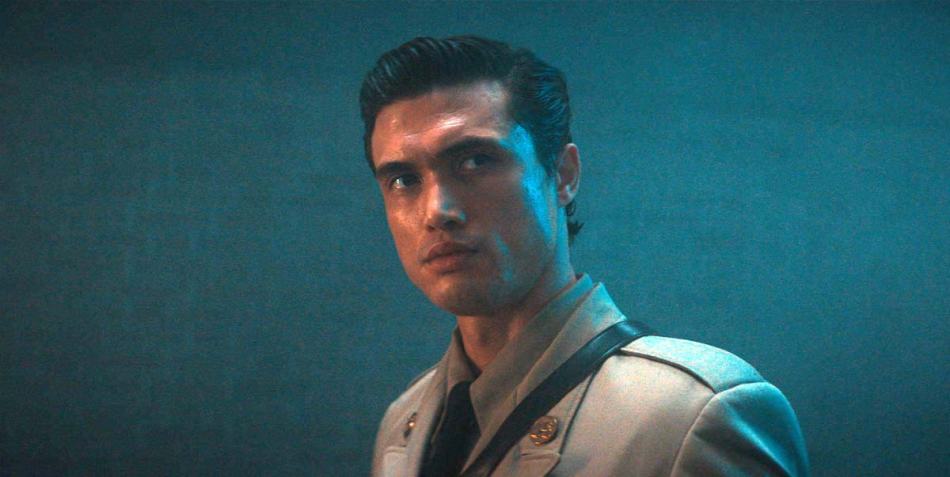
The giallo influence on Her Private Hell is mostly a positive quality. I am partial to the genre and love the works of Mario Bava, Argento, and Lucio Fulci that Refn draws on here, as well as those of Alfred Hitchcock and Brian De Palma that also stand as key influences on Her Private Hell. Refn touches all the usual tropes from leather-clad killers, BDSM/fetishistic overtones, gore, voyeurism, and a unique blend of cheesy and sleazy that makes them into hard films for newcomers to enjoy, but catnip for those accustomed to their odd plot beats. Elle, Dominique, and Hunter feel ripped from Blood and Black Lace, while Private K’s story of searching for his daughter’s apparent killer touches on a familiar anxiety within giallo films. He is challenged with being a failed father for not protecting his daughter, sending him on this desperate search for answers and a chance to re-assert himself. Refn unfortunately fails to cultivate the overall atmosphere of suspense or any of the emotional involvement that drives these films, instead using these influences as additional aesthetic and window dressing to distract from the mostly empty provocations with which Her Private Hell proceeds. Nevertheless, a scene – from the film-within-the-film that Elle, Hunter, and Dominique are working on – that is perhaps connected to Refn’s prior attachment to a Barbarella remake and is, most notably, a reference to Bava’s Planet of the Vampires is a real highlight.
Where one wonders if the giallo influence is a negative is in the acting. Like many Italian films of the era, giallo films were frequently dubbed. They would have an international cast who delivered lines in their own native language, then they would all be dubbed over in Italian or English. The result is often stilted and odd line deliveries that, naturally, are disconnected from the facial movements and expressions of the actors. It feels as though Her Private Hell is after this aesthetic. If so, it would at least explain the baffling direction Refn gives his cast. Sophie Thatcher is a very talented actor, having showcased this in Heretic and Companion in recent years, and Havana Rose Liu has really broken through this year with a fantastic and expressive performance in Tuner. Yet, both feel entirely inhuman. Their characters are reduced down to acting out Refn’s fetishistic impulses while the dialogue given to both and a bewildering Kristine Froseth is stilted, stiff, and nonsensical.
Her Private Hell is perhaps the most Nicolas Winding Refn film to date. It is distant, stylish, and utterly indifferent towards bringing its discordant elements into any sense of harmony or coherence. It is impossible to write off Her Private Hell entirely, no matter how bewildering its acting, directing, and editing decisions are, as the score, cinematography, and overall mood are intoxicating. The goal of Her Private Hell is not to be a straight-forward horror thriller, but to instead ride the wave of its shapeless and impulsive structure. Her Private Hell wants to be bizarre and chaotic, but it all feels so empty and vapid that even as one admires Winding Refn’s refusal to conform to conventional taste, it is hard to endorse Her Private Hell as an overall experience.
Discover more from Cineccentric
Subscribe to get the latest posts sent to your email.


0 comments on “Her Private Hell ★★”