
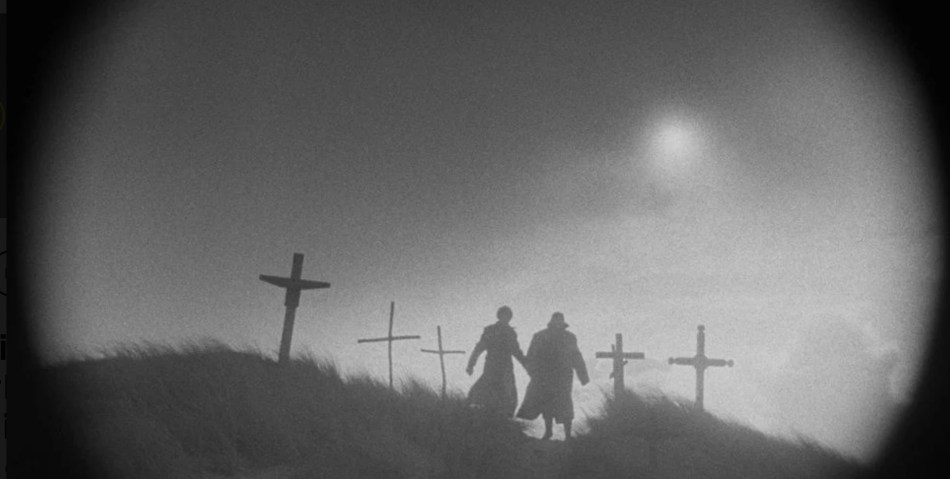
In a world of constant and consecutive catastrophes, where one terrible event is surpassed by the next before its consequences have even been processed, would people even notice the apocalypse? Would they recognise it, as it happens? And once it’s over, wouldn’t humans be the actual monsters? These questions haunt F.J. Ossang‘s spectral scenario, like the eerie silhouettes on the distant dunes of his paranoid protagonists. From their abode on a lonely beach, Louis (Alexis Manenti) and Lénore (Elvire) see the strange figures appear at dusk. Are they survivors in this bleak and curiously depopulated realm, the ruinous state of which suggests some cataclysmic change?
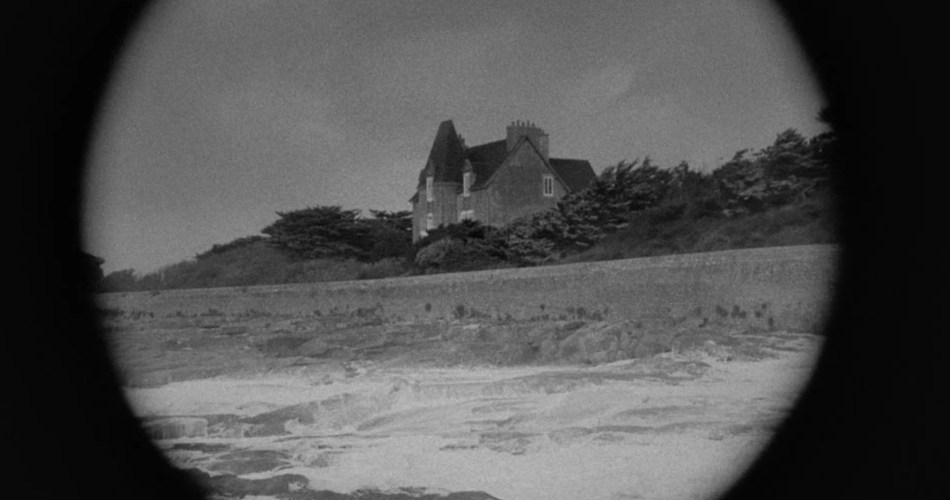
Nothing gives away what exactly has happened to mankind in this bizarre but alluring setting that might be an alternative reality, an imaginary past or a dystopian future. Once again, the French director-writer shows his film historic foible by effectively evoking the cinematic characteristics of the past. With its pinhole aperture, dialogue told by text cards, and condensed run time of only 25 minutes, the phantasmagorical tale strives for the dreamlike atmosphere and metaphysical metaphors of the fantastic films from the silent era. Sean Price Williams’ atmospheric cinematography seems itself haunted by the imaginative imagery of Victor Sjöström’s The Phantom Carriage and Carl Theodor Dreyer’s Vampyr (the latter an early talkie).
These surreal strands are gone, though, with the approach of the creatures. They are revenants reminiscent of the hypnotised zombies in the Halperin brothers’ White Zombie. Only are Ossang’s walking dead surprisingly eloquent and literate, closer to the vampiric mutants in Richard Matheson‘s “I Am Legend”. Among these cult and classic references, the horror miniature plays out like an episode from a forgotten vintage TV series, or one of the B short films that used to be screened with A-features as part of a double bill. It’s a true cinematic weird tale where brilliance and pulp become inseparable.
Shot on Super 16mm, the scenes’ grainy tactility recreates the motif of evanescence. Brittany’s rugged coast around Finistère serves as a perfectly moody background for this playful composition of gothic melodrama and postmodern social satire. As Louis and Lénore turn from the haunted into the hunted, their flight through deserted villages and along an empty coastline marks them as the misfit monstrosities. It’s a touch of morbid lyricism among the somnambular visuals, theatrical dialogue and rather clumsy acting. The only short film premiering in Locarno’s Out of Competition slate, Tomb of Dreams is a cinematic horror poem enjoyable despite and because of its flaws.
Discover more from Cineccentric
Subscribe to get the latest posts sent to your email.


0 comments on “Tomb of Dreams ★★½”