
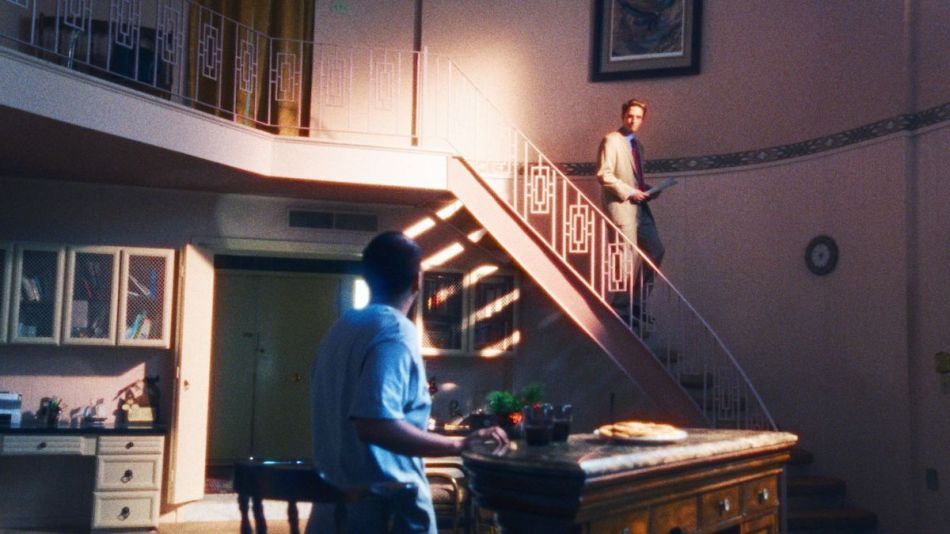
As ugly as the ethics behind the show and the showman at the centre of Lance Oppenheim‘s media morality play are its vintage visuals. Grainy, slightly distorted images, the unfavorable angles of hidden cameras and a palette of the most hideous shades, all aggressively oversaturated, make David Bolen’s cinematography both a reflection of the world the characters are part of and an (anti-)aesthetic copy of their formative success show. The latter is Chris Hansen’s To Catch a Predator. Created at the height of reality TV, each episode would feature a varying number of filmed encounters of so-called decoys—adults posing as children as young as 12—and the titular wannabe-abusers whom they had met online.

Just that instead of with a minor, the potential perpetrators would chat with one of Hansen’s team members (played by Matthew Maher as equally sleazy and sex-obsessed). When the predators would visit the supposed kids, they were instead confronted by Chris Hansen (Robert Pattinson). Smug and self-aggrandising, he would quote their recorded obscene language and perverse fantasies back to the men. Some of them tried to flee, only to end up in the arms of police who were already waiting outside the sting house. Others would beg for forgiveness and even more for the footage not to be released. Hansen would always wear a bulletproof vest; some men would turn violent—in one infamous case with deadly results.
Oppenheim follows the ruthless showman’s ascension from notoriety to the coveted primetime slot to the moment when it all culminates live on TV. His closest associates are his pragmatic producer Andie (Merritt Wever) and aspiring actor Dan Plum (Skyler Gisondo). As the newest of a long line of decoys, most of whom quit because they can’t take the harrowing situations anymore, he looks up to Hansen with starstruck idealism. “Decoy Dan”, as the team nicknames him, and his slow realization that the show isn’t the harbinger of justice as which Hansen frames it, are a frustratingly clunky dramatic tool. Supposed to give the audience a less uncomfortable identification character, his dilemma distracts from the much more interesting protagonist.
Despite Pattinson’s excellent performance, Hansen remains a crass, almost caricature-like manipulator—of his audience, his crew, his family, and himself—with little psychological depth. Talking casually with his seat neighbor during a flight, he responds to the man’s suggestion to kill the predators: “What I’m doing is actually worse.” In the 21st century, public humiliation is the ultimate punishment, with the media taking the place of the pillory. That’s about it, in terms of social analysis. Ahead of the premiere in competition at Venice, where Primetime provides a grim counter-piece to Danny Boyle’s mythologising media history Ink, Oppenheim said, “Chris Hansen pioneered a spectacle of punishment”, and “the moment moral outrage became must-see TV”.
Both claims are nonsense from a historical viewpoint, which explains the lack of ideological, social, and psychological insight. Society has always tightened its bonds by publicly shaming those perceived as transgressors, and other media formats capitalized on that need before Hansen. He just brought it to a new level by allowing the audience to indulge their own voyeurism, sadism, and hunger for spectacle while feeling morally justified in doing so. In a few gripping scenes, Primetime captures this idea of – to paraphrase the name of the vigilante organization aligned with the show – “Perverted Justice”. Despite the thrall of its gritty atmosphere and excellent performances, its most urgent and uncomfortable questions go not only unanswered, but unasked.
Discover more from Cineccentric
Subscribe to get the latest posts sent to your email.


0 comments on “Primetime ★★½”