
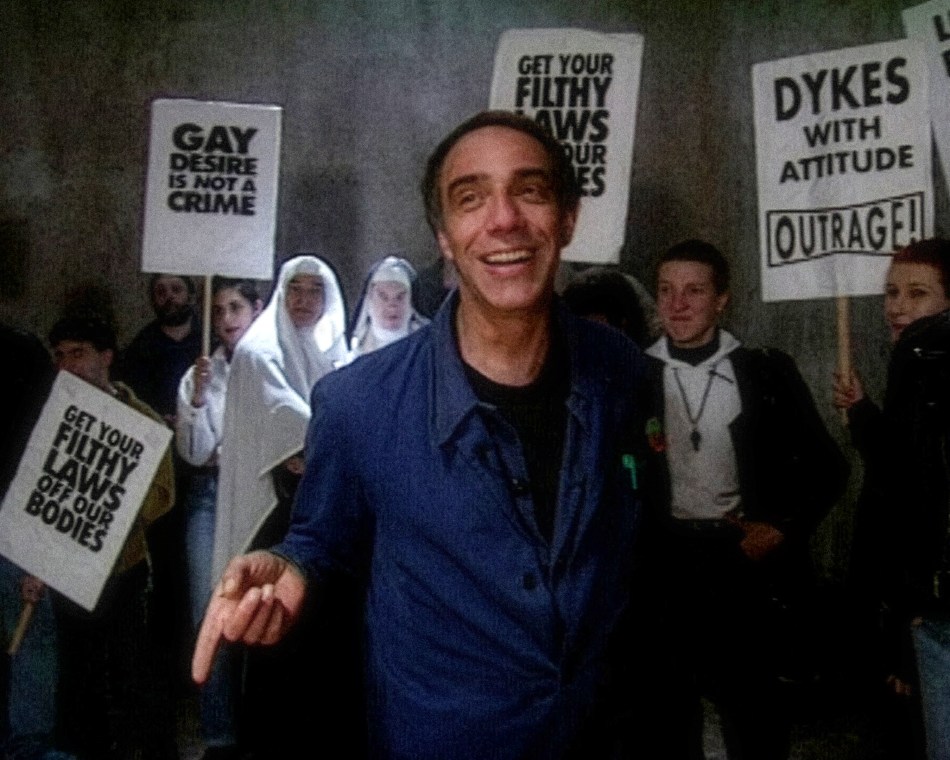
Looking at Derek Jarman‘s titular historical drama today, it’s easy to be swept away by its innovative settings and wild costumes, its artistic daring and queer self-awareness. But it’s hard to imagine how revolutionary and risky the project actually was at that time and how hostile and homophobic the UK, its politics, laws, and morals, were in 1991. Roughly 35 years later, Theo Rollason looks back at the creation of Jarman’s Edward II as well as its social and political impact. It was a time when, as a protester for gay rights points out in one of the engaging archival scenes, Britain had more anti-gay laws than any other Western country.
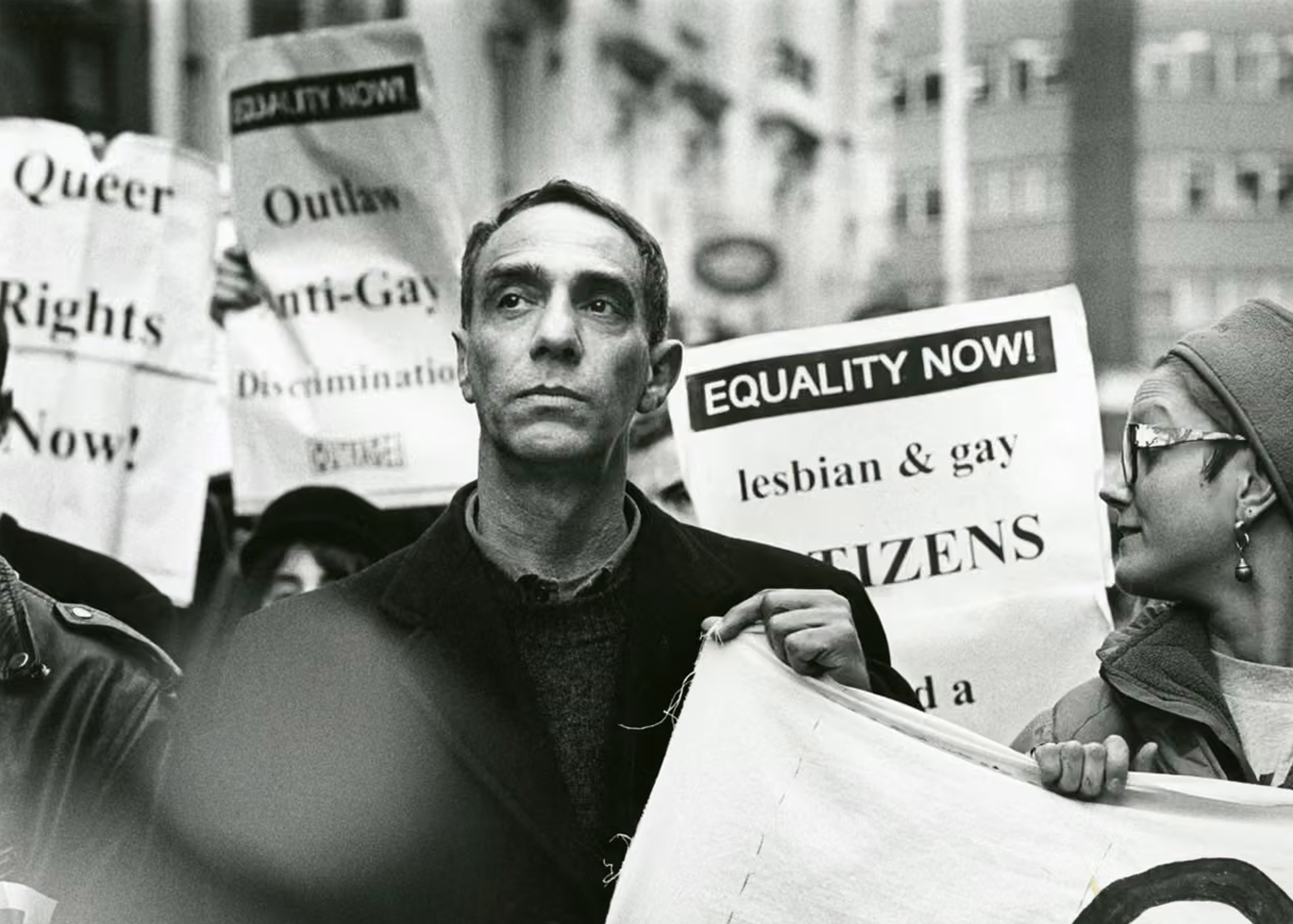
Jarman himself summed up this institutionalised discrimination in front of the camera, during a public protest: “The first 25 years of my life I have been a criminal. And then the following 25 years I’ve been a second-class citizen.” Edward II hit screens at a key moment in gay history which it galvanised and glorified. Constantly gaining momentum, the gay rights movement achieved a major success with the end of the Foreign Office ban, and demanded better government response and care regarding the AIDS crisis. Its death toll was constantly rising and Jarman himself was ill. Vivid footage from the film set and shoot shows him full of creative energy and charisma.
Rollason’s debut documentary captures Jarman’s artistic rush and the increased political urgency of his work, which became more unapologetic and confrontational after his diagnosis in 1986. Over the most vital moments looms the feeling that his time is running out. His radical reimagining of Christopher Marlowe’s play as a gay rights anthem was both produced with his biggest budget to that day and became his last major work before his health would dramatically decline only a year later. Previously unseen scenes shot by the young Seamus McGarvey capture the creation of a canonical work of New Queer Cinema that has become inseparably linked with political agitation and Jarman’s private life.
When he’s not working feverishly on every aspect of the production, sketching costumes, rearranging sets, discussing cinematic concepts, or listening to the soundtrack, Jarman is joining protest events and is among the crowd at rallies. His prominent persona makes him a target of public attacks and threats. At one point his car is plastered with anti-gay slogans and slurs. The next moment the extras are demanding extra pay, having heard of a higher budget, which, as one disillusioned close friend notices, can turn family and friends into strangers. Grainy images preserve the unfiltered memories of rehearsals and intellectual intimacy as well as production tensions and the peculiar social choreography of Jarman’s crew.
Drag nuns taking a cigarette break, naked figures in angelic poses, and lifelong friend and collaborator Tilda Swinton on the cusp of international art-house fame are part of this enthusiastic, sometimes contentious microcosm where performance and protest meet, figuratively and literally. Emblematic of this inseparable intertwining of Renaissance theatricals and rebellion is Rollason’s particular attention to the groundbreaking LGBTQ+ rights organisation OutRage!, a split section of which caused fractures even within the community through its practice of outing closeted queer people. Sir Ian McKellen speaks about the cruelty of this kind of intrusive incentivisation that could destroy careers and lives, and feels uncomfortably close to the conservatives’ moralist branding of people as “perverse”.
Experiencing Jarman as the centre of a unique queer circle of fellow filmmakers, friends, colleagues, critics, and lovers contradicts the myth of the solitary outsider provocateur. Queer Edward II’s sheer archival exuberance and excess becomes its stylistic strength, going against the current trend of self-regarding semi-fictional hybrid documentaries. The lived experience palpable in the footage goes beyond didactic historical commentary. Premiering at the Venice Film Festival – the same place where Edward II screened in competition in 1991, Rollason’s fresh take on a controversial classic remembers both a seminal cinematic work and the fact that, in Queer Cinema, visibility itself has always been a form of resistance and a victory over establishment entertainment.
Discover more from Cineccentric
Subscribe to get the latest posts sent to your email.


0 comments on “Queer Edward II (documentary) ★★★½”