
Making the move from woodsy New England to sprawling San Bernardino, California when I was nine years didn’t seem like a huge deal at the time. It’s easy to make new friends at that age, and despite the radical difference in topography and cultural demographics, at first, things didn’t seem like they were all that different. But the reality was, my childhood was now over, as was any sense of stability or peaceful family dynamics.
I didn’t really pick up on any of that at the time. In my adolescence, I was already a movie-mad kid who was in love with all the 80s stuff that kids my age were in love with: Star Wars, Indiana Jones, Back to the Future, Ghostbusters, etc. I was fully ensconced in my own world, just as my parents were in theirs. And if there was any advantage to that scenario it’s that they – but especially my father – were very lenient when it came to the movies I could watch. They let me see “grown up” films like Beverly Hills Cop and Witness, both of which I adored as a nine-year-old.
But after the move to California, it was like the floodgates opened. We immediately started a weekend routine of renting a VHS player along with a few movies until we finally got a machine of our own. My dad had a penchant for new genre films, but he also liked to revisit any classics from the 60s and 70s that’d been released. So I was getting Coppola and Kubrick, as well as Carpenter and the Coen Brothers. I was already developing the cinephilia itch. Eventually we got our premium cable package and I was meticulously combing through the back section of every TV Guide, looking for anything interesting in the movie listings and programming the VCR to record the ones I wouldn’t be awake to see.

I always think of these formative days whenever the cinema versus streaming debate reemerges. San Bernardino was a sizable city at the time, and not far from Los Angeles, either, but it was still hard, if not impossible, to find “cool” movies like Raising Arizona and Miracle Mile. To see those you had to have a car and drive to an art house cinema, probably in a college town like Montclair. I have fond, big-screen memories of seeing early Tim Burton movies, the riotous spectacle of Terminator 2 on opening weekend, the magic of Who Framed Roger Rabbit?, and the giddy thrill of sneaking into a screening of The Silence of the Lambs. But a lot of the most impactful ones, the ones that really expanded my mind, forged my personal taste, and made me dream about making my own movies, were the idiosyncratic films that I could only catch up with on television. And it goes without saying, our TVs were far from the home theater experience that has become so affordable these days.
I remember when the Coen Brothers were doing the rounds of interviews for, as of today, their last movie together, The Ballad of Buster Scruggs. Much ado was made about the fact that this was a straight-to-streaming, Netflix movie. But when asked about this (I believe it was on the Team Deakins podcast), Joel and Ethan didn’t see it as a big deal since their career had been built upon VHS rentals and cable TV – that’s how most people in the late 80s and early 90s discovered their films. They’ve rarely made what anyone would consider a hit upon its initial release. They, and most of the big figures of the American indie film movement that coincided with the Gen X era – including Jim Jarmusch, Steven Soderbergh, Quentin Tarantino, and Todd Haynes – owe their initial success and cult followings to the increased accessibility that arrived with home video.
That was how I first discovered all of these influential auteurs who would come to define a great deal of mainstream 90s cinema, as well as the more idiosyncratic 90s auteurs like Hal Hartley, Whit Stillman, and Gregg Araki. But the advent of home video – the infiltration of both cable TV and VCRs into our living spaces – can still be seen in both good and bad terms. I didn’t question my movie madness as an adolescent or a teenager, but the reality is that it can be an addiction just like any other – a means of avoidance and distraction from other things in your life. On the one hand, I’m glad I had at least one thing I could bond over with my dad. But on the other hand, it was likely an activity that kept us from talking about the things that really needed to be discussed. As our family fell apart during the six years we spent in San Bernardino, the TV was rarely off.
Martin Scorsese popularized the Frank Capra quote that goes: ”Film is a disease. When it infects your bloodstream, it takes over as the number one hormone; it bosses the enzymes; directs the pineal gland; plays Iago to your psyche. As with heroin, the antidote to film is more film.” I recommend watching the 1991 documentary The Scorsese Machine, which follows the day-to-day life of the director in his NYC offices, where the TV is always on and the assistants are busy doing what I did as a kid: making sure the VCR was set to record certain movies when they aired on cable – except Scorsese had the luxury of a room with multiple TVs and multiple VCRs set to record different channels at the same time. Total junkie behavior. I can relate.
As an already pop-culture obsessed teenager in high school, I wasn’t a great student, though I was president of the drama club for a while. I enjoyed acting and putting on plays, but had little headspace for anything that wasn’t related to art and creativity in some way, be it music, photography, or creative writing. Like a lot of the kids we talked about in the previous entry on growing up in the 80s, I had a hard time envisioning a future where I’d be applying things like algebra, geometry, physics, chemistry, and biology – all classes I struggled to get a passing grade in. Where was the practicality? Why was I about to graduate high school feeling utterly unprepared to function in the real world? Why did the “real world” seem like nonsense I wanted no part of? Why did I feel like the most valuable things I’d learned about life came from movies?
When I think about this kind of adolescent disillusionment, I remember my middle school friend Ron who, barely a teenager, was already confidently proclaiming himself a nihilist. (If you’d like to read about the night Ron and I went to see The Rocky Horror Picture Show for the first time when we were 14-year-olds, go here). Like a lot of the kids I grew up with in San Bernardino, Ron came from a broken home. But he wasn’t dark and broody, he was a shy kid in normcore clothes, smarter and more sarcastic than most, but he had a scar on the side of his mouth – kind of like Tina Fey’s – which made him a regular target for bullies. It gave him a bit of an edge. What made him attracted to nihilism – the idea that life and the universe have no inherent meaning, purpose or value? It’s a fair question.
Nihilism wasn’t invented by Gen Xers, and maybe adolescence has always been, in part, a push and pull between nihilism and humanism, but I suppose there was a reason the Coen Brothers gave them a prominent role in their 1991-set The Big Lebowski. As far as things like meaning, purpose, and values goes, the 80s were rough going. The future wasn’t looking too bright for those who didn’t put wealth accumulation as their raison d’être. The bullies were winning. As we discussed in the previous article when referencing the book Growing up Absurd, society had created a so-called “failure of opportunities” for young people to find purposeful meaning in life. Why wouldn’t nihilism seem fitting?

The 1989 movie Heathers can be read as a cumulative reaction to the 80s, a movie for kids like Ron, who wouldn’t mind seeing a devilish teenage nihilist take out the popular kids, the jocks and the bullies. It’s also a movie that had an outsized influence on my 13-year-old brain – a movie that, at the time, felt like it tapped into a very familiar headspace but in a very unfamiliar and exciting way. I have to admit I hesitated in whether or not I’d include Heathers in this series, feeling it might be a little obvious or overdiscussed. But it would be disingenuous to say that the movie didn’t have a very solid standing in both the Gen X movie canon and my own personal cinematic development.
Heathers was not a movie I’d heard of when I saw it sitting on the New Release shelf in the San Bernardino video store. But I had heard of Winona Ryder. There was a sizable subsection of boys my age, and I’m sure similar boys in subsequent generations, who found her performance in Beetlejuice to be unforgettable. So, one day in 1989, I convinced my dad to rent Heathers and ended up watching it at least twice before returning it. Soon I was getting in trouble in French class for reciting lines with a fellow student when the teacher really thought I was calling said classmate (a cheerleader no less!) a “mega-bitch.”
Most of what made Heathers so memorable at the time, and continues to make it stand out all these years later, even as it may not seem as unconventional today as it was at the time, is the screenplay by Daniel Waters. Not to throw shade on director Michael Lehmann (I’ll even stick up for Hudson Hawk if I’m feeling pugnacious enough), both he and Waters were making their feature debuts with Heathers; and while Lehmann’s rambunctious style adds to the movie’s charm, it’s Waters’s ambitious script that earned the film its overnight cult status. There are so many memorable lines that the IMDb Quotes page currently contains 134 entries. Famously, Waters actually had Stanley Kubrick in mind when writing. After all, Kubrick had moved from genre to genre during his career, but he hadn’t done the high school comedy yet, had he? That kind of ambitious overreach is the lovely, impossible dream of a neophyte, and yet, in its best moments, Heathers does approach the heightened, screwball style that, at moments, might bring to mind a sort of raunchy, less sophisticated version of a Leo McCarey picture.
Maybe that’s an exaggeration, but Heathers is the odd movie that is easy to both overrate and undervalue. In a way, it’s the perfect movie to discuss the one thing that’s of utmost importance to all adolescents: coolness. Of all the movies we’ll touch on in this series, the perceived quality of Heathers might be most dependent upon timing – where you were in your life when you first watched it. One’s teenage years are of course extremely formative. These are the years when you start to develop your own tastes. Finding something like Heathers, that wasn’t broadly popular but, at the time, still recognizably cool, was something that had the power to become, for better or worse, part of your personality.

For me, Heathers was part of a major pop cultural/personality vortex. The first band that I felt some personal ownership over was They Might Be Giants, whose music videos for “Don’t Let’s Start” and “Ana Ng” were absolutely the coolest thing I’d ever seen in my life at the time. I joined their fan club and bought every TMBG tape I could find, which at the time was just two albums but also a good number of maxi-single cassettes. The one for “Don’t Let’s Start” included the b-side “We’re The Replacements” which led me to the next band I would obsess over: The Replacements. So imagine my widening eyes when I read the back of the VHS box and discover that Heathers is centered around Westerberg High School, named after The Replacements’ ringleader Paul Westerberg. This wasn’t just a throwaway gag, either. In her interview in Rolling Stone magazine, Winona Ryder dreams about having Paul sing at her wedding.
It was as if I had no choice – the stars were aligning and making Heathers out to be a huge deal for me in 1989. It may sound a little snobbish now, but it was important that They Might Be Giants, The Replacements and Heathers all sat in that perfect zone: just far enough outside the mainstream to be mine. This proximity to broad popularity was of huge importance to young Gen Xers when determining if something is, in fact, cool or not. It’s so important that Heathers is essentially based around the idea that being popular is the opposite of cool. (Which in turn could lead one to ask the question, if Heathers gets turned into a Broadway musical, is it still cool?)
Heathers starts off with our hero, Veronica Sawyer (Ryder), in a predicament. She’s made the mistake – perhaps even committing the cardinal sin of vanity – of desiring mainstream popularity by becoming part of Westerberg High’s most powerful clique. It’s a dire predicament because the other members of this clique, the three Heathers, are all mean girls while Veronica is burdened with moral integrity. It’s a questionable set-up and the movie does little to suggest that Veronica was ever the kind of person who would want or agree to join this clique, to be pulled away from her childhood friends and have to spend everyday with three girls who are so unlike her. But like a magician’s slight of hand, the movie distracts you away from this shaky premise by kicking things off with a disarmingly surreal, dream-like, fourth-wall-breaking intro and then launching you into a verbally dazzling establishing scene where the girls stalk the cafeteria and all the characters, social hierarchies, and relationships are cleanly drawn.
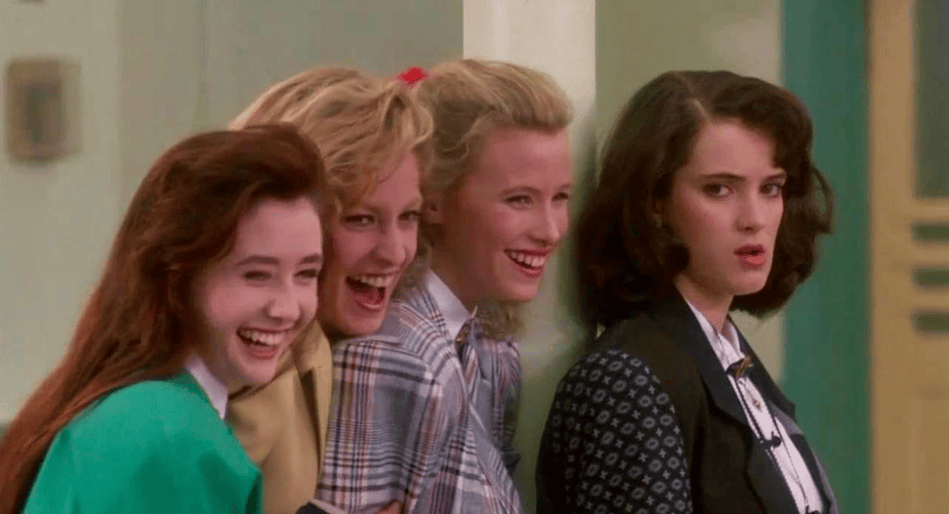
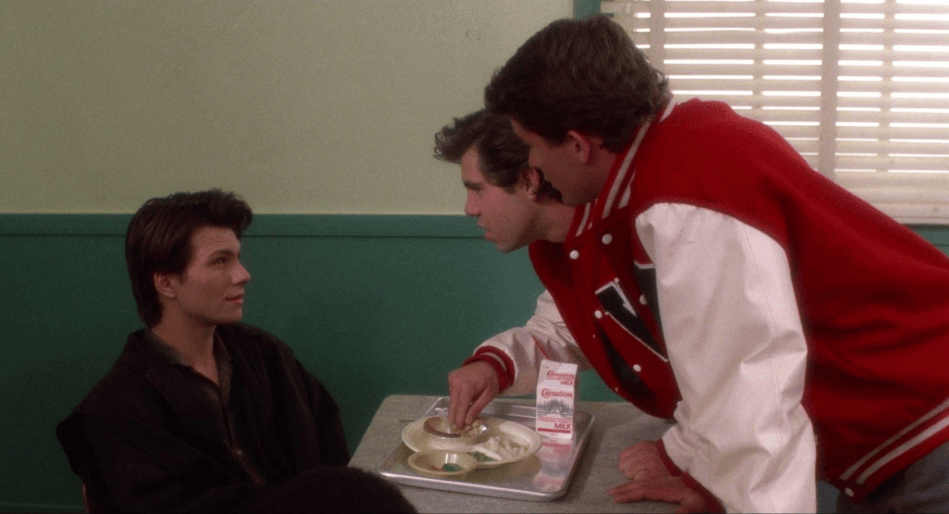
In this extended introduction, Veronica is attracted to new student J.D. (Christian Slater), a stereotypical bad boy, our archetypical nihilist, sitting in the corner with a black trench coat and a fondness for guns, his motorcycle parked outside. At various points, J.D. is compared to Bo Diddly, Jesse James, and Billy the Kid. Nowadays, it’s difficult not to see J.D. as an eerie provenance of the Trench Coat Mafia, the clique at Columbine High School dedicated to protecting kids from jocks and made infamous for its association with Eric Harris and Dylan Klebold, the two students who murdered 13 classmates and a teacher on April 20, 1999 (the birthday of the most famous nihilist, Adolf Hitler). Harris and Klebold made their own movie, entitled Hitmen For Hire, featuring guys wearing long black coats and shooting school bullies. The opening cafeteria scene in Heathers ends with J.D. pulling out a revolver from his coat and shooting the school’s two biggest bullies and the stars of the football team, Kurt and Ram.
In the biggest bit of questionable storywriting, even when accounting for late 80s social mores, we’re asked to believe that since J.D. was firing blanks at Kurt and Ram, he’s only received a slap on the wrist and is still allowed back at school. Indeed, Veronica remains charmed by J.D.’s gonzo shenanigans and even has backyard sex with him after a particularly hellish experience at a frat party that Veronica was brought to by Heather #1. Veronica had to fight off a pushy, smarmy dude-bro and ended up puking on Heather’s shoes after she refused to leave with her. For embarrassing her, and being generally ungrateful, Heather #1 vows to ruin Veronica’s reputation at school tomorrow.
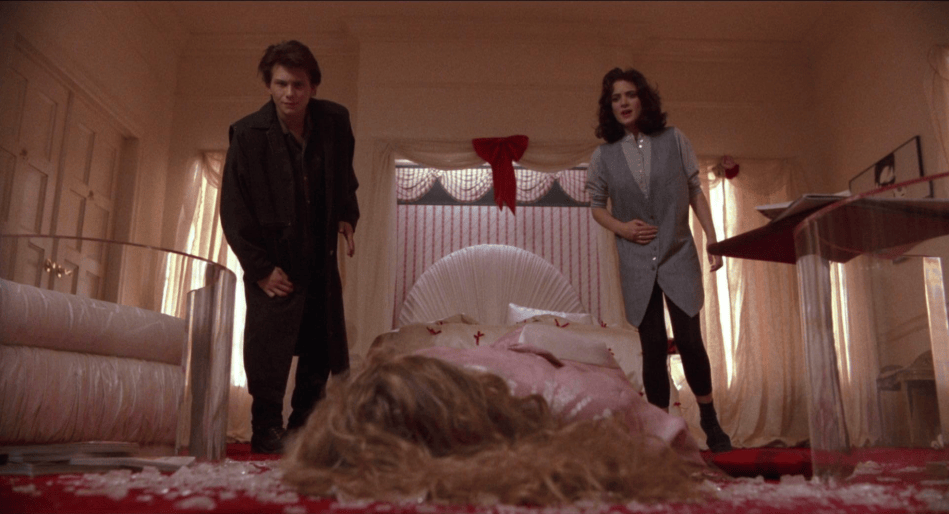
But during their post-coital bliss, J.D. encourages Veronica to strike at Heather before she can strike at her. The result is that the two accidentally (in Veronica’s case), but not accidentally (in J.D.’s case), give her nemesis a hangover cure laced with drain cleaner, causing her to splash down into a glass table, dead. Jumping ahead a little bit, similar circumstances leads to Veronica and J.D. offing Kurt and Ram, the two date-raping jocks. But having some dark fun by killing the popular kids, accidentally or otherwise, is only half the point of Heathers. A lot of the film’s satirical edge comes from having our transgressive couple cover up their deeds by forging suicide notes (in the case of the jocks, they frame them as closeted lovers). The irony being that the public now believes that these despicable teenagers were actually deep, thoughtful, tortured souls, making them not only more popular than before, but beloved, sending the whole school and community into a panicked state of mourning. People are now wondering, if the popular kids are doing it, does that mean suicide is “in” now? After all, there’s a new hit tune on the radio, soundtracking the events, with the memorable lines, “teenage suidice, don’t do it / teenage suicide, she blew it.”
One of the impressive tricks that Heathers pulls off is that it reaches such heights of irreverence while never coming across as being glib about the subject of teen suicide. The stylized world it creates is nevertheless recognizable enough as a place where authentic adolescent misery resides. It always reminds me of The Replacements in that way. They were a band that had built its foundation at the start of the 80s with genuine punk rock irreverence, with many a song about getting drunk, breaking traffic laws, hating school, needing a job, or requiring more cigarettes – but by 1987 Westerberg penned “The Ledge,” a cinematic, heartwrenching tune sung from the perspective of a suicidal kid planning to jump from a building. As the chorus goes, “I’m the boy they can’t ignore / For the first time in my life, I’m sure / All the love sent up high to pledge / Won’t reach the ledge”.
One of the disturbing things about the teenage brand of nihilism, is that it often carries with it at least a modicum of suicidal ideation. If you think life doesn’t have any inherent purpose or meaning, then it stands to reason you would hold your own life with the same regard – all the more so if you’re the perpetrator of extreme violence. You can argue that Heathers doesn’t really get that deep, but the ingredients are all there and it’s safe to say that it looks at the allure of nihilism and suicide with the same skewed eyes.
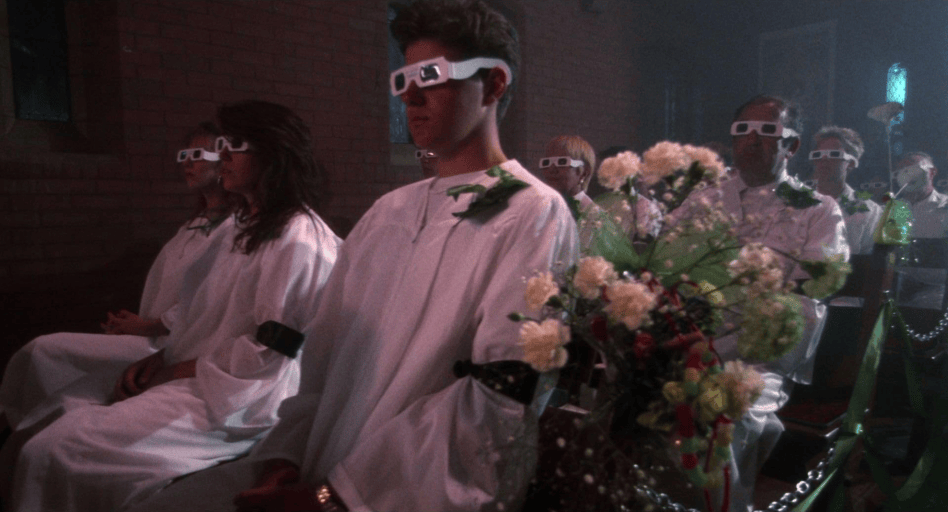
The best, most unexpected stuff in Heathers comes from the reaction of the adults in the community. As one teacher says to Veronica, with painful sincerity, “Whether to kill yourself or not is one of the most important decisions a teenager can make.” Painting the teachers, parents, and authorities as roundly oblivious, bad at their jobs, incapable of helping anyone, lends the satire in Heathers far more bite. The heightened reality doesn’t just extend beyond the kids, it becomes even more heightened, showing an entire community that is a dead end of self-centered indifference and hypocrisy. It doesn’t go so far as to directly blame the adults and the previous generation for what’s going on with the teenagers, but it does broaden the scope rather nicely. Even the local pastor is dramatically out of touch, using Heather #1’s funeral service to ask, when are the kids going to stop looking to “MTV video games” for answers and start getting in touch with that “righteous dude” Jesus?

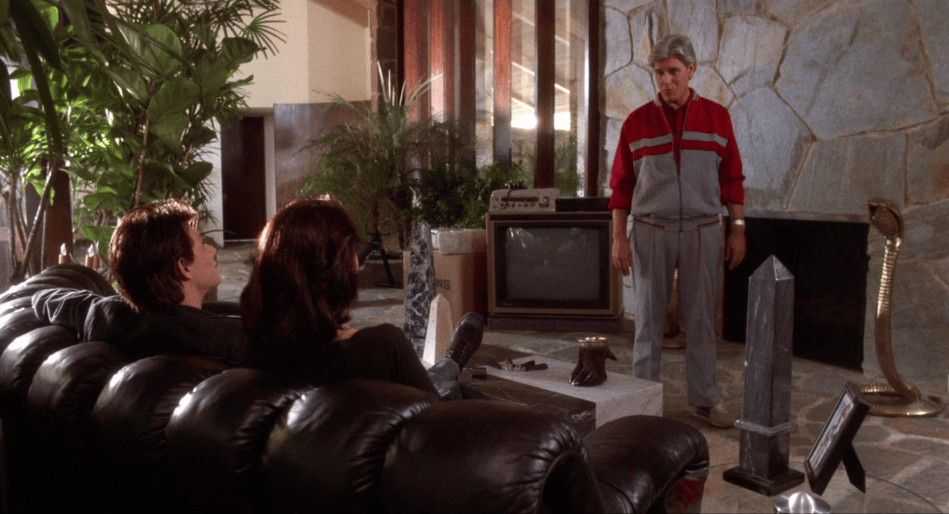
The peeks into Veronica and J.D.’s family life are, like the movie itself, funny and chilling at the same time. Veronica and her parents are stuck in a meaningless rinse-and-repeat conversational loop. J.D., who you might expect to come from the wrong side of the track – from a less privileged upbringing – actually has a rich dad who owns a construction company that is famous enough for Veronica to name it virtually unprompted. The conversations at his house are a game of switching roles, the dad asking, “Gosh, Pop, I almost forgot to introduce my girlfriend.” J.D.’s father is a vulgar, sadistic capitalist, happily kicking people out of their buildings and practically drooling over videotapes of demolitions. In a telling moment about who J.D. really is, when Veronica asks him if he likes his father, he admits that he hasn’t given the matter much thought.
While I admire Heathers for being that rare 80s teen comedy with a strong central female character, and one that even passes the Bechdel Test, I find the character of J.D. the most interesting of the bunch, and not just because he so perfectly represents the unknowing vagaries of the teenage nihilist. Yes, he’s got the kind of mysterious background that could spawn reams of fan fiction, but what’s really impressive is how much of a homicidal psychopath he turns out to be, and how tricky it is to parse out his motivations. After the deaths of Kurt and Ram, when Veronica’s finally had enough of his lies and manipulations, J.D. quickly turns Fatal Attraction – becoming a violent, pushy, scheming, vengeful jilted lover. It’s not entirely clear if Veronica dumping him is what sets him off on his final plan – to blow up the school after getting all the students to unwittingly sign a mass suicide note – nor is it clear exactly why he would want to go from killing bullies and date rapists to killing everyone in the school.
The closest motivation we get is that J.D. sees the potential of creating, as he puts it, a Woodstock for the 80s, a generational event where people will see that it’s not just kids who are self-destructing, but society itself. He also says he’s doing it because no one ever loved him, which pops up like a red flag causing you to wonder if anything he’s saying, as he desperately tries to prevent Veronica from foiling his plan, is actually truthful or just more bullshit. Again, it leads to thoughts of real world school shootings and teenage violence where rationality takes a backseat to the underdeveloped, hormone-drenched psyche of the highschooler – one that is both unpredictable in its apocalyptic intensities and intimately familiar to anyone who’s lived through the loneliness and longings of their own adolescence.
Even though Heathers was an independent picture, coming from Cinemarque and New World Pictures, the producers were antsy enough not to go with the original ending, in which Veronica unloads a gun into J.D., who dies in the boiler room. She then steps outside the school wearing the bomb and blows herself up to “clean the slate.” Then, her and J.D. are reunited with their victims at a heaven-set prom where all kinds of kids are dancing happily together – geeks, jocks, and mean girls alike – a callback to J.D.’s assertion that heaven is the only place where different people would get along.
It’s easy to be overoptimistic when fantasizing about unseen alternate endings, but the one we have, with J.D. committing suicide in a crucifixion pose and Veronica becoming “the new sheriff” in town, never really felt like the right one. Both Waters and Lehmann have admitted to this being an imperfect compromise (there’s a nice little Zoom discussion about it here) but what they don’t seem to realize is that while the ending may be happier, it’s also more irresponsible – and not in a meaningfully transgressive way, either. It’s telling us that J.D. was still alive with the bomb in the boiler room, and could have set it off and blown up the school but he suddenly decided not to. And what’s being said if we’re allowing J.D. this redemptive moment and sending him off in a Christ-like fashion?
Waters has also talked about how the inspiration for Heathers came when he had the idea of, what if a teenage girl met the antichrist? J.D. often has this sort of devilish vibe to him. He’s the nihilistic dark angel on your shoulder, appearing when you’re most vulnerable and hyping all your darkest urges. But at a certain point in the movie (for me it’s when he starts forcing himself on Veronica when she’s trying to leave his home) this devil becomes purposefully irredeemable, an unappealing bully in his own right. That’s a big part of the movie. The mask falls off and the devil is revealed. So the redemptive ending doesn’t work. To make it sensible at all, you’d need to go back and change the other parts of the film that are pointing to J.D. dying in the boiler room. But perhaps more importantly, the redemptive ending opens the door for J.D. to be a more sympathetic, martyred character than he has any right to be. The proper send-off for J.D. was the moment after Veronica tells him the truth, that he’s not “cool,” he’s a “fucking psycho.”
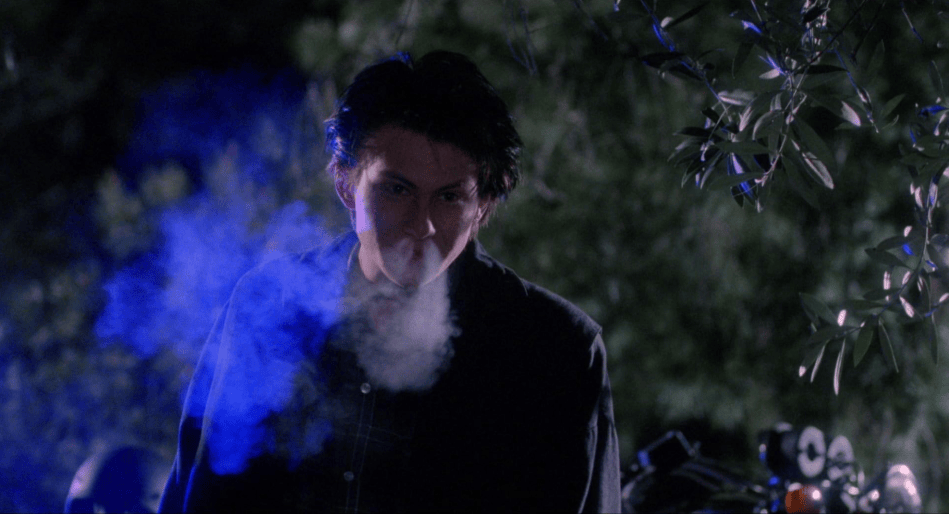
Of course, both Waters and Lehmann are well aware of the disturbing similarities between J.D. and the Trenchcoat Mafia. They believed they were making a movie so outlandish and unreal that it could never be taken seriously. But movies always have a life of their own, and it’s safe to say that the filmmakers underestimated the power of their charismatic, nihilistic antihero. Much in the same way that none of the filmmakers behind 1983’s Scarface would have predicted that Al Pacino’s grotesque, over-the-top Tony Montana would be considered a hero to certain folks – but here we are. As odd as the hero-worship of Scarface may be, you can’t accuse Brian De Palma of betraying the character by giving Tony a last minute moment at the redeemer. It’s worth noting that while Heathers did find a second life as a successful musical (with a significantly changed story), the attempt to reboot it as a television show in 2017 was aborted after more school shootings kept the pilot episode from ever being aired.
The ending is a big problem, but if we put it aside, the character of J.D. is transgressive in the right ways. The filmmakers are perhaps right in thinking they were making a character that was unrealistic and outlandish is the way he (and everyone else in the movie) talks, but that is also what makes his unique brand of teenage nihilism all the more appealing to Veronica and the viewer. There were plenty of cynical bad boys in movies over the years. On a surface level, J.D. isn’t that different from John Bender, the rebellious hunk played by Judd Nelson in The Breakfast Club, or even some of the delinquent kids in River’s Edge. But in all the important ways, J.D. is practically an inverse of the stereotype. He’s an eloquent, moneyed, smooth and charming devil, all of which makes him a far more broadly appealing version of the teenage nihilist than we’d seen before. Sure, the kids in Rock n’ Roll High School and Over the Edge also wanted to blow up their school, but none of them were so seductive as J.D. And that, I think, was the point all along: the devil is a seducer, beware.

I don’t know if it’s accurate to say that the Gen X era was making nihilism more attractive. Guys like James Dean and Marlon Brando had already appealed pretty strongly to previous generations. I do know that I unabashedly loved Heathers when I was a teenager. And even though I can see some flaws now, its success remains as it was intended: partly as a cultural statement but more as the anti-John Hughes movie. It’s fair to say that Sixteen Candles, Pretty in Pink, The Breakfast Club, and Heathers are all Gen X movies. But if Gen X has a particular cultural sensibility, it must be closer to Heathers than John Hughes. Certainly, Hughes left his own sizable impact on the generation. He ran the table in the 80s as far as teen movies were concerned. But by the end of the decade a lot of those movies felt far less “real” than Heathers, a movie which could be accurately called anti-realist, filled with people talking in ways no humans talk.
To put it another way, in 1989, John Hughes was no longer cool. The ending of Pretty in Pink, with the working-class Andie walking into the sunset with rich kid Blane, was one of the defining cinematic crimes of the 80s – and, if you’re feeling hyperbolic enough, could be seen as representing everything that had gone wrong in the decade, and certainly far worse than the punches that were pulled in Heathers’ ending. Veronica’s teen angst had a body count while Hughes’s angst had increasingly focused on upper class concerns of very little consequence. J.D.’s nihilism does provide a lot of what made Heathers cool and different at the time, but I’d like to think that it was just as much about the darkly ironic, satirical tone that made it special.
With its embrace of stylistic artificiality to get its point across, Heathers was a gateway movie for me into the postmodern sensibility that would come to feature in a lot of 90s films. The fullness of the world it creates and all its hypocritical absurdities makes Heathers a fine first step towards the movies of John Waters (don’t worry, we’ll get to him!). At the very least, it made Cry-Baby, which came out just one year later, seem like a very natural progression for my developing cinematic sensibilities. But the 90s was really a decade full of stylization, a time when realism was put on the back burner in favor of a more dynamic approach to filmmaking. It was a decade when a postmodern approach would find mainstream traction.
It’s also a decade that will continue to wrestle with nihilistic violence and what’s “cool” and what’s not in different ways, and we’ll get to plenty of those movies. But in the next installment, we’re going to go full postmodern with a look at a trilogy that will take us out of adolescence and into the harsh realities of the job market.
Discover more from Cineccentric
Subscribe to get the latest posts sent to your email.


0 comments on “Latchkey Cinema – Teenage Nihilism (ft. Heathers)”