

From the moment that Onslaught begins, those familiar with the works of director John Carpenter will know what Onslaught’s director Adam Wingard is after. Using the Albertus font that Carpenter’s films became known for, a synthy score, and soon revealing itself to be about government corruption and a group of outsiders having to fight for their lives, Onslaught wears its Carpenter influence on its sleeves. True to that, it is all centered on a “Hawksian woman”, an element Carpenter himself was influenced by in the works of Howard Hawks, a tough-talking woman in a traditional man’s world. Wingard’s Celeste (Adria Arjona) fits the bill. An ex-Army sniper who now works as a site manager at a trailer park, Celeste gets her hands dirty fixing up anything that goes wrong at the park, while spending her days shooting guns, reminiscing on her time in the Army, and bantering with fellow ex-soldier and trailer park resident Josiah (Reginald VelJohnson). She is tough and not about to back down from a fight, even one as formidable as is offered in Onslaught.
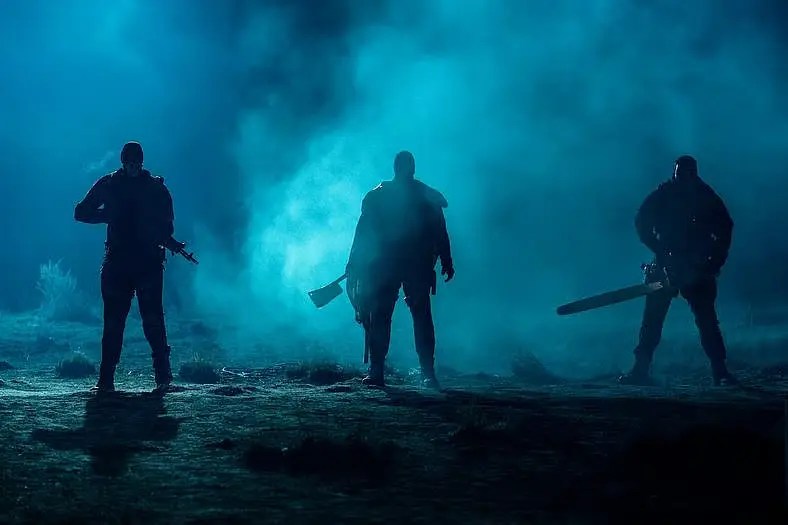
The conceit is simple. Dr. Hans Kimmler (Dan Stevens) has been working at a remote New Mexico research facility to create super soldiers who will kill until there is nothing left to be killed. Stevens has cited his performance in Cuckoo as an influence on this, and it is deeply felt in how weird Kimmler gets. His work finds him transforming real soldiers who appeared to be killed in action but miraculously survived or were revived into supersoldiers. Kimmler and his team have prepared three prototypes and are ready to showcase them to the company official bankrolling their operation. After the three supersoldiers lay waste to the platoon of Army soldiers brought to the showcase, they move onto the doctors themselves and, soon, break containment and wander out into the New Mexico desert, headed straight to Celeste’s trailer park. One can think of Carpenter’s Assault on Precinct 13 as a direct influence, while Onslaught visually recreates shots from films like The Fog with these supersoldiers and their glowing eyes while their bodies are backlit by blue, smoky fog. As a fan of Carpenter, it is hard not be swept away by some of this pastiche as Wingard knows the beats, machinations, and feelings of watching a classic 80s B-movie and is able to create Onslaught firmly in that style.
Onslaught looks great. The cinematography from Oren Soffer is excellent. The aforementioned The Fog-esque scene is a real highlight. There is an awesome shot of a truck that the supersoldiers hijack, framed from the spiked tires as they roll on the road with this steadicam shot providing a menacing aura. As the supersoldiers are unleashed on this remote city, they embark towards a truck stop and the green and red overhead lights at the convenience store and gas tanks set against the dark, desert night around them makes for a striking visual. This is a beautifully lit film with great compositions, highlighted by a scene such as one in the climax, a close-up on Arjona as she revs a chainsaw, shot in a slight oblique and low-angle. The angle provides an intensity to Arjona, one her rough-and-tumble delivery amplifies, and the complement of a revving chainsaw sets the moment as properly badass and exciting. Wingard knows how to create a mood and Soffer’s cinematography is crucial to this. The synthy score from Matt Pusti is a total vibe, matching the influence to a tee and providing a nervy and intense backdrop punctuated by great, vibrating, and immersive sound effects.
Unfortunately, Onslaught has little else to offer. Thematically, Onslaught is inert. It waves its hand in the direction of government corruption, research run amuck, the ongoing impact of “Operation Paperclip” and Nazi scientists, and the mistreatment of military personnel and veterans, but has very little to say if anything. It is all window dressing, never diving into any of these topics with any intention or detail. It is here that the emptiness of its pastiche is highlighted. Onslaught is entirely about looks and feeling. It is not about themes or characters. While Carpenter’s films often looked and sounded great, there was something else beneath the surface. There were rich characterizations and nerve wracking commentaries on our own world brought to life. Once one gets the gist of Wingard’s angle here, Onslaught has little to offer.
Frequently, Onslaught returns to stories Celeste tells about her time in the Army, most notably her involvement in an amateur boxing match with a fellow soldier. It reads as a thematic wave towards commenting on toxic and fragile masculinity, but is also nonsensically looped into the creation of the supersoldiers. It is all too neat and tidy, trying to add in an additional personal angle when the need to kill these supersoldiers in order to stay alive and to save her daughter is more than enough motivation for Celeste in the climax. As Onslaught hypes up the reveal and connection, one badly wants to be wrong about where this foreshadowing is headed only for Onslaught to lean all the way in and feel rather insulting.
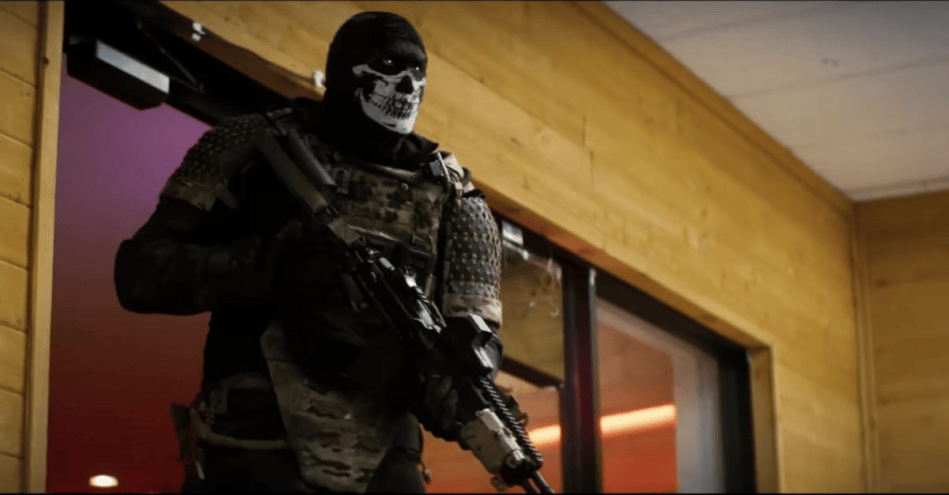
In general, Onslaught is strangely unwilling to confront the nasty implications of its world. This is a world where the government has created supersoldiers and is willing to let them be tested on the populace once they escape a government facility. Yet, in the end, government agent Cyrus (Drew Starkey) is there to offer advice to Celeste on how she can escape this without any issues – he was not so kind previously to the survivors of a truck stop attack by the supersoldiers – and while the ending heavily implies added surveillance on survivors, this is a dark and twisted tale that mostly lets its characters walk away unscathed, even one who was presumably left for dead and is revealed to have miraculously survived. This squeamishness towards embracing its implications leaves the few thematic threads Onslaught tried to develop even more undercooked. This film needs a nastier edge and as it barrels towards its high-octane final act, ending in such a way feels anticlimactic. The battle was not as great or as formidable as was it was made to seem in the prior two acts, the supersoldiers feeling more like empty aura and the government presence leaning towards just being kooky, distant, and fetishistic – Kammler and his wife Hanna (Rebecca Hall) are introduced via Kammler’s foot fetish, while Cyrus is introduced at a BDSM club – without much teeth.
Set in the same world as Adam Wingard’s prior film The Guest, Onslaught lacks the same intensity and punch. The Guest was violent, thoughtful, and exciting with a great cast and a stylistic flair that exceeded pastiche into being its own thing. Onslaught never escapes the feeling of empty imitation, embodying every element of a John Carpenter film that Wingard can include, but none of the heart and soul. It is all surface-level with poor characterizations, undercooked themes, and a climax that never embraces the nasty implications upon which Onslaught is built. Even though Adria Arjona is suitably badass as the protagonist Celeste and despite its strong cinematography, score, and sound, Onslaught never escapes the shadow of its influences.
Discover more from Cineccentric
Subscribe to get the latest posts sent to your email.


0 comments on “Onslaught ★★½”