

It’s the middle of the Great Depression. Samuel Murphy (Ethan Hawke) is a widowed father raising his daughter Penny (Avy Berry). The two share enough grit and spunk to counter the hardness of the times, The Weight opening with Murphy driving fast on a dirt road being chased by the police. Murphy vows never to be caught, and Penny encourages him to drive faster, embracing the thrills to be found in Murphy’s livelihood. The two share a close bond, Murphy enamored and protective as a father while Penny observes Murphy’s gritty demeanor and schemes, even providing him with her witty two cents on how to pull off a scam. It might be the Depression, but the two have each other.
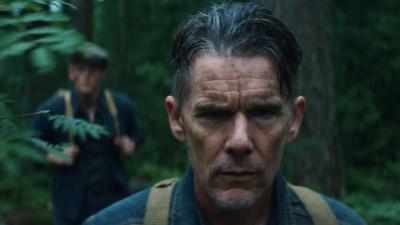
The rush and thrill of their lives is disrupted after they are evicted from their home, and Murphy gets into a tangle that lands him in a prison labor camp and Penny as a ward of the state, separating the two and changing the trajectory of each of their lives. At the labor camp, Murphy is tasked with clearing out rocky terrain where a road will be placed. Amongst his fellow inmates, Murphy is the most clever and he earns their trust and admiration through their work together. This is quickly noticed by Warden Clancy (Russell Crowe) who comes to Murphy with a proposition: lead a team of inmates to transport gold from a private gold mine before it is confiscated in exchange for his freedom and reunion with his daughter (by an executive order from President Franklin D. Roosevelt, gold is to be confiscated to prevent hoarding and combat deflation during the Depression).
Murphy chooses Olson (Lucas Lynggaard Tønnesen), Rankin (Austin Amelio), and Singh (Avi Nash) to accompany him, and two men from the gold mine join them to supervise their journey. Each of Murphy’s fellow inmates represents a minority or an outsider, this idea reinforced as Anna (Julia Jones), an Indigenous runaway, joins them. It is their gruelling effort to transfer 40 gold bars – each weighing over 27 lbs – across 100 miles of Oregon wilderness that will ultimately enrich the operators of the gold mine while their lives are placed at risk in their journey. Screenwriters Matthew Booi and Shelby Gaines make it clear through interactions between the inmates and the two men from the gold mine that the lives of the inmates are viewed as expendable. They traverse through vast terrain, battling the elements, precarious heights, and the threat of greed and betrayal that could surface when transporting such valuable cargo. Murphy is determined to transport the gold safely and be reunited with his daughter, but as he and his companions approach their destination he starts to come to the realization of what could happen to them at the end of their journey.
First-time film director Padraic McKinley, who got his start as an editor, first collaborated with Ethan Hawke on Hawke’s The Good Lord Bird, The Weight continuing their collaboration. It comes at little surprise that a strength of The Weight comes from its editing. In the survival genre, skillful editing is important for maintaining a high level of tension and McKinley excels as an editor here along with co-editor Matthew Woolley. The Weight’s survival sequences are harrowing, and the danger that Murphy and his men face is readily apparent. Matteo Cocco’s cinematography is also a standout, filming both in tight quarters in the forest and above through aerial shots that show just how vast the expanse of woods is the characters have to travel through. His camerawork also becomes a valuable source of closure through opening and closing shots of The Weight that parallel each other.
Where the film struggles, however, is in its character development. Murphy’s fellow inmates are primarily symbolic rather than fully-formed characters. They each have core attributes – Anna as an Indigenous woman runaway, Singh as an immigrant who favors socialism as opposed to capitalism – that attempt to convey information about their lived experiences and beliefs, but they are not granted enough personal traits to elevate themselves as individual characters rather than being representative of a class of people or an idea. While themes such as capitalism versus socialism are greatly relevant to The Weight and its Depression setting, the commentary the film provides is fairly shallow. And contrary to great performances lifting a film, Ethan Hawke and Russell Crowe are immensely captivating, but ultimately at the expense of the film’s secondary characters as Hawke and Crowe’s characters draw our attention in rather than lead us to explore the themes relevant to The Weight’s secondary characters.
With the title The Weight, McKinley’s film carries with it expectations in terms of its thematic heft and intensity. In a genre with standouts such as The Revenant and Sorcerer, it’s an uphill battle for a film to distinguish itself, and while The Weight illustrates technical filmmaking prowess, Padraic McKinley’s film also carries with it the predictability and unevenness that often comes with a debut film.
Discover more from Cineccentric
Subscribe to get the latest posts sent to your email.
 Cineccentric
0 comments on “The Weight ★★½”