
A year ago, Kathryn Bigelow entered the Venice competition with her apocalyptic atomic strike thriller A House of Dynamite; a nerve-wracking what-if scenario about the USA reacting to a nuclear attack of unknown origin, the formal mastery of which contrasted starkly with its highly problematic ideological implications. Now first-time director Alexandre Smia brings a European take on a strikingly similar scenario to the same festival, though his chamber play about a newly elected French president facing a nuclear crisis is screening out of competition. This is only apt given the in every sense smaller frame of the French follow-up that’s interesting at best as a polar opposite to Bigelow’s blockbuster.
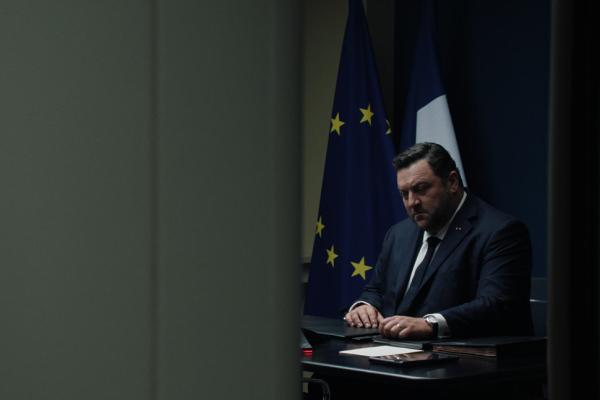
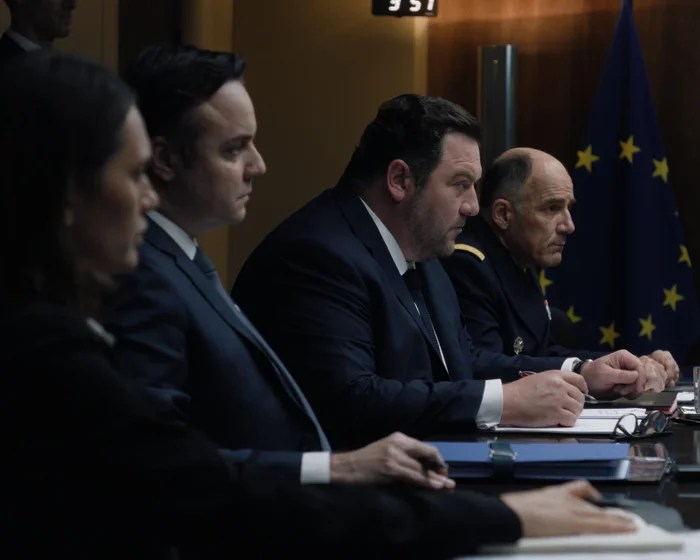
While the latter assembled an all-star cast, Smia has to content himself with Denis Ménochet in the leading role of fictional French head of state Paul Archambault. Only weeks after his election, he is rushed to the titular command room beneath the Élysée Palace where an assassination attempt against the Russian president is on the brink of escalating into nuclear warfare. Co-writing with Thomas Finkielkraut, Smia concentrates the approaching armageddon which Bigelow spread out over multiple distinctly different locations, to the bureaucratic center of power. The H-bomb is just an apocalyptic abstract evoked by those in charge of its potential release. Telephone calls, computer screens, briefings, and heated discussions postulate its theoretical threat.
This minimalist move is first and foremost a necessity, given the considerably smaller budget. But director-writer Smia fails to turn the restrictions into an advantage. The bunker where the major part of the events plays out becomes an unintentional symbol of the story’s narrative limitations. While the clock is supposedly ticking, the characters circle in endless discussions about the same questions regarding moral and militaristic imperatives, and World War III as the worst-case scenario. Little happens in the conventional cinematic sense, and with next to no character development, the situation stalls before ever picking up pace. The destructive danger fails to become more than a cinematic construct, lacking any palpable sense of dread.
At the center, Ménochet’s Archambault and his colleagues perpetuate the cinematic myth of white male conservative competence. Everyone always acts in the best interest of humanity, with every trace of fanaticism and fundamentalism delegated to the adversarial side of a Putin-stand-in. His Eurocentric opponents, however, are infallibly guided by their moral conscience. In an era of omnipresent right-wing rhetoric and populist paranoia, such idealistic image-making seems as dramatically detached as it is delusional. A fictionalized version of the Russia–Ukraine conflict only underscores the script’s inept integration of actual geopolitical events. What its director has described as an “autopsy of power” is little more than a derivative demonstration of patriotic pathos.
No sense of urgency undercuts the bureaucratic boredom stifling any suspense. At odds with the crisis’ global scale, the condensed cinematic formation fails to effectively convey the weight of every word uttered under these circumstances. Jupiter’s perfunctory paradox is that its subject is geopolitical while its visual language remains resolutely architectural. Nicolas Loir’s conventional cinematography watches the characters trying to look important when walking down narrow corridors and debating in subterranean conference rooms. But this generic grammar of claustrophobia can’t generate genuine atmosphere. One almost wishes the ensemble of papier-mâché politicians would finally push the button, just to have anything happen at all or at least escape this bloated TV feature.
Discover more from Cineccentric
Subscribe to get the latest posts sent to your email.


0 comments on “Jupiter ★½”