
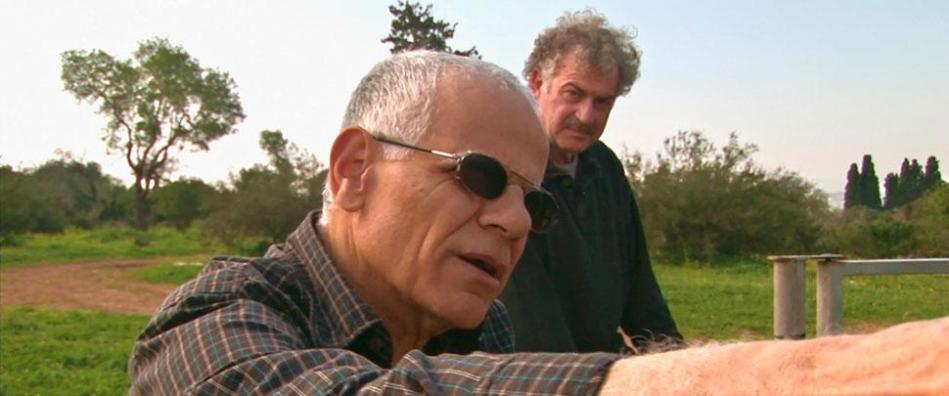
At a little under half an hour’s runtime, Avi Mograbi‘s documentarist meditation carries the weight of a historic chronicle of forceful erasure and the determined persistence of life. Set in a landscape haunted by the ghosts of a past that has supposedly been scrapped from it, the unassuming account of two elderly friends on a long walk weaves memory and trauma, war and friendship, into a cinematic exploration of individual and historic identity. Accompanied by his Arabic teacher and friend Ali Al-Azhari, the Israeli filmmaker goes in search of the destroyed Palestinian village of Saffuriya from which Al-Azhari was expelled during the 1948 Nakba.
During the conflict surrounding the founding of the State of Israel, in the years from 1947 to 1949, around 15,000 Palestinians were killed and more than 750,000 displaced and dispossessed. One of them was Al-Azhari, whose return to the scenic spot carries a palpable melancholic air. Mograbi, on the other hand, seems in much better spirits, joking and doing most of the talking to the point where his musings border on a monologue. It’s easy for him to speak, since there is nothing around them to remind him of the terror and loss Al-Azhari and his people went through. Every last remnant of the village has been destroyed and even its ruins removed.
This total annihilation turns the fields into an uncanny allegory of the genocide against the Palestinians by Israel that’s happening as they revisit an earlier stage of the conflict. Now, only weeds and a few trees grow there, and among them “Halayon”. The documentary’s original title is the Arabic word for wild asparagus, on which Mograbi starts to snack. On the surface, the metaphor at the heart of his cinematic sketch sees the Palestinians as the plant thriving despite adversarial conditions, while the village’s destruction represents the attempted obliteration of the Palestinian people. It’s rather on the nose, despite its poetic touch.
However, a little less obvious is another unintentional allegory. Mograbi munches away on the wild asparagus, while Al-Azhari doesn’t even want to taste it, regardless of his friend’s constant urging. The suffering of generations, the brutal colonization of a people, the personal loss of someone Mograbi apparently considers a friend – all this is just food for his directorial work. Its latest output is ironically wholly centered around him and his own experience, regardless of its compassionate gestures. According to him, the project was assembled from footage from his 2012 film Once I Entered a Garden. Its disregard for the changed political context makes its opportunism the hidden story.
Discover more from Cineccentric
Subscribe to get the latest posts sent to your email.


0 comments on “Wild Asparagus (short film) ★★½”