

Director Alejandro G. Iñárritu’s Digger is an audacious film. It is a true original, a film that has immediately divided audiences and critics alike upon its release. It is not hard to understand why with Iñárritu making numerous bold creative decisions throughout, adding layer-upon-layer to its initial setup and making multiple hard left-turns in developments that are best left unspoiled. Digger starts off following Digger Rockwell (Tom Cruise), the inheritor of a multi-generational oil company, who has continued to grow his grandfather’s company and expanded their drilling operations to risky sites in Antarctica and Greenland. Receiving a call from the latter, Digger is warned about a crack in the ice shelf that is growing, a warning he did not heed before and moments after signing off from the call, he learns that the oil rig has exploded and the ice shelf has broken off. Now, a gigantic glacier is hurtling towards Europe.

One comes into Digger with the expectation that this is a modern Dr. Strangelove-esque look at climate change. To some extent, it is this with many of the characters in Digger standing as satirical and comically heightened versions of the politicians, businessmen, and grifters who have led our society towards this global climate change. Digger is filled with the double-dealing, corruption, and incompetence that one can see on the news today. These larger-than-life buffoons who play fast-and-loose with the immense responsibilities they have in order to make money for themselves are right at the center of everything that goes wrong in the world of Digger. However, Iñárritu has more up his sleeve. As Digger twists and turns, one can feel influence from Charlie Kaufman, François Truffaut, Federico Fellini, and Alfonso Cuarón. The film grows into being more of a study of satire, a satire of satires, a deconstruction of art, and examination of art’s role as escapism from the world and its ills. There is a great monologue delivered by Jesse Plemons towards the end of Digger that centers some of its larger discussions, examining art’s role in our world for financiers, artists, and audience alike. It is a chance to disappear and forget about the troubles, a quality that one can easily see films lean into a “magic of cinema” celebration, but one that Digger plays more as a condemnation of our world. It is not a hate letter to cinema like some have heralded it as, but rather a desperate lamentation about art’s role as dopamine for the masses while the world is swindled away from them by those in power and our own inaction. It holds up a mirror to the audience, showing ourselves, the cast, and crew alike as more after comfort and peace of mind, empty catharsis and easy laughs, and playing to the end like the band in Titanic. Its final shots cement Digger as a truly brilliant deconstruction of the form and society, showing a society more apt to consume history than to reckon with its present and future.
It is a challenge to discuss Digger without giving away the game. Digger is a tough film to settle into initially with the over-the-top performances, chaotic mise-en-scène, loud and almost echoy sound design, and a ridiculous on-the-nose and juvenile script making for an abrasive experience that feels like an assault to the senses. Digger will slip into these moments throughout, but as they fall into context, what Iñárritu is after becomes clear. As it sets up early on, Digger is part of the task force set up by President Compson (John Goodman), a sleepy, dying, and malevolently incompetent man, to help address the ice shelf problem. Naturally, their options and decisions are ludicrous, delivering laughs from their irrational ideas and reactions. They deny science and charge into battle, deciding whether to bomb the ice shelf or to just use AI to wage war online to shift blame to other parties. Digger is not exclusively about what these characters are talking about – though much of the discussion will ring true – rather it is about these events’ fallout, what these characters are bringing with them to the screen (past trauma and current stress, especially), and what drama is occurring outside of the context of Digger’s work around the ice shelf. There are more layers to Digger than it first hints at, making this a film that grows in esteem and estimation as it wears on and as one sits with the film in its aftermath. It truly builds minute-by-minute, reveal-by-reveal, and character-by-character, unfolding in a very precise and thoughtful manner. It is in its full breadth that one really appreciates and can be swept away by what Iñárritu has created.
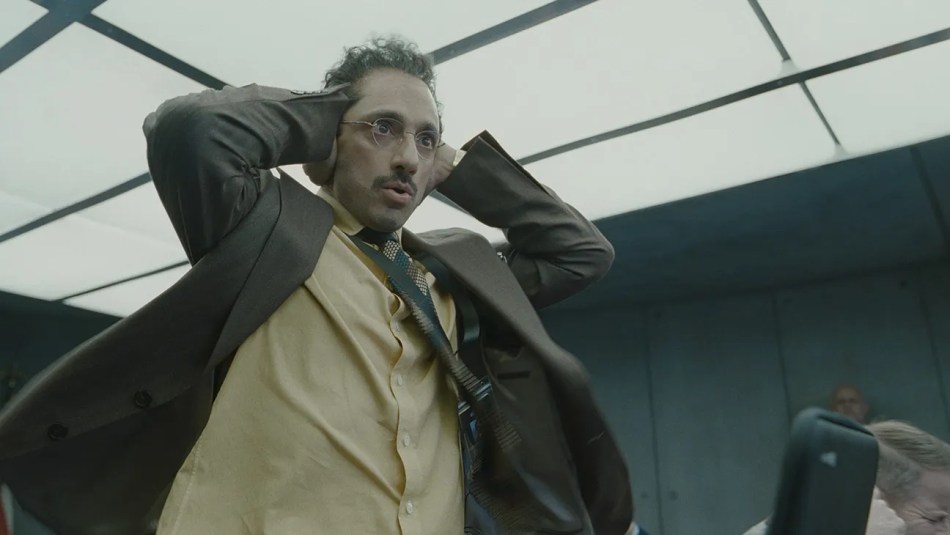
One’s perception of the cast’s performances also shifts with Digger’s numerous angles. They can be rough, too theatrical, and abrasive at first, but in time, the performance smooth out and the intentions become clear. Riz Ahmed, Jesse Plemons, and John Goodman particularly impress among the supporting cast with Ahmed standing out. His drunk acting is great, but his great performance is in large part due to a scene on a plane as he tears down Digger for what he has done. It is a great, fiery explosion from the gut of Ahmed’s reserved Dr. Ganesh, one that Ahmed nails. The overall scene is one that feels like a distillation of what Digger is after. Some of it is that tear down of Digger, but the larger implications are based around Digger offering Ganesh a plate of tuna. Ganesh is a man with rigid moral compass – about the ice shelf, which he is an expert on, but also about this species of tuna that is about to go extinct, feeling that it is unethical to eat – until he sits back, listens to an elaborate story by Digger about where the tuna came from, and is entranced enough to immediately fold on his convictions to give into the fantasy sold to him by this powerful performer. The scene showcases the charisma of men like Digger, but it also showcases his audience’s gullibility and eventual culpability in destroying the future. Men like Ganesh believe themselves to be “better” for their morality, but still eat the tuna. Digger did not care about the tuna, he just wanted to consume it. Ganesh did care, he just needed a nudge to forgo the pretense.
However, this is Tom Cruise’s show. There is one scene in particular that stands out, set in the European Parliament as Digger and his actions before and after the ice shelf broke off coming under scrutiny. Digger takes ownership of and shows indifference towards his role in the disaster, but also points a finger at the world and society at-large. It is a brilliantly delivered monologue by Cruise, a great usage of his manic energy and larger-than-life persona, a performance of a true showman who knows how to work a crowd and make every word pop. There is a real energy to the scene, heightened by the great mise-en-scène as Digger’s podium spins around, as Digger wanders into the crowd and antagonizes them face-to-face (a George W. Bush-esque shoe throw is a moment of great comedy), and he is engulfed, via a great low-angle shot by cinematographer Emmanuel Lubezki, by the crowd. As the scene descends into violence and rage, Digger never yields and Cruise’s incisive delivery and strong physicality make it a hallmark of his career. There is a defiance to his words, a quality of indignation that he is being questioned at all when he perceives his role as one ordained by society. To some extent, this is a quality that Digger further comments on and satirizes with Digger’s story being an examination of older generations stripping the Earth for parts and leaving later generations to pick up the crumbs. In a larger part, it is the exact kind of pointing-at-the-audience moment that Digger is after. Men like Digger are to blame, but so is a society that stands by and watches them without taking action. He is a result of our society, one who is an open and honest demon we created and empowered to toil in the avenues the average person did not have the stomach for. It can be fun to watch them fall, like Digger is, due to his hubris but that catharsis is a distraction. The world he made still exists.
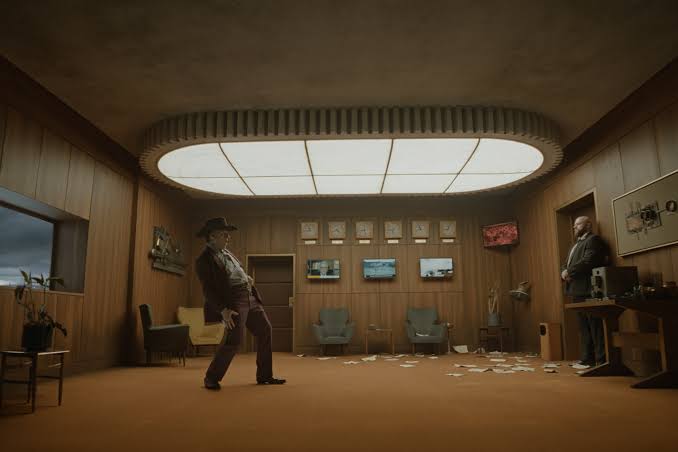
That courtroom scene is one real highlight of Lubezki’s work, though it is exemplary throughout. The final establishing shot is especially striking, a pan from a building to a flooded city street with the skyline in the background. It is a haunting and stirring image, a shot that fills one with dread. The overall production design is exceptional, playing into the angle that Iñárritu takes with a hyperreal look at times that nails the tonal tightrope Digger is walking. As it comes into context, the level of depth and detail in Digger’s sets come into focus. Items, tools, and adornments that seem innocuous and are presented as simply “being” with no attention called to them in the moment are real signs and elements of what has been wrought in Digger Rockwell’s world. A sound effect in the credits brings it all home, a brilliant final touch that solidifies Digger as a play about us, our world, and what ruins we are set to inherit. It is fascinating and richly textured with every detail adding to the horror and wonder of the film.
Digger plays like a warning from the future, a notice that our world is doomed and damned. It is bleak and cynical, a nightmare that feels as though it is flashing through society’s mind as it hurdles off a bridge to the water below. If one comes in with an open mind and a willingness to go where Alejandro G. Iñárritu’s imaginative and innovative film takes them, Digger can be an exceptional and wondrous experience or it can still be entirely off-putting. This is truly a film and experience that will come down to the individual viewer, a challenging film to recommend but one that is exactly the kind of film I want to see created. It is ludicrous and funny. It is bold and daring. It is exhilarating to think about and be challenged by a filmmaker in the way that Iñárritu challenges his audience. Maybe Digger is messy and scattered. But, it is not just empty ambition falling flat in self-indulgence and pretentiousness. There is a desperation and a bravery to it, a boldness that pays off as it builds like a tidal wave barrelling towards its nightmarish conclusion.
Discover more from Cineccentric
Subscribe to get the latest posts sent to your email.


0 comments on “Digger ★★★½”