
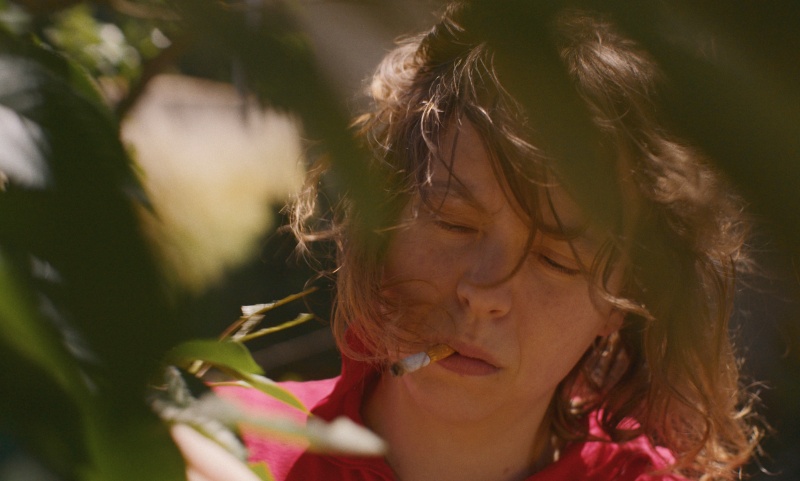
With the self-centered sophistication of a filmic family romance, Angelica Ruffier‘s debut documentary unearths supposedly forgotten feelings in the house where her brother and she spent part of their teenage years. The last of these becomes the titular time period; a formative moment, the emotional intensity and impact of which were blunted by the years. “The Beautiful Year,” to which the French original title translates, was marked by a sapphic infatuation with her schoolteacher Sylvie Bresson, but also fear of her father’s violent outbursts. After all, a bit of transgenerational trauma is almost obligatory in this newly emerged sub-genre of hybrid-documentary, or in Ruffier’s case, hybrid-drama. It effectively and a little too smoothly wraps an ordinary middle-class childhood in the stylish scenes of a melancholic memoir.
As such, the combination of autobiography, family history, and autofiction, inseparably intertwined into one narrative thread, undermines the empathic appeal of its – in a double sense – familiar story. It starts with the message of her father’s passing. After what were supposedly years of suffering his aggression, their mother moved to Sweden with Ruffier and her brother. The specifics of this whole episode, which could have been a normal, if overdue separation or the carefully planned escape from a dangerous man, remain unclear. The same goes for the nature and extent of her father’s violence towards their mother and his children. Considering her palpable keenness to be the center of cinematic attention and her intentional inclusion of fictional elements, the reality of her relationship with her father could be rather different than what is presented.
Only a black-and-white home video, an audio recording, and a few photographs give a vague idea of Ruffier’s father, whose estate functions as a doorway into the past. Like a personal time capsule, his cluttered house, which is now theirs, is filled with materialized memories: boxes full of children’s drawings, photo books, and her old diary, chronicling her crush on Ms. Bresson. Leo Svensson Sander’s theatrical score evokes the supposed suspense and, possibly, sensuality of Ruffier devouring the entries on her own teenage romance. Ironically, watching Ruffier absorbed in her own accounts of herself also fittingly represents the narcissistic tendencies of her concentric collage, resorting to fantasy whenever reality is too banal and boring.
As imaginary intimate moments between Ruffier and an eternally young Bresson suggest, this was often the case. Curiously, this peripheral aspect of reinvented bourgeois biographies appears more interesting and worthwhile than the dallying with a fictional lesbian love that makes queerness look like the puberty “phase” it was once commonly reduced to. While marginalized groups and underclass people are far less likely to have the means to get their stories out there, and if they do, they are all the more likely to be dismissed as “another misery memoir” (as one well-known film outlet phrased it). On the other hand, privileged film creators just spike the accumulation of privilege that brought them where they are, including the screen, with fabrications and are applauded.
However, critical self-reflection of any kind is absent in this elaborated excavation that culminates in the director positioning herself in the role of Delphine Seyrig in Harry Kümel‘s 1971 exploitation vampire cult film Daughters of Darkness, with Ms. Bresson – a history teacher, on top of it all – as her willing victim. In another unintended ironic touch, this association with a straight man’s commercial perspective on female queerness is apt for a work that feels thoroughly straight in its approach to sapphic desire as fictional spectacle. As such, the romantic pining after Ms. Bresson seems just a dramatic tool for another desire: that for audience attention and a rather calculated artistic image.
Discover more from Cineccentric
Subscribe to get the latest posts sent to your email.


0 comments on “La belle année (documentary) ★½”