

Yet another hybrid of fiction and documentary at the San Sebastián International Film Festival, María Aparicio‘s cinematic city tour through Madrid evolves into a visualised narration of the life of Juan Bialet Massé and the struggle of the workers’ rights movement. For the latter, the Catalan-Argentine intellectual became a pivotal figure as a pioneer of Argentine labour law. Though this is only one of the many facets in the busy biography of the physician, lawyer, agronomist, and entrepreneur whose so-called Bialet Massé Report of 1904 investigated and publicised the working classes’ cruel exploitation and harsh living conditions. Two representative Argentinian protagonists look for the traces of this remarkable personality in Madrid, where they meet at a museum.
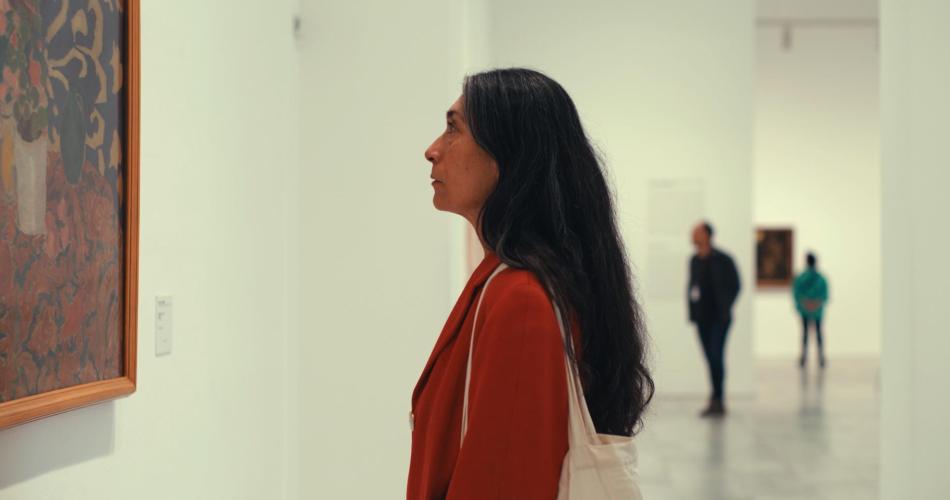
Serving as a literal and symbolic point of departure, the museum location also signals the director-writer’s educational intention though such signposting shouldn’t be necessary. The pedagogical inclinations are unmistakable in the intellectualist lesson that seems more eager to display Aparicio’s own dedication and education than to pass any of it on to the audience. Her story begins like a late-life romance movie with two Argentines meeting in Madrid’s Reina Sofía museum. Filmmaker Eva Bianco essentially plays herself as a director visiting the Spanish capital after attending a film festival in France. Without a set agenda, she ends up in the Reina Sofía where she meets Argentine historian Dante (Roger Koza).
His name gives an idea of the obvious references and winks littering the sparse storyline that mainly functions as a reference point for extensive dialogues and monologues about interlinking historical subjects. Dante is researching Juan Bialet Massé, whose report becomes the examinational essay’s historical and political axis. Through lugubrious conversations, the two recognise their shared interest in cinema, history, and politics, which might be the most common denominator of personal interests ever. Nevertheless, the pair is framed as intellectual exceptions among an apathetic majority. This view seems all the more biased and blasé as the events all but exclude the class that the two main characters and the whole film seem to be all about.
Eva and Dante walk around, catching glimpses of Madrid’s impressive architecture and sit down to monologise over certain issues. Though there is zero chemistry between them, one almost expects them to kiss out of pure cinematic convention. If Aparicio shuns the latter, it’s likely because she has a whole bunch of TED Talks to deliver. There is a place for those, but it’s not the cinema to which the director might have retreated because the outstretched conversations lack originality, dynamism, and most of all the titular rebellion. Every scene appears to be designed to show how cerebral everyone involved is, to a degree that the supposed subject becomes secondary as a tool of intellectualist image-making.
Bianco seems on a self-promotion journey while film critic Roger Koza‘s lack of acting skills further undermines the scenario’s credibility. Any attempts to move the debate of labour exploitation from more than a century ago towards the present remain an empty gesture. With all its supposed concern for labour conditions from another century, the didactic debate stays apathetic to present-day labour conditions, where the gig industry erodes labour laws while freelancing and self-employment leave people without financial security and stable work conditions, always dependent on their next assignment. There’s a bitter and somewhat infuriating irony in watching two privileged people on a tourist vacation boasting their humanist concerns with a working class they’re utterly detached from, while not even acknowledging the existence of an underclass.
This distance is unintentionally underlined by Ezequiel Salinas’ picture-perfect postcard cinematography, giving museums and street cafés a trendy, edgy flair. Obviously positioned to present their exchange of scripted ideas, the characters’ stilted performance of spontaneity becomes an awkward disguise for their political research as academicist consumption. When workers and migrants are cued in to say a few sentences, it’s too little, too late in this decidedly elitist exercise in intellectual ignorance.
Discover more from Cineccentric
Subscribe to get the latest posts sent to your email.


0 comments on “Sometimes Happy, Sometimes Rebellion (documentary) ★½”