
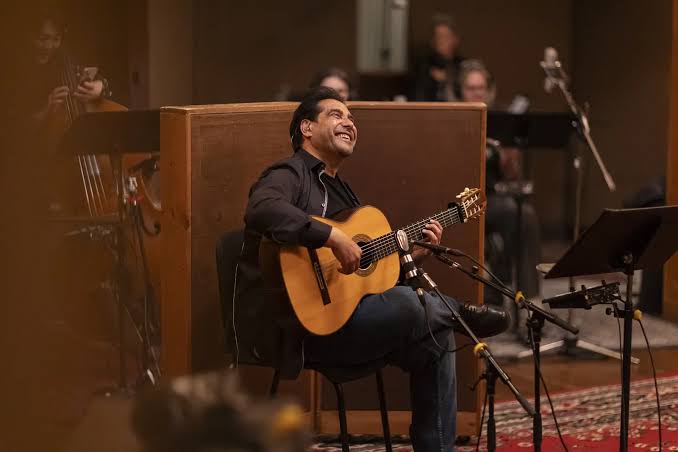
It’s odd for a theatrical film to not truly require any moving images. But this is the case with Fernando Trueba‘s intuitive documentary on one of Spain’s nostalgically distinctive musical styles and its interpreters. Part concert film, part monograph, part homage, Bajañí allows its audience to succumb to the sounds and rhythm of the titular instrument. Bajañí means “guitar” in Caló, the traditional language of the Romani people in Spain and Portugal. It’s a fitting title, corresponding to the formal simplicity and acoustic flow of the scenes, effectively listening to the guitar songs and singing of flamenco guitarist Niño Josele.
His interpretations of traditional and original songs create a musical relief connecting flamenco, jazz, and Brazilian music, bringing him into dialogue with figures including Caetano Veloso, Ron Carter, Rubén Blades, Kenny Barron, and Marisa Monte. Each ballad is framed as a personal encounter with the artist, sitting close to the camera which studies his every move. Josele’s musical journey is sketched out in biographical vignettes. Trueba’s “cinema in the service of music,” as he described his project at San Sebastián where it premiered out of competition, makes the construction and definition of images through sound its formal principle.
To keep the 112-minute running time from being too monotonous, the director pairs Josele with musicians of distinctively different styles and traditions. Their performances appear as a form of wordless conversation, creating new harmonies out of individual variations. Still, over time the picturesque playlist becomes involuntarily somewhat monotonous for those who are not die-hard fans of Josele and his songs. Cinematographers Raúl Azuara, Lula Cerri, Juan Fernández, and Fernando Young do their best to inject some visual vibrancy into the sets, playing with lighting, theatrics, and color schemes. The result is reminiscent of a patriarchal prototype of music videos, driven by a curious idolatry that lacks historical awareness.
Not even a trace of criticism is allowed in this document of devotion from which women seem tellingly absent. As the male singers listen to and applaud one another, an air of self-congratulatory smugness undermines the aestheticized atmosphere. The discrimination, cultural eradication, and persecution Romani people have faced throughout history give the songs an element of resilience and rebellion, regardless of their specific lyrics and composers. But without sufficient contextual information, these aspects are easily lost, reducing a rich cultural tradition to something decorative. This stylization underlines the deliberately imperfect, taking suggestion, rhythmic intuition, and impulsive inspiration. Spontaneity becomes a carefully calibrated gloss on Josele’s cinematic and commercial image.
Monographic interludes and a bit of black-and-white archival footage replace the conventional grammar of concert films with another, equally conformist optic. At almost two hours, Bajañí is a special kind of fan service, struggling to find deeper meaning in the pleasant catalogue of songs. It’s a documentary of one filmmaker’s admiration for another artist, as much as it is a filmed recording. The naive mantra that music transcends borders feels out of sync with a grim present, plagued by genocide, neo-fascism, climate change, and Christian fundamentalism. Maybe listening alone is enough, not because the sound is so grandiose, but because the images are weak… but such thoughts are drowned out by slick sycophantism.
Discover more from Cineccentric
Subscribe to get the latest posts sent to your email.


0 comments on “Bajañi (documentary) ★★”