
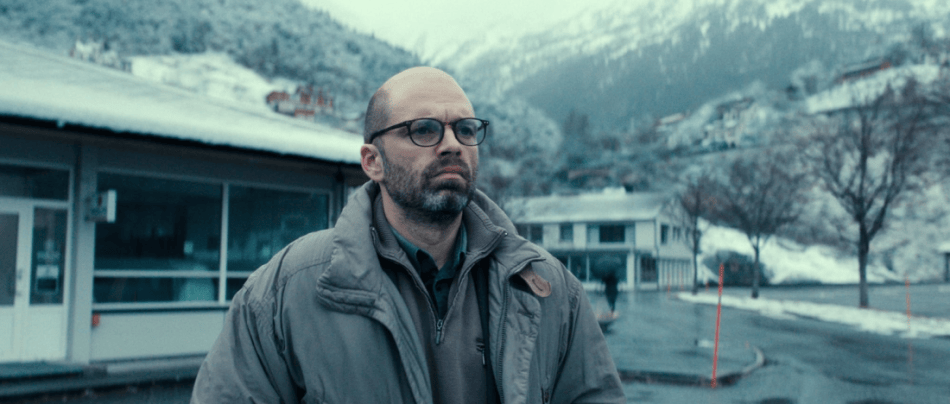
Fjord is a provocative film from director Cristian Mungiu. Inspired by a true story, Mungiu’s film is centered on the Gherghiou family. Mihai (Sebastian Stan) and Lisbet (Renate Reinsve) recently moved themselves and their five children from Romania to Lisbet’s Norwegian hometown. It is a small town, the kind where everybody knows everybody. On the surface, it is quite welcoming. Lisbet finds work at a nursing home and Mihai, though a trained engineer, finds work as an IT professional and even helps perfect the wi-fi at the school his children attend. However, they are strict at home. The Gherghiou’s are devout evangelical Christians, them and their children having daily prayer routines and their children restricted from nearly all secular activities. Their education and entertainment are all Bible-based, outside of attending the local school run by the Gherghiou’s neighbor Mats Halberg (Markus Tønseth). Norway itself and, especially, this town are socially progressive with the Gherghiou’s beliefs – notably regarding child-rearing and homosexuality – running afoul of this town’s mores and beliefs.
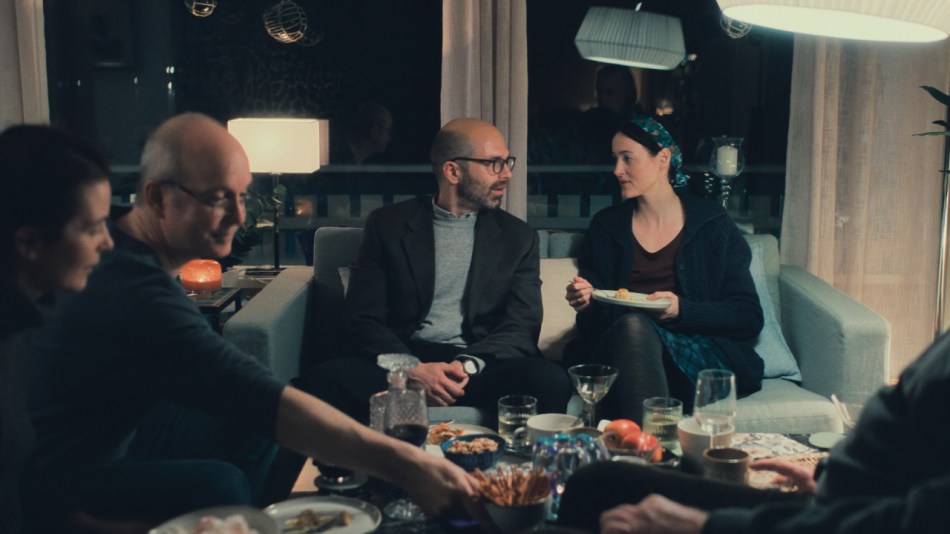
Fjord is a drama that creeps up on the viewer. As the Gherghiou’s settle into this town, one can be lulled into its small-town ebb-and-flow. Everybody seems to be working together, the children finding new friends, their parents fulfilled in their work, and the community tight-knit and kind. However, after the Gherghiou’s eldest daughter Elia (Vanessa Ceban) shows up to school with a bruise on her cheek and shoulder, everything changes. The school’s mandatory reporters alert Child Protection and soon, an investigation is opened to determine whether Mihai and Lisbet physically abuse their children. An admission that the kids have been “slapped on the butt” as a punishment is enough confirmation for all five children – even a baby – to be taken from the Gherghiou home, placed with foster families, and a civil and criminal case started to determine whether the kids can return and if, in particular, Mihai will go to prison.
Mungiu is out to start a conversation. While one can acknowledge that there are situations in which a child is benefitted by not being raised by their biological parents, are the Gherghiou children benefitted by not being raised by their parents? As much as the early scenes of Fjord make it appear to be a film about community, this is a film about division. The Gherghiou family is, of course, divided but from the onset, their religious beliefs put them at odds with this socially progressive town. They are, aside from Lisbet, foreigners who speak and understand a varying degree of Norwegian, though all can speak English. Their language, beliefs, customs, and mores, all differ from those of the people around them and, most importantly, those who will ultimately make the decision regarding whether the Gherghiou children can return to their family. In an increasingly globalized world, the sociocultural hegemony within this Norwegian town is being directly challenged by the Gherghiou’s, even if the family did not set out to confront this standard.
Fjord is fascinating, engrossing, and complex, demanding viewers to reckon with the issues it sets forth and, in particular, to examine the society around us. Acceptance and understanding are wonderful ideals, the beliefs that this town has towards social progressivism are not, in-and-of themselves, bad. But, can these beliefs lead to a moral rigidity, one that ascribes any actions or beliefs counter to one’s own as immoral and wrong? It is this complexity with which Mungiu assesses the sociopolitical state of play in Norway, a cultural battle in a nation that believes children’s rights to be paramount and not beholden to their parents. Norway regards children as individuals who need to be raised to fit into and become functioning members of Norwegian society, receiving an education and universal experience that would enable that development. But, how far is too far for the State to reach in and influence that upbringing? At what point does it become policing “wrongthink” and “thoughtcrimes” like in George Orwell’s 1984 (a book that makes a brief, but noteworthy appearance on a character’s bookshelf)?
Mungiu’s thought-provoking line of questioning makes for a consistently captivating drama, punctuated by lively courtroom scenes that can equally make one’s blood boil and sit back in contemplation. It is fascinating and enthralling, while the natural human drama underpinning it with these kids desperate to get back to their parents and Elia determined to get back to her new friend Noora (Henrikke Lund-Olsen) – they have an implied burgeoning romance, an element that adds to the Gherghiou’s complex set of circumstances – pulls at the heartstrings, even as one questions where the truth of the matter lies. Crucial to this humanistic pull are the performances. Renate Reinsve is particularly exceptional, her expression of Lisbet’s mixture of confusion, restraint, and fiery rage after first being confronted with these allegations is remarkable. There is so much frustration and tension in her face, trying to keep her composure – especially once only two of her children return home from school one day – mixed with motherly desperation when faced with being separated from her baby that Reinsve captures beautifully. Sebastian Stan has a reserved and dark intensity to him, a quality that can make one see how he can seem aggressive and violent. He has a directness and a sternness in his tone, an old-school fatherly hardness to him and his emotions.
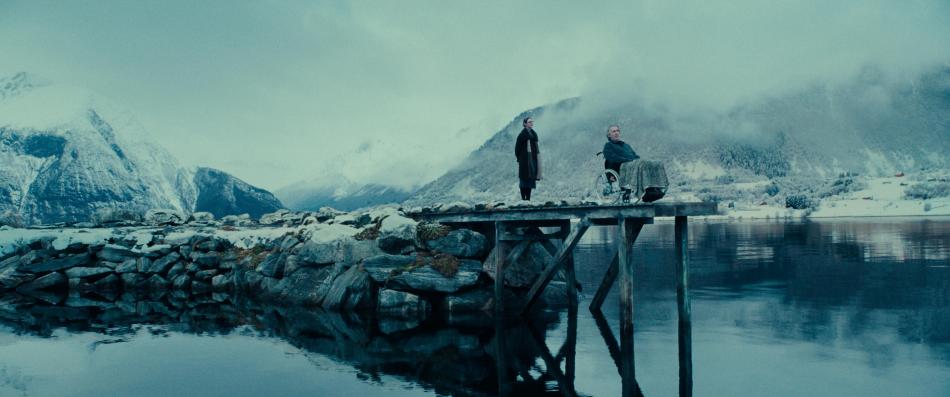
Visually, Fjord is just as impressive. There is a precision to it, an unfussy but nevertheless artful presentation that soaks in the terrain and turns this setting into a vibrant character all its own. This town, set within a “fjord” with frequent avalanches and right on the waterfront is chilly and frigid on the exterior. Fjord is dominated by whites and blues, its punches of red coming in Elia’s bruises, Lisbet’s flushed cheeks at the first accusation, or in graffiti painted on the school by a pro-Gherghiou and Christian faction supporting the family once the story of their case breaks internationally. Fjord is frequently snowy and slushy, cinematographer Tudor Vladimir Panduru’s propensity for long shots allows this frigid demeanor to become part-and-parcel with the similarly icy nature of its legal machinations. These long shots also enable Fjord’s impressive mise-en-scène to shine, while highlighting its interesting sound design. A shot set from the marina is punctuated by dialogue as Mats’ aging father Åke (Øyvind Venstad Kjeksrud) is wheeled to the waterfront by Lisbet, who has volunteered to keep an eye on him and take him out on occasion. The shot never moves from the marina, one is at first not quite sure who is talking but then Åke and Lisbet appear in the distance, moving down the street towards the water.
In the same regard, the street where the Halberg’s and Gherghiou’s live, lit up for the holidays or parties, footprints in the snow, and engulfed in their tundra-like feeling once this drama begins, are presented in shots that are similarly from a distance with movement and blocking occurring from far away. This is a story where we, the viewer, are distant from the figures at hand. It is one where, as Mats’s wife and later the Gherghiou’s lawyer Mia (Lisa Carlehed) says, one cannot truly know what happens in someone’s home. This distant camera placement feels intentional to this point, positioning us as a voyeur, an outsider peeking in on situations and dramas we can never truly comprehend as we are not members of the Gherghiou family or Norwegian society. This can perhaps make Fjord come across as emotionally distant, but there is enough drama and compelling sociocultural and political questions arising to keep the audience inquisitive and engaged, determined to come to an understanding from our distant perch.
Fjord is a riveting legal drama from director Cristian Mungiu. Impressively constructed, the film is undoubtedly a conversation starter. Fjord challenges social norms, leaving the viewer to pour over its numerous sociocultural and sociopolitical thought lines, especially as it regards religion, social progressivism, children’s autonomy and rights, and governmental intervention. It is not a film out for simple digestibility, but rather one that aims for fiery and impassioned discussion, a quality that Mungiu excels in capturing and eliciting. With these compelling ideas, a brilliant cast led by Renate Reinsve and Sebastian Stan, and gorgeous cinematography, Fjord is a drama that builds with every minute.
Discover more from Cineccentric
Subscribe to get the latest posts sent to your email.


0 comments on “Fjord ★★★½”