

Sense and Sensibility, the debut novel from legendary English writer Jane Austen, has been adapted for the screen before. In fact, it has been adapted for television, film, and even in languages other than English. The most noteworthy adaptation to date is director Ang Lee’s version from 1995 with Emma Thompson and Kate Winslet starring as the Dashwood sisters and Hugh Grant and Alan Rickman as their suitors, respectively. It is a marvelous adaptation and leaves director Georgia Oakley’s adaptation much to live up to.
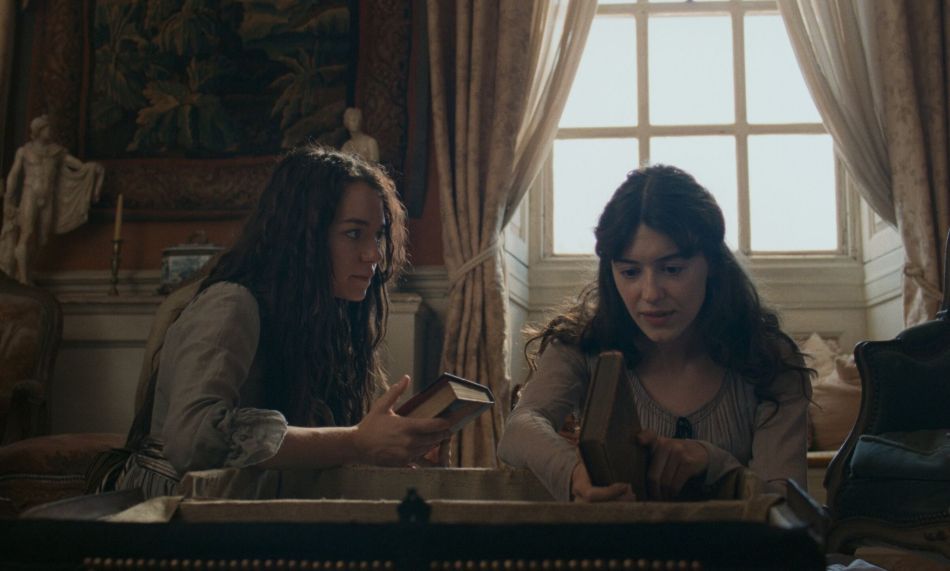
Oakley’s Sense and Sensibility stars Daisy Edgar-Jones and Esmé Creed-Miles as Elinor and Marianne Dashwood, the two eldest and unmarried sisters of the Dashwood family. Originally, Austen had entitled her novel Elinor and Marianne with the title later changing to the dominant traits of these two sisters, Elinor being “Sense” and Marianne being “Sensibility”. Elinor’s sense is most notably defined in her romance with Edward Ferrars (George MacKay). The Dashwood family is unbalanced upon the news that their estate’s ownership is to be transferred to their half-brother John (Tom Brooke) and his cruel wife Fanny (Stacy Martin). Though John takes seriously the promise he made to his father to support the Dashwood women – matriarch Mrs. Dashwood (Caitríona Balfe), Elinor, Marianne, and the youngest Margaret (Bodhi Rae Breathnach) – Fanny encourages him to break this tie, making the home as inhospitable to the Dashwood’s as possible.
While all living under the same roof, Fanny’s brother Edward comes to visit and it is then that he and Elinor’s courtship silently begins. It is a romance defined by trepidation and reticence, a hesitancy to bear one’s heart lest it be broken and their growing love unrequited. Edgar-Jones and MacKay are wonderful together, their mutual devotion to “honor” and virtue come to be their defining qualities, even if it comes at the cost of love and being together. MacKay, especially, brings out the poetic and stately dialogue of Diana Reid’s script and Austen’s novel, but it is particularly in what Edward and Elinor do not say to one another, what they keep guarded, that defines their scenes together and creates the center of yearning that underpins so much of Sense and Sensibility. Edgar-Jones’ expressive face and physicality are remarkable in this, her physicality expressing what her character’s words cannot.
As the Dashwood family leaves John and Fanny’s home upon receiving an offer to rent a cottage in Devonshire from distant relative Mrs. Jennings (Fiona Shaw) – Shaw is wonderful, playing a lively and crass figure at first whose heart and mettle come out in time as her ties and devotion to the Dashwood family grows – Elinor and Edward are separated, the former following her family and the latter off to London for business. In Devonshire, however, Sense and Sensibility begins its exploration of Marianne, her “sensibility” side of the story as Mrs. Jennings whisks her away to be introduced to Colonel Brandon (Herbert Norddrum). He is a reserved man, one whose knowledge of heartache is written all over his face. He is quick to volunteer for any tasks, his love expressed in glances and actions. The pair do not click at first, Marianne finding him “dull” and without “personality,” instead she is taken by John Willoughby (Frank Dillane), a man whose vivaciousness matches her own. He is her hero who “saved” her after a fall at the beach and afterwards, Marianne is enraptured by the glow of Willoughby’s attention. That is until he, too, has to go to London for business and leaves Marianne without an engagement. It is only then that she can see more of Willoughby’s character and can appreciate more of how Colonel Brandon expresses his feelings for her.
Marianne feels everything deeply, it is this depth that imbues her scenes with Elinor with so much vitality and authenticity in Sense and Sensibility’s exploration of sisterhood and its bonds. It is also a quality that draws her towards disaster in Willoughby, and a quality that makes her affection for Colonel Brandon take a while to grow. Norddrum’s portrayal of Brandon is terrific, the shine in his eye as he takes in Marianne dancing at a party, the way he talks about her and admires her internal light from afar often defines this side of Sense and Sensibility. However, it is Creed-Miles who shines brightest. There is so much feeling in her eyes, her every expression and utterance carrying with it a richness and light. This is a role that, hopefully, will stand as a breakthrough in Creed-Miles’s career just as this role helped Winslet break out 30 years ago.

As with any period drama, the success of Sense and Sensibility’s execution is often reliant upon its details. The hairstyling, make-up, and production design all bring to life this late-1700s setting. Arnaud Potier’s cinematography is often striking, though compared to this film’s clear visual inspiration, the Joe Wright-directed Pride and Prejudice, Sense and Sensibility is slightly lacking. Though, Potier’s camera does make great use of the warm interiors and the golden glow of the sun outside on the vast terrain outside of the various Dashwood family residences. Potier’s work is particularly impressive when it comes to how the camera moves, not settling for static medium and two-shots too often, instead tracking and panning around a room and matching the often chaotic action on screen. There are some great focus racks, especially in a tight two-shot on Elinor and Edward as they dance around expressing their feelings for one another, while the use of superimpositions – especially with the Dashwood sisters’ faces reflected in windows then superimposed on their often sumptuous view – gives Sense and Sensibility an elegance and beauty that is consistently striking. Roger Goula’s score matches this with its flourishes and rapturous crescendos making for a stirring and emotionally involving musical accompaniment.
While perhaps not eclipsing the heights of Ang Lee’s Sense and Sensibility, Georgia Oakley’s adaptation is nevertheless impressive. Austen’s source material provides a rich tapestry of characters, deeply felt romance, and a beautiful exploration of sisterhood and love that Oakley’s adaptation wonderfully expresses. It is an easy film to be swept away by, knocked head-over-heels for its romance and humanity, especially due to the wonderful score, striking cinematography, and the across-the-board impressive cast. Daisy Edgar-Jones, Esmé Creed-Miles, and George MacKay shine the brightest, but it is truly an ensemble achievement, all helping to transport the viewer to the feelings, mores, and styles of late 1700s England.
Discover more from Cineccentric
Subscribe to get the latest posts sent to your email.


0 comments on “Sense and Sensibility ★★★½”