
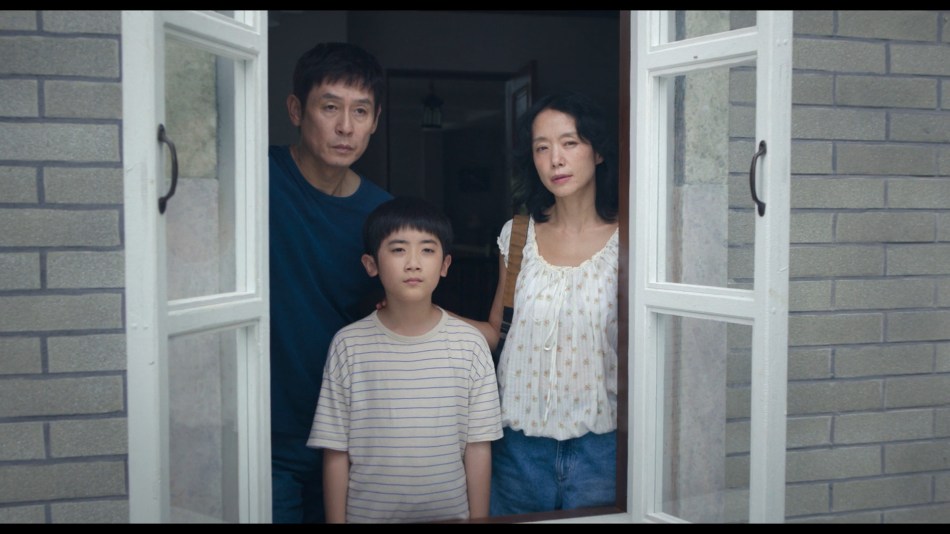
Choi Ho-seok (Sul Kyung-gu) is a working class man. Like Yoo Man-su in Park Chan-wook’s No Other Choice, he has been laid off from his job. Ho-seok feels diminished as a man, as a father, and as a husband. He is forlorn in demeanor and has succumbed to the comforts of the bottle. Director Lee Chang-dong makes it very clear that he isn’t a bad person: he is a broken person. Ho-seok goes through the motions of being a father and a husband, and is crushed by having lost his job. A part of his identity has been stripped away from him, and he observes the lives of men who weren’t laid off by his company as an outsider, no longer experiencing a shared camaraderie. Ho-seok has found another job, but he is clearly still stunned by having lost his prior job.
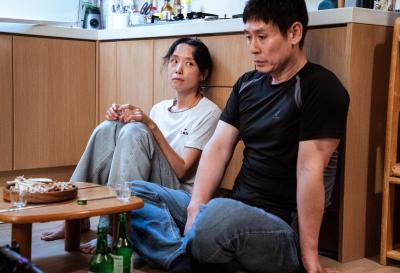
Following the suicide of one of his previous coworkers, Ho-seok is hesitant to attend the funeral. After he musters up the strength to go, he and his wife Ahn Mi-ok (Jeon Do-yeon) notice a woman filming parts of the gathering. They learn she is there to document the lives of the “invisible laborer” of which Ho-seok and his deceased coworker represent. After Lee Ye-ji (Cho Yeo-jeong), the documentarist, observes Ho-seok and Mi-ok in an argument, she approaches them with interest in including their story within her documentary, believing that underlying their argument are sources of drama.
Ye-ji is in a place of privilege, married to the wealthy Sang-woo (Zo In-sung), although she chooses to pursue grants for her filmmaking rather than rely on her husband’s wealth. Ye-ji regards herself as not too different from the people she films although Sang-woo, having grown up with wealth, is under no illusion of their financial wellbeing. Ye-ji defends the non-commercial subject matter of her documentary to her financers, and she seems to have some genuine desire to provide an empathetic lens to the lives of the families she is filming.
Even so, the lines are blurred between Ye-ji (the director) and Ye-ji (the person). As she grows close to Mi-ok, Ye-ji has to actively state when asking a question when she is curious as a person to know more in contrast to as a director mining for material for the next scene. Mi-ok notices that the handbag that Ye-ji carries is a luxury product and even points out to Ye-ji as Ye-ji conducts interviews with the different laborers that Ye-ji may be unintentionally distancing herself from her subject matter by wearing expensive clothing. This scene, along with a conversation between Sang-woo and Ye-ji, reinforces that Ye-ji is oblivious to her privilege.

It is this distance between people that Lee Chang-dong is most interested in exploring in Possible Love. Ye-ji’s camera and her position behind the camera during interviews is a distance between herself and her documentary subjects that she is never able to overcome, despite the friendship that she forms with Mi-ok. Ye-ji is portrayed as a voyeur, her and her camera even going so far as to capture what she shouldn’t. Lee slowly peels the curtain back through multiple scenes in Possible Love, and dispels any notion that trust or genuine connection could be formed between Ye-ji and Mi-ok. They will always come home to vastly different homes at the end of the day.
Apart from the bubbly, alcohol-induced friendship that forms between Ye-ji and Mi-ok, Ye-ji is interested in interviewing Ho-seok regarding his involvement in a labor strike and believes becoming close to Mi-ok will help her persuade Ho-seok to speak on camera. Given that Ho-seok remains impacted by the loss of his job and is uneasy when speaking on the topic, Mi-ok convinces Sang-woo to invite the couple to their beachside home to attempt to ease Ho-seok’s nerves and enjoy a weekend together. Yet, somewhat expectedly, this distance between the couples expands even further. Despite the tranquility of hearing the birds sing and the wind rustling through the leaves, Lee refuses to let audiences become complacent. When Sang-woo reminisces about his time spent on the private beach in isolation, he misrepresents the experience, and Mi-ok and Ho-seok’s curious son Cheol (Jung Seol) uncovers details about the family’s visit to Sang-woo’s to the audience that have been withheld from Mi-ok and Ho-seok.
In directing Possible Love, Lee uses flashbacks shown during documentary interviews to uncover the hardship faced by Ho-seok and reveal why he has been emotionally drained and distant. Like his previous films, Possible Love slowly unwinds with meticulous pacing and precision. Much credit for the film’s impact can be attributed to the performances of its four lead actors, in particular Sul Kyung-gu who symbolically shoulders the emotional brunt of the working class and shows this in the laborious way he moves. Jeon Do-yeon excels as portraying Mi-ok as a stabilizing presence within her family, trusting in the love of her marriage and able to support Ho-seok. Mi-ok is a hopeful and optimistic woman, able to provide warmth towards others that Ho-seok cannot. She finds the casualness with which Ye-ji and San-woon address each other as quirky and humorous, eschewing the formalities of traditional Korean marriage standards, while Cho Yeo-jeong and Zo In-sung portray a very stereotypical coldness found within upper class families.
Possible Love finds inspiration from Krzysztof Kieślowski’s Dekalog, specifically Dekalog: Ten. Both films begin with the intertitle Thou shall not covet, and in Lee’s film the meaning of the commandment refers to coveting the lived experiences of others. Regardless of her intentions in filmmaking and in her personal life, Ye-ji will never fully relate to the families she is filming and Mi-ok will never be able to find a true friend in her. Likewise, Mi-ok and Ho-seok will never feel truly at home when visiting Sang-woo’s residence given their jealousy of Ye-ji and San-woon. In this manner, Lee’s film recalls the contrast that Bong Joon-ho showed between two families in his social satire Parasite and provides another skillfully directed, discomforting entry in a recent selection of Korean cinema focused on socioeconomic differences.
Discover more from Cineccentric
Subscribe to get the latest posts sent to your email.


0 comments on “Possible Love ★★★½”