
Of people my age, I’m probably not alone in admitting that my first exposure to Spike Lee was through Nike commercials. He directed and starred in a series of wildly popular TV spots for the Air Jordan line of basketball shoes, reprising his character Mars Blackmon from his debut feature She’s Gotta Have It. The ads stood out – black and white, lo-fi, clever, funny – and they were inescapable for a good three years or so, starting in 1989 with this single-shot ad for the Air Jordan III.
Imagine an advertisement for a sneaker being shot in black and white today… Anyway, many more ads followed – one of them even featured another character from She’s Gotta Have It – and they got a bit more frenetic in that recognizable, jazzy Spike Lee style, and the character of Mars Blackmon became, improbably, a household name. With his handmade aesthetic and knack for a good catchphrase, “it’s gotta be the shoe,” Lee basically rewrote the book on what a massively successful ad campaign could look and sound like. So even though Do the Right Thing, Lee’s third film, came out the same year as those Nike ads were revving up, it wasn’t until ‘91 or so that I’d finally caught up with the film on home video.
For that reason, I’ve always had Spike Lee’s Do the Right Thing tied up with the 1992 Los Angeles riots. I was living in San Bernardino, California, when, on March 16, 1991, 15-year-old Latasha Harlins was shot and killed by a Korean shop owner as she was leaving the store. The horrific nature of this murder was captured by security cameras, and it was seen by the world just days after videotape was released showing Rodney King, face down in the street, being nearly beaten to death by a group of police officers.
I must have watched the movie at home, not long before these two incidents were all over the local and national news, ushering in the months of boiling-tea-kettle-like tension that preceded the April 1992 riots. San Bernardino was of course a fairly safe distance from Los Angeles, but school was nonetheless closed, a couple shops were looted, and the overall vibe around town was edgy and unnerving.
In my young, fairly ignorant, teenaged mind – movie obsessed as it was – at the time I kept thinking about how prescient Spike Lee’s movie had been. It even featured the details about the friction between the Black community and the Korean grocers! Little did I know that Do the Right Thing wasn’t prescient at all. Here was a movie that simply spoke truth to how things were and continued to be. The movie was even partially inspired by an 1986 incident where three Black men were attacked after visiting a pizzeria in the Howard Beach neighborhood of Queens. One of the men, 23-year-old Michael Griffith, died while trying to escape.
It went over my head at the time, but it’s right there in the final moments, with the names spoken and the on-screen tributes given to the families of Arthur Miller, killed by police in 1978, Michael Stewart in 1983, Eleanor Bumpers in 1984, Edmund Perry in 1985, Michael Griffith in 1986, and Yvonne Smallwood in 1987. Stewart, in particular, is a name that Lee often goes back to when talking about the movie’s inception. He was a young graffiti artist who fell into a coma after being beaten and likely choked by police. He died shortly thereafter, with no one ever being held responsible for his death.
According to a Daily Variety article from 1988, it was after talking to Robert De Niro about the Howard Beach incident that Lee began putting the pieces of Do the Right Thing together. It’s hard to find a reliable second source to back up this De Niro anecdote, but the Howard Beach pizzeria does get mentioned in the fantastic behind-the-scenes documentary that St. Clair Bourne made. To hear Lee talk about it these days, the more relevant inspiration was two-fold: the incident surrounding Stewart’s death, as well as an episode of Alfred Hitchcock Presents that hypothesized about how acts of violence increase when the temperatures get hotter. It was one of those impressionable things, like the opening dance sequence of Bye Bye Birdy, that Lee saw as a kid and found a place for it in Do the Right Thing.
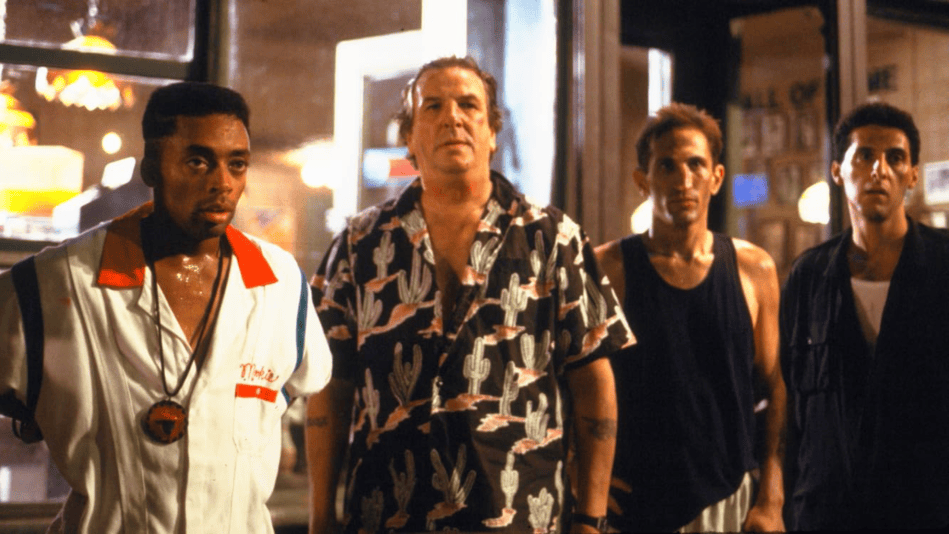
These are the things that laid the foundation for the movie, and in Lee’s usual style, he creates a story that is less about plot and more about showing the various circumstances of how this kind of tragic murder at the hands of the police might come to pass. Like his influential friend Martin Scorsese, Spike Lee isn’t a plot-driven filmmaker. That’s not to say he can’t excel in the genre mechanics of a thriller like Inside Man or Highest 2 Lowest, but these aren’t the kind of joints he made his name with. Rather, Do the Right Thing is a day-in-the-life tale, heavy on vignettes, tightly contained within one block of the Bedford–Stuyvesant neighborhood of Brooklyn, with much of the action in or around Sal’s Famous Pizza, an Italian-American-owned restaurant that’s been in the neighborhood for years. It’s the hottest day of the year – “hot as the devil!” – but tensions have already been simmering. Resentments, inequities, strained relationships, impending gentrification… Just about everyone has a “last straw” vibe going on from the start, and as it moves along, with all of these people stacked on top of each other, it just notches up as Buggin Out (an impossibly young Giancarlo Esposito) tries, quite unsuccessfully, to get the neighborhood to boycott Sal’s until he puts some pictures of Black people on his wall of fame.
Caught in the middle, between Buggin’ Out and Sal, is Mookie (played by Spike Lee), Sal’s beleaguered pizza deliveryman, who can sympathize with both perspectives. As Sal says, it’s his pizzeria and he can put whomever he wants on the wall. If you want to decide who goes into your wall of fame, then open your own pizzeria. But then Buggin Out does have a point: Sal’s clientele is either Black or Puerto Rican people – “we spend much money here!” – so wouldn’t it make sense to have some people of color on the wall? Not for nothing, the first time we see Sal (Danny Aiello), he’s pulling up to his storefront in an enormous, shiny, white Cadillac.
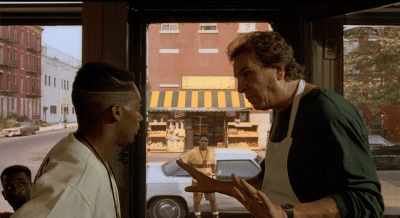
There are a lot of brilliant things about this movie, but the fact that most characters are at least a little flawed is a big reason why it continues to be so compelling. As tolerant as Mookie is to Sal and his two sons, Vito with the gentle soul (Richard Edson of Stranger Than Paradise fame) and Pino the unrepentant racist (John Turturro, a year before his real breakout performance in Miller’s Crossing), he’s also a lousy dad. The corner guys and Radio Raheem (the magnetic Bill Nunn) show some nasty intolerance toward the Korean family who’ve turned a boarded up building across from Sal’s into a successful grocery store, and the nicest guy on the block, Da Mayor (the legendary Ossie Davis), is a chronic alcoholic.
Describing Do the Right Thing can make it sound like a slice-of-life picture, an attempt to recreate a gritty, street-level realism. But Lee’s films – especially his early films – are as good a representation of the Latchkey Cinema aesthetic as any. In fact, with his first film, the defiantly plot-less She’s Gotta Have It, he was foundational, alongside Jim Jarmusch, the Coens, and the others we mentioned last month in establishing the heightened, often purposefully anti-realistic, style of filmmaking that can be seen throughout the American indie movement and popular cinema of the 1990s. Do the Right Thing isn’t quite as heavily stylized as She’s Gotta Have It and his ambitious follow-up, the full-on candy-colored musical School Daze, but it’s still a boldly cinematic take on the subject matter, full of canted angles, fourth-wall breaking sequences, audacious uses of light and color, and plenty of sequences that could only exist in a Spike Lee joint.
The other hallmark of Latchkey Cinema is the postmodern way in which these movies mix and match genres and styles from previous generations. This too is on full display in Do the Right Thing, which grabs elements from musicals, film noirs, Golden Age Hollywood social dramas as well as classic theater tropes. The characters of Da Mayor and Mother Sister (Ruby Dee), for instance, could’ve been lifted from one of August Wilson’s period dramas. But for the most part, the movie is in Lee’s trademark expressionistic mode, using every opportunity to keep the energy up and do something interesting.
Like Hal Hartley and the other Latchkey directors emerging around this time, Spike Lee also counts Jean-Luc Godard and the French New Wavers among his list of essentials, but I want to take one step further back in time to look at a guy who, in turn, had influenced the likes of Godard and other post-WWII, postmodern innovators with the kind of social conscious that Spike Lee has often emphasized in his work. Actually, I’ll let the critic Dave Kehr introduce this influence in the opening of his 1989 review, written for The Chicago Tribune:
“Spike Lee`s ‘Do the Right Thing’ sits squarely on the dividing line. At times it seems fresh and stimulating, a truly Brechtian piece of political propaganda that confronts the audience with a difficult moral problem – when and how is racial violence justified? – and forces us to grapple with it. At other times – especially at its incoherent finale – the film seems crudely opportunistic, trying to pander at once to black resentment and white guilt.”
There’s a good chance you’ve heard the phrase “Brechtian” before, and maybe, like me, you were introduced to the Three Penny Opera in high school, but even Kehr’s use of the term in his largely negative review of Do the Right Thing might cause you to second guess your understanding.
Bertolt Brecht, along with other artists like James Joyce and Pablo Picasso, was a major figure in the wave of modernism that emerged after World War I. What sealed his relevance for generations to come was a new approach to dramatic compositioning that he called “epic theater.” In what can be seen as a sign of the postmodern fashion that would follow, Brecht didn’t invent something wholecloth, he took a variety of techniques and ideas and merged them together into a new, philosophically bent practice. Some of the principles of epic theater included doing away with realistic sets and adopting a more expressionistic backdrop or abstract design. The same actors could play multiple characters, lighting equipment might be visibly placed on the stage itself rather than hidden away and a set change could happen in full view of the audience. Just as Latchkey directors like Hal Hartley and Spike Lee will continually remind you that you’re watching a movie through eye-popping art direction, jarring edits, and other distinctive cinematic techniques – Brecht’s epic theater was a form that was constantly calling attention to itself as an artistic construct rather than an attempt at realism.
Many of the principles of epic theater were aligned with what’s called the Verfremdungseffekt, or alienation effect. But contrary to what it might sound like today, the goal wasn’t to push the audience away, but rather to use “estrangement techniques,” like having actors break character or break the fourth wall, so that the viewers will be forced to actively process and consider what they’re watching – to be more engaged and ask questions about the choices that are being made in front of them.
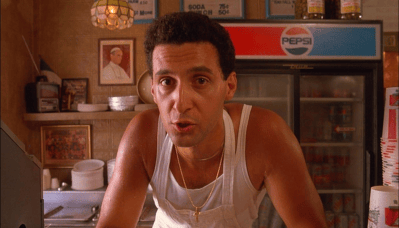
It’s not style for style’s sake, it’s always a purposeful part of the storytelling. When Spike Lee has characters from Do the Right Thing look directly at the audience and rattle off racial invectives – that’s to create a Verfremdungseffekt. And when he uses his signature double dolly move, a disorienting technique that emphatically calls attention to itself, it’s always trying to say something. It’s asking you, why? What is this saying about the character’s inner life or what’s happening in the story at that moment? It’s the same with Godard’s many disruptive, postmodern flourishes, just as it is with Hartley’s circular, deadpan conversations, abrupt moments of choreographed dancing, and unsettling editing techniques.
Another important aspect of Brecht’s approach, and one that certainly applies to Do the Right Thing, is his disinterest in creating the kind of heroic characters that the audience would fully embrace. Often, Brecht didn’t want the audience to be overly sympathetic towards his characters and subsequently miss the bigger point of the work. He even tried rewriting one of his most beloved plays, Mother Courage and Her Children, in order to make the title character less sympathetic. It didn’t really work. Mother Courage’s plight is undeniable. But you can see a similar approach taken in Do the Right Thing, of making sure none of the characters are overtly heroic or too sympathetic. And yet, just as with Mother Courage, people will nonetheless get caught up defending Mookie or Sal rather than focusing on the societal conditions that brought them to their fates.
Movies with morally flawed antiheroes can be seen throughout cinema, in all kinds of styles, genres, and eras, but it’s also a hallmark of the movies we’re talking about in this column and certainly a feature in many of Spike Lee’s movies. Just as the films we’re calling Latchkey Cinema were in direct opposition to the stuffy, self-serious, realist dramas that had grown in popularity leading up to the late 80s, Brecht’s epic theater was in direct opposition to the kind of naturalism that Konstantin Stanislavski was developing for the stage at the time. Stanislavski’s approach would lead to “method acting,” which caught on big in the US and in turn was a major reason why so much of post-World War II cinema became so obsessed with trying to present this sense of authentic, “gritty” realism.
But the ideas of epic theater lived on as well, influencing Godard and other post-World War II European filmmakers like Rainer Werner Fassbinder – and perhaps more indirectly through the influence of Godard, went on to inspire the aggressive, stylistically-driven American cinema of the 1990s. But Spike Lee is more Brechtian than most because of the social consciousness that is fueling his writing and directing. Like Brecht, Spike’s desires are to shine a light on what’s happening – to use the techniques and tools of his art form to get at a reality or truth that needs to be addressed.
Brecht was a German, a Communist sympathizer, an admirer of Karl Marx and the ideas of collectivism, as opposed to the corruption, inequalities, and many other inherent, inhumane flaws in capitalistic and Church-run societies. Brecht made his name as an enfant terrible, a rabble rouser, and, after the huge successes of The Threepenny Opera and Rise and Fall of the City of Mahogany, he was famous and influential enough in Weimar Germany’s art scene to find himself on the Nazi Party’s black list. Not long after Berlin’s Reichstag caught fire, Brecht fled north, spending years in a chilly, Nordic exile before he was able to get a boat to California where he could await the war’s end while trying his hand at some unrewarding screenplay writing. Remarkably, during his many years abroad, Brecht never stopped writing about war, fascism, the struggles of the underclass and economic exploitation.
While living in exile, Brecht came up with his “Five Difficulties,” which are the five things that Spike Lee has made his career at being adept in overcoming and often excelling at. The five difficulties are the challenges that await those who seek to fight the good fight against the proliferation of lies and ignorance.
First is the courage to speak the truth when it is often being suppressed, opposed, or even persecuted by powerful forces. Second is the keenness, or awareness, to recognize the truth even when it is being concealed. Third is to have the skill required to fashion the truth as a weapon so that it can be used effectively. Fourth is to have the judgment – to select the right audience so that your message will serve its purpose. And fifth is the cunning, or shrewdness, to spread the truth among such persons, which might require being artful, or using satire and ambiguity, in order for your message to resonate and possibly outwit or evade the censors.
These are the challenges that Brecht and Lee overcame, in part, through the kind of techniques and stylizations that were central to the epic theater. Eventually, Brecht was able to live out the final years of his life back in what was now a divided Germany. By this time, as he was assembling his Berliner Ensemble theater company, he was less happy with the name “epic theater” and preferred “dialectical theatre,” which only further underlines the simpatico relationship to the work of Spike Lee. Dialectic is a term that dates back to Socrates, and it basically refers to taking a contradictory idea and working both sides until you arrive at a truth. In many cases, including that of Do the Right Thing, the truth isn’t so much straightforward and clear as it is painful and messy.
This film is so dialectical that it ends with two famous quotes, one from Martin Luther King, Jr. extolling the virtues of non-violence, and one from Malcolm X which frames certain acts of violence as self-defense – as maybe being necessary in order to bring an end to a people’s oppression.
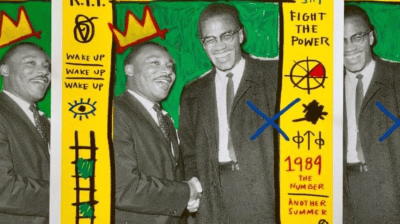
That contradiction is at the heart of Do the Right Thing, and it’s raised by examining another contradiction within the story of the film: of Sal’s pizzeria being both part of and apart from the neighborhood. This is one of those America-in-a-nutshell stories, and the dialectical approach in attempting to resolve this contradiction essentially functions as the plot itself, moving the story along. On the one hand, Sal feels as though he is part of the community. He talks about having watched so many of these kids grow up. He doesn’t want to move. He’s proud of what he’s built. He even reminisces about installing the tiles in his restaurant himself, one by one, with his own hands. The neighborhood is mostly appreciative, too. When Buggin Out tries to get his boycott rolling, most people are brushing him off. No way. I don’t want to go to some other neighborhood to get my slice and Sal’s never done me wrong. Maybe he charges too much for extra cheese, but what are you gonna do?
Sal makes a strong case for himself, but in doing so he inadvertently points to the other side of the contradiction: why isn’t there a Black-run pizzeria or grocery store in the neighborhood? One could argue that if you want a good slice of pizza you probably want or expect it to come from a guy like Sal, but Sal’s point is still valid when he tells Buggin Out to open his own place if he doesn’t like how Sal runs his.
One of the corner guys, ML (Paul Benjamin) also laments the intrusion of Koreans in the neighborhood, but his friends laugh at the very idea of ML having the ambition and taking the initiative to open his own business. But then again, what bank is going to give him a loan? When ML says, it must be because I’m Black, there’s some truth to that as well. People in the community don’t have the same opportunities as people outside the community who are willing and able to exploit the conditions.
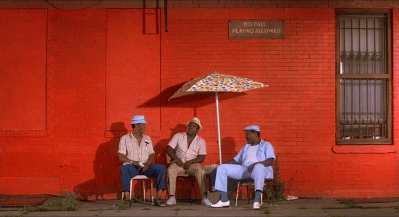
The dialectical approach, burrowing down from both sides of the issue, brings us to other, related issues like gentrification, which the movie touches on as well, with perhaps the funniest scene, involving a white guy wearing a Larry Bird jersey apologizing – but not really apologizing – for running over Buggin Out’s Nike Air Jordan IV sneakers as he hauls his bike up the stairs of his newly purchased brownstone.
Lee even shows us the two sides of the policing. In an earlier scene, the police decline taking the bait of a white guy complaining about the neighborhood kids getting water inside his convertible. They refuse to escalate the situation. But then, given a situation that’s already escalated, one where Buggin Out and Radio Raheem have confronted Sal with Public Enemy pumping at full blast, and Radio Raheem refuses to turn off the boom box, and the day’s trial and tribulations tip over to cause Sal to furiously smash the boom box while letting slip some venomous words, so Radio Raheem attacks Sal, and at least one police officer uses it as an excuse to let loose all his hatred and kill a Black man.
All of these scenes are steps toward what is perhaps the most honest moment in the movie, which comes shortly after Radio Raheem’s death, when Mookie snaps, picks up a trash can and breaks the window of Sal’s pizzeria, which starts a small riot that finds Sal’s business torn to pieces. Much has been written and theorized about this ending, a lot of which is arguably misguided. Some have suggested that Mookie’s act is a distraction, to get people tearing up the restaurant instead of tearing up Sal and his sons – a theory that Lee has outright rejected.
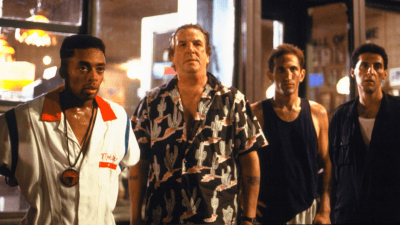
As Brecht was aware, this can be a problem when a drama diverges from the usual mold of heroic storytelling – certain viewers can feel adrift when a character does something unheroic, so they bend over backwards to justify it as secretly heroic. Often it’s the problem of depiction versus prescription in the world of auteurism. A character says or does something ignoble and it’s held as prescriptive – an endorsement, representative of the filmmaker’s beliefs. This is why some critics at the time accused Lee of making an irresponsible film that could incite violence – after all, here he was playing Mookie himself, the character who ignited the riot.
One last dialectical element of Do the Right Thing that is worth pointing out is whether or not the character of Sal is a racist. This one is so baked into the movie that it even plays a significant part of the making of documentary. In one of Spike Lee’s masterful decisions as a director, he doesn’t press Danny Aiello to see eye-to-eye with him on this question. Aiello doesn’t believe Sal is a racist. Lee does, but I think he also sees the value in Aiello in approaching the character from his own, more generous perspective. It’s something that Lee and Aiello would continue to debate decades later. You could say that since Lee wrote the character he should know whether he’s racist or not, but at the same time, Lee knows that’s not really what the movie is about.
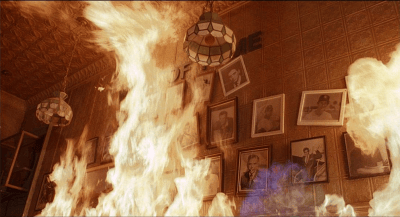
Getting caught up in trying to iron out these flawed characters is a distraction from the real truth. Why can’t Mookie’s act of throwing the trash can through the window simply be the truth of Mookie’s feelings? Do the Right Thing is a series of escalations, culminating in the death of Mookie’s friend, which is a devastating, personal moment for him. It’s an outcome that Sal certainly didn’t want, and it’s meaningful that we’re given the shot of Sal, Vito and Pino looking on in shock and heartbreak as the restaurant catches fire. How can this be an endorsement of violence? Isn’t it simply an honest depiction of what is likely to happen when society fails to do the right thing, fails to address inequality, the lack of opportunities within these marginalized communities?
This was the recurring theme in Brecht’s work, too. In some of his best-known works like The Threepenny Opera, Mother Courage, and perhaps most directly in The Good Person of Szechwan, we’re presented with stories about people who struggle to do the right thing due to the oppressive conditions they’re forced to live with on a daily basis. In these works, Brecht makes the point that it’s nearly impossible to be a virtuous, morally steadfast person when the pressures of poverty and economic hardship are weighing down on you. We may aspire to be Martin Luther King, Jr. and to turn the other cheek with dignity intact, but in these circumstances human beings are far more likely to act out in less honorable ways – out of both desperation and a sense of self-defense.
Contrary to Dave Kehr’s 1989 review, that’s what Do the Right Thing is about. He was right in pointing out that the movie is Brechtian, but the question isn’t “when and how is racial violence justified?” It’s a movie about how and why racial violence erupts. Likewise, the answer to that question isn’t because of something Sal did or something Mookie did, it’s because we as a society have failed to address the same kind of inequality, poverty, and injustices that Brecht was writing about generations ago.
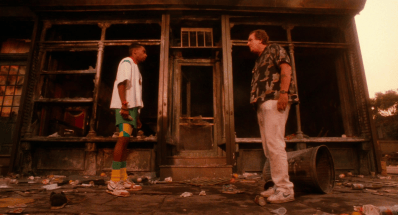
The proof is in the fact that, decades later, very little has changed and the results are the same. People like Michael Stewart continued to be killed by police officers and protests continue to spiral into violence. There’s no better claim to Do the Right Thing’s success in achieving what it set out to do than the test of time and how sadly relevant it continues to be.
For both Spike Lee and Bertolt Brecht, two creatives who strive to enlighten and tell the truth by making art that is didactic, dialectic, and epic, there are pitfalls to their approach. Whether they use satire or earnest sensitivity, in some cases the didactic element is bound to come across as overbearing. This is the third “difficulty” Brecht mentioned: the skill to fashion the truth as an effective weapon – effective meaning that it doesn’t come across as overbearing, heavy-handed, blunt editorializing.
It helps when you’re as good as Lee was in overcoming the fifth difficulty, of having shrewdness, and are able to enlist another artist like Public Enemy, who can create a song for your soundtrack like “Fight the Power,” which can become an instant generational anthem. For my last comparison, I’ll go ahead and say that this collaboration was not unlike Brecht and the composer Kurt Weil, whose collaborations resulted in some of their most broadly successful work. Maybe ‘Mack the Knife’ and ‘Alabama Song’ don’t carry the same weight as ‘Fight the Power’, but they have all lived long lives apart from the works that inspired their creation.
From today’s perspective, Spike Lee’s body of work is amazing to consider. So monumental that there are still a couple I haven’t caught up with. How many filmmakers have been as prolific and successful as he has? It’s an odd thing to say about a filmmaker who I first learned about through his work in producing Nike ads, but the thing I find most admirable about Spike is how successful he’s been at sticking to his modus operandi and creating films that buzz with both artistry and purpose. Even his rare “one for them” movies can be remarkable in their craftsmanship – I’m mostly thinking of the immensely enjoyable caper film Inside Man. And while there have been a few films that have fallen short of overcoming that third difficulty, Do the Right Thing is one of those cases where all the ingredients are just perfectly measured. As a result, the film has become, like Brecht’s best work, timeless and eternally essential.
Discover more from Cineccentric
Subscribe to get the latest posts sent to your email.


0 comments on “Latchkey Cinema – Epic Theater (ft. Do the Right Thing)”