
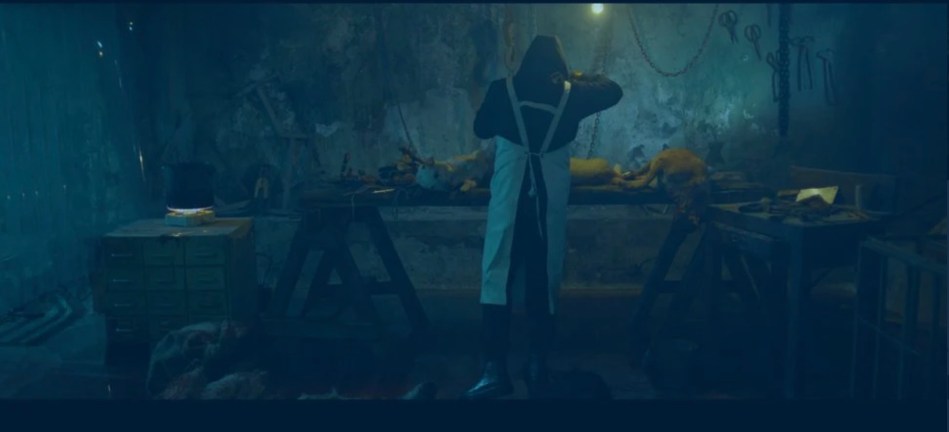
“Bakma” is a Tunisian term for voicelessness or the inability to speak, Abdelhamid Bouchnak explains in a brief introduction, just before the world premiere of his gritty crime thriller. The fourth feature of the Tunisian director-writer—who already showed a foible for genre cinema in his occult horror Dachra and the fantasy tale Golden Butterfly—is screening at Locarno’s Fuori Concorso, the Out of Competition section reserved for major productions which don’t quite fit into the more mainstream mould of Piazza Grande or the competition’s highbrow standards. This is certainly true for its grim tone and gruesomeness, both psychologically and physically, of the events that at times tumble into splatter.
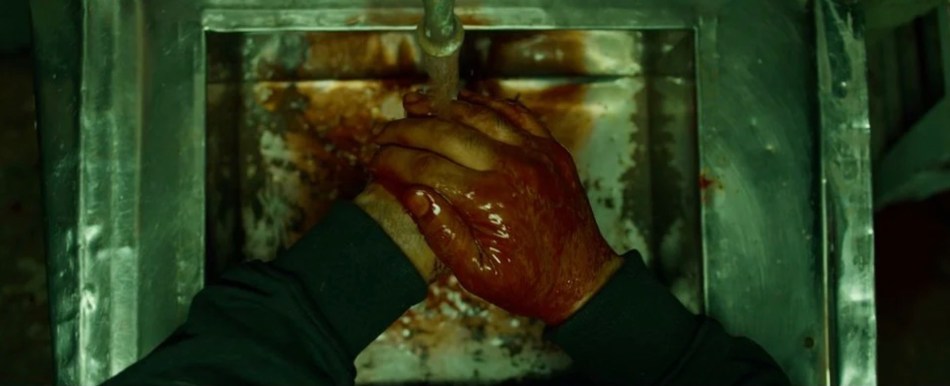
Blood flows in buckets and the serial killer whose megalomanic, menacing voice-over frames the socio-critical scenario basically showers in it. Both quite literally, as Bouchnak has a tendency to extend and excess-ify his scenes, just to make sure the audience gets it. Apparently they do, as the walk-out rate is so high the almost full theatre seems half empty at the end of the screening. This could be related to the almost comical absurdity of some developments or ambivalent socio-political implications as to the morbid details cinematographer Chams Ghorrab captures full-frontal. Nothing is discreet or subtle about the sinister, symbolically charged story which Bouchnak describes in the Q&A as very political.
Tunisia’s touristy side is far away in the nameless town stalked by a hooded killer. His generic voice-over laments the run-down state, in his eyes embodied by the homeless, drug addicts, sex workers, and the growing population of stray dogs. The latter become a multifaceted and rather murky metaphor: for mistreated outcasts, for what is presented as degenerates and delinquents, but also for a collective descending into brutish cruelty and inhumane cold-heartedness embodied by himself. He taunts the police and especially alcoholic commissioner Khaled (Aziz Jbali) with the corpse of a murdered young woman, assembled with other victims’ body parts and a dog’s head.
This bizarre creation is a high point of the voyeuristic spectacle, but its mannequin origin is as obvious as the dogged provocation. Testing his superior Ali’s (Hedi Krissaane) patience to the limit, Khaled hunts the killer who systematically murders the marginalised while coming closer and closer to Khaled’s own broken nuclear family. Said motivation remains as opaque as where the director stands with his prominent politics. While there are no thoroughly good characters, the police chief comes closest to a moral instance. Both Khaled and the killer are granted humanising moments, in contrast to the sex workers, depicted as vulgar interchangeable stereotypes and their mutilation as spectacle.
Khaled’s dutiful wife and mother of their little daughter is the sole positive female character. The actions of the psychopathological protagonist named Yassine are blamed on his chain-smoking unchaste mother (delightfully over-the-top veteran actress Mounira Zakraoui). Stray dogs are alternately described as innocent and as waste to get rid of. The sadistic mutilation and suffering of the sex workers and one smarmy, self-absorbed journalist (Chawki Khouja), representing a morally bankrupt press, are presented as self-provoked punishment. Is the killer’s contradictory, volatile hatred of women, the press, and unhoused individuals a critique of quasi-fascist rage? Does it echo the crude narrative’s own tendencies towards moralist male anger?
Equally conflicting are acting and atmosphere. While Khouja and Zakraoui give their theatricalities an ironic edge, Krissaane and Jbali play their parts deadly serious. Long camera pans through the nightly streets evoke a sense of gloomy realism, and the only truly innocent characters are a family of Sudanese refugees. Bouchnak’s conservative criticism never turns against institutions or larger social structures, blaming the individual for systemic failure. Then there are utter grotesqueries, like Yassine fashioning dog-faced headgear from the corpses of the mutts he slaughters, like a pet player from hell. At some point it becomes impossible to take this fully seriously, but curiously enough, this works in the horror thriller’s favour.
Discover more from Cineccentric
Subscribe to get the latest posts sent to your email.


0 comments on “Bakma ★½”